


Packaging's Role in Cosmetic Safety: A Developer's Guide
Packaging is the first line of defense for cosmetic safety. It preserves formula integrity, blocks contamination, and constrains chemical migration between the container and the product inside it. That’s the whole job, and when packaging fails at any part of it, the formula behind it doesn’t matter.
Regulators treat packaging as a safety variable, not a shipping detail. Under EU Regulation 1223/2009, a safety assessor must evaluate packaging as part of the Cosmetic Product Safety Report (CPSR), and that evaluation gets documented in the Product Information File (PIF). Extractables and leachables (E&L) testing exists precisely because a bottle, jar, or pump is never a neutral bystander. It’s a chemical system interacting with whatever you put inside it.
The core safety roles packaging performs:
- Containment — keeping the formula physically sealed and stable from filling to final use
- Barrier protection — blocking oxygen, light, and moisture that degrade actives and preservatives
- Dosing control — delivering consistent, measured amounts that match the labeled use instructions
- Contamination control — preventing microbial ingress during storage, shipping, and repeated use
- Information and compliance — carrying the labeling, warnings, and durability data regulators require
Pro Tip: Treat packaging selection as a formulation decision, not a procurement one. The people choosing your bottle need to sit in the same room as the people choosing your preservative system.
Key Takeaways
Packaging safety depends on requalifying every material change with fresh extractables and leachables testing, documenting that evaluation in the CPSR, and testing preservative performance in the actual final container.
| Point | Details |
|---|---|
| Test in final packaging | Run preservative efficacy and stability testing in the actual production container, not a reference vial. |
| Requalify sustainable swaps | Any switch to recycled or biobased material needs new E&L and migration data before approval. |
| Document every component | Keep supplier TDS, MSDS, COA, and migration reports current in the CPSR and PIF. |
| Match material to formula risk | Reserve glass and aluminum for chemically sensitive or high-fragrance formulas. |
| Build change control upfront | Require supplier notification agreements before any material or process change ships. |
Table of Contents
- Why Packaging Materially Matters to Product Safety and Integrity
- How Packaging Can Compromise Safety: Migration, Contamination, and Mechanical Failure
- Materials and Coatings: Safety Profiles and Trade-offs
- Testing and Assessment: E&L, Migration, Stability, and Microbiology
- Regulatory Expectations and Required Documentation
- Design Controls That Reduce Contamination and Misuse Risk
- Sustainability Tradeoffs: When Green Packaging Creates New Safety Risks
- A Practical Supplier and Selection Checklist for Developers
- How One Product Team Actually Builds This Into a Launch
- Authoritative Resources to Keep in Your Packaging File
- Frequently Asked Questions
- Sources
Why Packaging Materially Matters to Product Safety and Integrity
A formula’s stability on paper means nothing if the container undoes it. Packaging translates directly into safety outcomes through five mechanisms: it contains the product without leaking or absorbing it, it blocks oxygen and light that trigger oxidation, it keeps microbes out, it delivers accurate doses, and it carries the information a user needs to use the product correctly. Miss any one of these and you’ve built a safety gap into the product before it ever reaches a shelf.
Sunscreens illustrate the stakes well. UV filters like avobenzone degrade under light exposure, so a clear PET bottle can quietly erode SPF performance over a product’s shelf life even when the formula itself was tested and approved. Water-based emulsions face a different threat: they’re microbial buffets once air gets in, which is why closure integrity and dispensing mechanism matter as much as the preservative blend. Fragrance-heavy formulas add another layer, since certain aromatic compounds are known to interact with plastic resins and accelerate leaching.

This isn’t a matter of best practice. Annex I of EU Reg. 1223/2009 requires safety assessors to evaluate the impact of packaging on the finished product, and MDPI’s review of EU cosmetic packaging regulation confirms that packaging-introduced contaminants are treated as a distinct safety category separate from the ingredient list itself. If your CPSR doesn’t address packaging interaction, it’s incomplete regardless of how rigorous your ingredient safety data looks.
How Packaging Can Compromise Safety: Migration, Contamination, and Mechanical Failure
Packaging failures fall into a few recurring categories, and knowing which one you’re dealing with determines what testing and mitigation you need.
-
Chemical migration and extractables/leachables. Compounds from the packaging material itself, bisphenols, phthalates, PFAS, and non-intentionally added substances (NIAS), can move into the formula. A 2026 Frontiers review on packaging-derived endocrine disruptors notes that migration rates depend heavily on temperature, storage duration, fat content in the formula, and how much the packaging material has already aged. A jar stored in a hot warehouse for six months is not the same chemical environment as one sitting in a climate-controlled facility for six weeks.
-
Microbial contamination pathways. Seal breaches, poorly designed closures, and pump backflow all create routes for microbes to enter a product that was sterile at fill. Repeated finger contact with an open jar introduces a different contamination vector than a pump that draws air back into the reservoir after each use, and preservative systems that were adequate for one dispensing format can fall short in another.
-
Mechanical degradation. Seals lose elasticity, plastics develop microcracks, and closures wear down with repeated use. A protocol study on packaging evaluation found that mechanical property changes in polymeric containers, measurable through tensile and impact testing, correlate with increased permeability and higher migration risk. A container that passed inspection at time zero can behave very differently at month eighteen.
-
User-behavior failure modes. Repurposing a container for a use it wasn’t validated for, storing product near heat sources, or ignoring “do not refill” instructions all introduce risks the original safety assessment never accounted for.
A container that is compliant for one context, like food contact, may still interact differently with a cosmetic formulation. Solvents, emulsifiers, and active ingredients can alter polymer barrier properties in ways that generic compliance certificates never capture. Documenting these interactions through shelf-life stability testing isn’t optional diligence. It’s standard practice for any team serious about safety.
Fat-heavy formulas and products subjected to sterilization face elevated migration risk, according to reporting on food packaging chemical migration, which found that high-fat content and sterilization processes both amplify how much plastic-derived material transfers into a product. Cosmetic emulsions with high oil-phase content deserve the same scrutiny.
Materials and Coatings: Safety Profiles and Trade-offs
Every packaging material carries a different risk profile, and the right choice depends on your formula chemistry, not just cost or aesthetics.
| Material | Inertness/Barrier | Migration Risk | Recyclability | Sterilization Tolerance |
|---|---|---|---|---|
| LDPE | Moderate barrier, flexible | Low to moderate | Limited, often downcycled | Poor, deforms under heat |
| HDPE | Good barrier, rigid | Low | Good, widely recycled | Moderate |
| PP | Good chemical resistance | Low | Moderate | Good, common for autoclaving |
| PET | Strong barrier, clear | Low to moderate | Good, widely recycled | Poor to moderate |
| Glass | Excellent, fully inert | Minimal | Excellent, infinitely recyclable | Excellent |
| Aluminum | Excellent barrier, opaque | Minimal if lined | Excellent | Excellent |
| Paper/laminates | Weak barrier alone | Depends on coating | Variable, coating-dependent | Poor |
| Bioplastics (PLA, PHA) | Variable, still maturing | Under active study | Limited industrial composting | Generally poor |
| PCR content | Depends on source purity | Elevated unless requalified | Supports circularity | Depends on base resin |
Glass and aluminum remain the gold standard for chemically sensitive or high-value formulas because their inertness eliminates most migration questions outright. Reach for them when you’re formulating with unstable actives, high fragrance loads, or anything requiring sterilization. Plastics earn their place through cost, weight, and dispensing flexibility, but PP generally outperforms PET and LDPE when heat or repeated sterilization cycles are involved.
Attention items that get overlooked far more often than the primary container:
- Gasket and seal materials, which degrade faster than the rigid components around them
- Internal pump components, especially springs and ball valves that contact the formula directly
- Coatings and inks on labels or closures that can migrate under pressure or heat
- Adhesives in laminated or multi-layer packaging structures
Testing and Assessment: E&L, Migration, Stability, and Microbiology
A defensible packaging safety file rests on four testing pillars, and skipping any one of them leaves a gap a regulator or a lawsuit will eventually find.
Extractables and leachables studies start with an aggressive extraction, typically using solvents chosen to mimic worst-case formula interaction, followed by targeted leachables screening under actual-use conditions. Reporting should include both qualitative identification of migrating compounds and semi-quantitative estimates of how much transfers over the product’s shelf life.
Migration testing in cosmetics differs meaningfully from food-contact testing. ToxHub Consulting’s analysis of cosmetic packaging safety points out that cosmetics use different surface-area-to-volume assumptions and usage-amount models than food does; a leave-on cream applied daily in small amounts creates a different exposure calculation than a beverage consumed in large volumes. Borrowing food-contact migration limits wholesale, without adjusting for actual cosmetic usage patterns, tends to understate real exposure.
Stability and accelerated aging tests need to run with the actual packaging, not a generic reference container. Accelerated aging at elevated temperature and humidity, paired with real-time stability tracking, reveals how the container and formula interact over the product’s intended shelf life rather than in isolation.
Microbiological challenge testing (preservative efficacy testing, or PET) must happen in the final packaging configuration, not a lab beaker. A preservative system that passes challenge testing in a glass vial can underperform in a jar that gets opened and closed fifty times by fingers.
| Test Type | Purpose | Common Methods |
|---|---|---|
| Extractables screening | Identify worst-case migrating compounds | GC-MS, LC-MS |
| Leachables (targeted) | Quantify real-use migration | Headspace SPME, LC-MS |
| Metal migration | Detect trace metal transfer | ICP-MS, ICP-OES |
| Preservative efficacy (PEC/PET) | Confirm microbial protection in final pack | Challenge testing per pharmacopeial method |
| Accelerated aging | Predict shelf-life interaction | Elevated temp/humidity chambers |
Pro Tip: Run your preservative efficacy test in the actual production packaging, including the dispensing mechanism, not a stand-in container. A pump that introduces air differently than your test vial can turn a passing result into a false sense of security.
Regulatory Expectations and Required Documentation
Packaging documentation isn’t paperwork for its own sake. It’s the evidence trail that lets a safety assessor sign off on your CPSR with confidence, and the record you’ll need if a regulator or retailer ever asks how you know your packaging is safe.
Documents to gather and retain for every packaging component:
- Technical data sheets (TDS) and material safety data sheets (MSDS) from every packaging supplier
- Declarations of compliance, including food-contact test data where the supplier has it as a benchmark
- Extractables and migration study reports specific to your formula and container combination
- Certificates of analysis (COA) for each production lot of packaging components
- GMP evidence covering the manufacturing conditions the packaging was produced under
- The packaging-specific sections of your CPSR and PIF, updated whenever a component changes
EU Regulation 1223/2009 requires this packaging evaluation as a mandatory part of the safety assessment, not an optional add-on. The recast legislation text further specifies that presentation and packaging must not endanger consumer health and spells out labeling and durability-date obligations the packaging itself has to physically support, things like the period-after-opening symbol and batch coding.
Change control deserves its own protocol, separate from routine documentation. Any time you swap a packaging material, whether that’s moving to recycled content, a new resin supplier, or a different closure design, treat it as a new safety event. Notify your regulatory team, trigger fresh E&L testing, and update the PIF before that new packaging touches a production line.
Design Controls That Reduce Contamination and Misuse Risk
Good packaging design solves safety problems before testing ever has to catch them. A handful of design choices consistently reduce risk across product categories:
- Airless dispensers eliminate the air ingress that degrades oxygen-sensitive actives and stresses preservative systems, which is why they’ve become standard for high-value serums and vitamin C formulas. Airless packaging’s role in preserving skincare formulas shows how much shelf stability improves when air exposure drops.
- Single-dose sachets remove repeated-contact contamination entirely, ideal for preservative-free or minimally preserved formulations.
- Lined pumps and barrier films create a physical buffer between the formula and reactive packaging materials, cutting migration risk without switching the entire container.
- Child-resistant closures matter for any product containing actives at concentrations that pose ingestion risk, not just for pharmaceuticals.
- Tamper-evident seals give consumers a visible integrity check and deter contamination between manufacture and first use.
- UV-protective coatings or opaque containers protect light-sensitive actives like retinoids and certain UV filters from degrading before the product is even opened.
Mucosal-use products, eye creams, lip products, anything near mucous membranes, warrant the most conservative design choices available. Rinse-off products can tolerate somewhat more design flexibility since contact time and exposure are both shorter than with leave-on formulas.
Redundant controls earn their cost for high-risk categories. A secondary sealed inner liner inside an outer jar, for instance, protects a sensitive formula even if the outer closure degrades over time. Validate any new design against the specific failure mode it’s meant to solve, not just against a generic drop test or seal-integrity check.
Sustainability Tradeoffs: When Green Packaging Creates New Safety Risks
Switching to recycled or biobased packaging without requalifying it for safety is one of the most common blind spots in cosmetic development right now. Sustainability goals and safety goals aren’t opposed, but they aren’t automatically aligned either, and treating a material swap as a marketing decision instead of a chemical one is how hidden risks slip through.
The Food Packaging Forum’s analysis of recycled plastics warns that sustainability transitions, reuse programs, recycled content, novel bioplastics, frequently move forward without sufficient chemical-safety testing behind them. Every new material, including recycled content sourced from a “trusted” supplier, requires its own migration and extractables evaluation. Recycled resin can carry contaminant histories from its prior use cycle that a virgin-material safety file never anticipated.
A few patterns show up repeatedly in the field:
- Post-consumer recycled (PCR) content used without decontamination can carry residual contaminants from its original application, which then migrate into a new formula that was never tested against that contaminant profile.
- Coatings applied to improve recyclability or barrier performance sometimes change a material’s migration characteristics in ways the base-resin safety data never covered.
- Sterilization processes applied to reused or recycled containers can increase migration risk rather than reduce it, since heat and radiation both accelerate polymer breakdown.
Mitigating these risks takes a specific set of controls: mandatory requalification through fresh E&L testing anytime material composition changes, documented process validation from the supplier, provenance documentation tracing where recycled content originated, and clear acceptance criteria that recycled or biobased inputs must meet before they’re approved for production.
Pro Tip: Never approve a switch to recycled or biobased packaging based on a supplier’s sustainability certification alone. Ask for the migration data specific to your formula, not a generic compliance statement covering the material class.
Consumer Reports’ review of concerning cosmetic ingredients reinforces why this matters commercially, not just technically: it documents real transparency gaps, particularly around fragrance trade-secret exclusions, and recommends third-party verification like EWG Verified or Made Safe as ways to help improve consumer confidence beyond sustainability claims.
A Practical Supplier and Selection Checklist for Developers
Build these requirements into your RFPs and supplier audits before you sign a packaging contract, not after a batch is already in production.
Supplier questionnaire essentials:
- Raw-material identification, including full resin and additive composition
- Substances of Very High Concern (SVHC) declarations under applicable chemical regulations
- GMP evidence covering the packaging manufacturing facility
- Extractables and leachables data specific to the material and, ideally, your formula type
- Migration or compatibility study results, especially for any recycled or novel material content
- Cleaning and sterilization instructions validated for the specific packaging component
- A signed change-control agreement requiring advance notice before any material or process change
Once supplier data is in hand, three actions turn it into a working acceptance standard:
- Set minimum analytical limits for migration and extractables results before you’ll accept a production lot, tied to your formula’s actual usage pattern rather than a generic industry benchmark.
- Require a standardized reporting format from every supplier so your regulatory team can compare data across vendors without reformatting each submission.
- Mandate documentation before the first production lot ships, not after. Retroactive data collection after a batch is already on shelves defeats the purpose of a safety-first workflow.
Fold every one of these acceptance criteria directly into your CPSR and PIF structure, and route them through procurement as a standing requirement rather than a one-time onboarding step. Packaging suppliers change formulations and sourcing more often than most developers expect, and a static checklist from two years ago won’t catch this year’s substitution.
How One Product Team Actually Builds This Into a Launch
Most packaging safety failures I’ve seen traced back to timing, not ignorance. Teams know what E&L testing is. They just run it after the packaging decision is locked in, when changing course means blowing the launch date.
The workflow that actually holds up starts earlier than feels comfortable. Supplier TDS and MSDS data comes in during formulation, not after. R&D flags any formula characteristic, high fat content, reactive actives, low pH, that raises migration concern, and that flag triggers E&L testing before tooling gets ordered. Regulatory affairs reviews the packaging alongside the ingredient deck, not as a separate downstream step, so the CPSR reflects a genuinely integrated safety assessment instead of two documents stapled together. Procurement holds the line on change-control agreements even when a supplier offers a cost break on an unqualified alternative material.
The shortcut that saves the most time isn’t a shortcut at all: build your acceptance criteria into the RFP before you ever talk to a supplier, so you’re not negotiating safety requirements after you’ve already fallen in love with a bottle design. Spyraverified applies this same standard when vetting the Japanese and Asian beauty brands it brings to market, verifying packaging and formula compatibility as part of sourcing rather than treating it as a final check before shipment.
Authoritative Resources to Keep in Your Packaging File
- Regulation (EC) No 1223/2009: the core EU cosmetic safety regulation, essential for understanding CPSR and PIF packaging requirements.
- Legislation: specific labeling and durability-date obligations packaging must physically support.
- Cosmetic Packaging: European Regulatory Aspects and Sustainability (MDPI): reference for packaging-related contamination risk and regulatory context.
- Packaging Evaluation Approach to Improve Cosmetic Product Safety (MDPI): practical protocol for mechanical testing and container evaluation methods.
- Packaging-derived endocrine disruptors and implications for nutrition and health (Frontiers): background on migration chemistry and the compound classes to screen for.
- Concerning ingredients in cosmetics, beauty products (Consumer Reports): consumer-facing transparency context and third-party certification guidance.
- Future of recycling and use of recycled plastics in food packaging (Food Packaging Forum): the sharpest available warning on requalification needs for sustainable material transitions.
Frequently Asked Questions
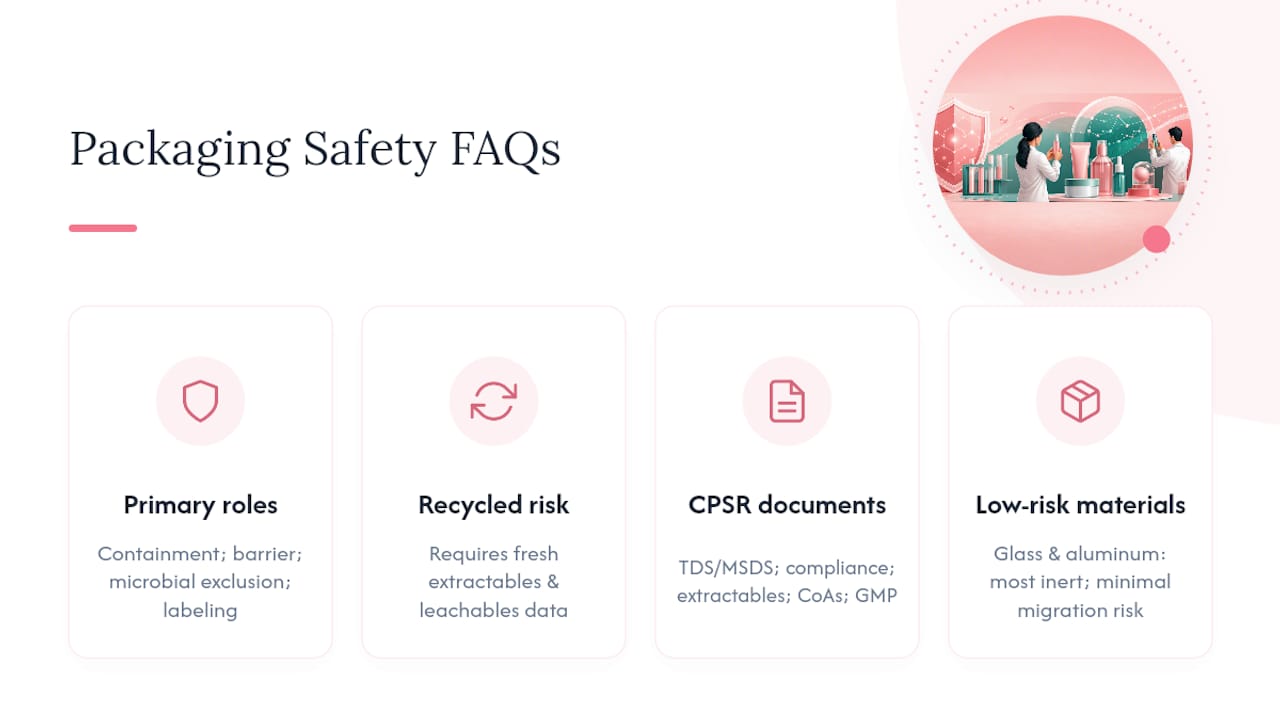
What is the primary role of packaging in beauty safety? The primary role of packaging in beauty safety is controlling four things at once: containment, barrier protection against oxygen and light, microbial exclusion, and accurate labeling for safe use. Fail at any one and the formula’s own safety data becomes irrelevant.
Does switching to recycled packaging automatically make a product less safe? Not automatically, but it does require new testing. Recycled content can carry contaminant histories that virgin material never had, so any switch needs fresh extractables and leachables data before it’s approved for production.
What documentation does a CPSR need to cover for packaging? At minimum, supplier TDS and MSDS, declarations of compliance, extractables and migration study results, certificates of analysis, and GMP evidence, all referenced in the packaging-specific section of the Product Information File.
How is cosmetic migration testing different from food packaging migration testing? Cosmetic testing uses different surface-area-to-volume and usage-amount assumptions than food testing does, since a leave-on cream applied in small daily amounts creates a different exposure model than food consumed in bulk.
Which packaging materials carry the lowest migration risk? Glass and aluminum are the most chemically inert options and carry minimal migration risk, which is why they remain the standard choice for high-value, chemically sensitive, or sterilization-dependent formulas.
For skincare and haircare products sourced with this level of packaging scrutiny already built in, browse Spyraverified’s skincare collection to see how verified sourcing translates into shelf-stable, safety-tested formulas.
This article is general information, not a substitute for advice from a qualified doctor. Consult a qualified healthcare professional about your own circumstances before acting on anything here.
Sources
- Cosmetic Packaging: European Regulatory Aspects and Sustainability
- Regulation (EC) No 1223/2009 of the European Parliament and of the Council of 30 November 2009 on cosmetic products
- Packaging Evaluation Approach to Improve Cosmetic Product Safety
- Packaging-derived endocrine disruptors and implications for nutrition and health
- Concerning ingredients in cosmetics, beauty products — Consumer Reports
