


Why Patch Testing Matters for Your Skincare Routine
Patch testing in skincare is defined as applying a small amount of product to a discreet skin area to detect allergic or irritant reactions before full-face use. Contact dermatitis affects roughly 20% of people at some point in their lives. That statistic alone makes patch testing one of the most practical safety steps you can take before introducing any new product. Clinical patch testing carries rare risks, including permanent pigment change in 1 in 1,000 cases and scarring in 1 in 10,000, which is exactly why at-home protocols have become the standard first line of defense. Patch testing is not a one-time precaution. It is a repeatable, preventive habit that protects your skin barrier every time you try something new.
Why patch testing matters in skincare safety
The core purpose of patch testing is to catch a reaction on a small patch of skin before it spreads across your entire face. A reaction on your inner forearm is manageable. The same reaction across your cheeks, forehead, and chin is not. Patch testing gives you that buffer zone between curiosity and consequence.
The practice also addresses a common misconception: that you only need to patch test if you have sensitive skin. Skin sensitivity is not fixed. Allergic sensitization can develop even to products you have used for years without issue. Your immune system can decide, at any point, that a previously tolerated ingredient is now a threat. Patch testing catches that shift before it becomes a full-blown reaction.
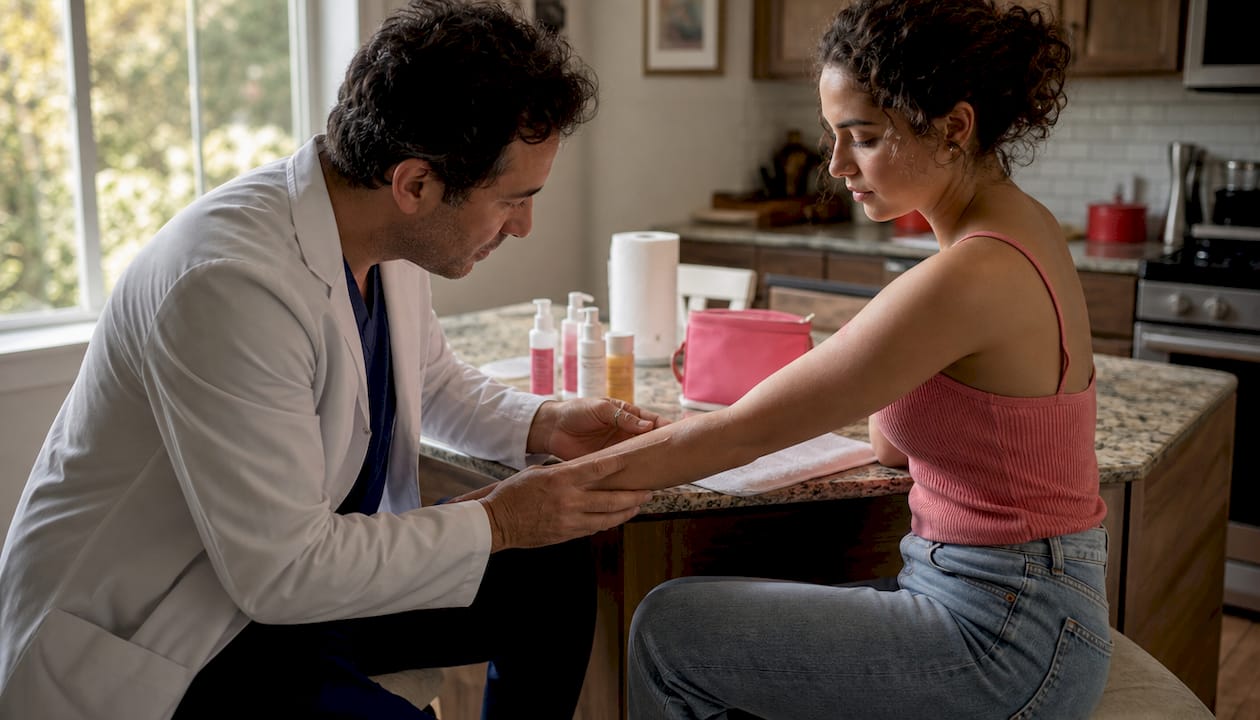
Patch testing also functions as a low-risk audition for every new product in your routine. Think of it as a trial run with controlled stakes. If the product passes, you move forward with confidence. If it fails, you have saved yourself days of irritated, inflamed skin.
How to patch test skincare products properly
The standard 2026 at-home protocol follows a 48-hour observation window with a reapplication on day two. A 24-hour test is not enough. Delayed reactions, particularly those driven by immune sensitization, often appear between 24 and 72 hours after first exposure.
Follow these steps for an accurate result:
- Choose your test site. The inner forearm or the skin behind the ear are the two best locations. Both are discreet, easy to monitor, and have skin that is reasonably representative of facial sensitivity.
- Apply a small amount. Use roughly the same quantity you would apply to a coin-sized area of your face. Do not layer it thickly.
- Leave it undisturbed for 24 hours. Avoid washing the area or applying other products over it.
- Reapply on day two. This second application mimics repeated daily use and increases the chance of catching a delayed reaction.
- Observe for 48 hours total. Watch for redness, itching, swelling, blistering, or any unusual warmth in the area.
- Assess the result. No reaction after 48 hours is a strong indicator of compatibility. Any reaction means you stop and reassess before using the product more widely.
Pro Tip: Environmental conditions during testing should match your intended use conditions. If you plan to use a product in the morning before sun exposure, do not test it in a dark, climate-controlled room and assume the result responds. Sunlight and humidity both affect how your skin responds.
Clinical patch testing, performed by a dermatologist, uses standardized allergens applied to the back to precisely identify specific allergenic compounds. This is the right step for people who react frequently and need to know exactly which ingredient is the trigger. For most people, the at-home protocol is sufficient and far less invasive.
Why natural and fragrance-free products still need patch testing
“Natural” and “fragrance-free” labels do not mean reaction-free. Fragrance-free and natural products can still provoke allergic reactions because their botanical ingredients are chemically complex. A plant extract contains dozens of individual compounds, any one of which can trigger a response.
Common allergens found in products marketed as natural or clean include:
- Botanical extracts such as lavender, chamomile, and tea tree oil, all of which are well-documented sensitizers
- Preservatives like phenoxyethanol and sodium benzoate, which appear in both conventional and natural formulas
- Fragrance components that exist naturally in essential oils, even when no synthetic fragrance is added
- Emulsifiers and thickeners derived from plant sources, including certain gums and waxes
- Vitamin C derivatives and other antioxidants that can cause irritation at higher concentrations
Your skin barrier resilience also changes over time. Stress, hormonal shifts, seasonal changes, and age all affect how your skin responds to the same ingredient. A product you used without issue two years ago may now cause a reaction. Checking out common skincare layering mistakes can help you understand how ingredient interactions compound this risk.
The safest approach treats every new product as an unknown quantity, regardless of its marketing claims. Patch testing is the only way to get a real answer for your specific skin.
How does patch testing differentiate allergic from irritant reactions?
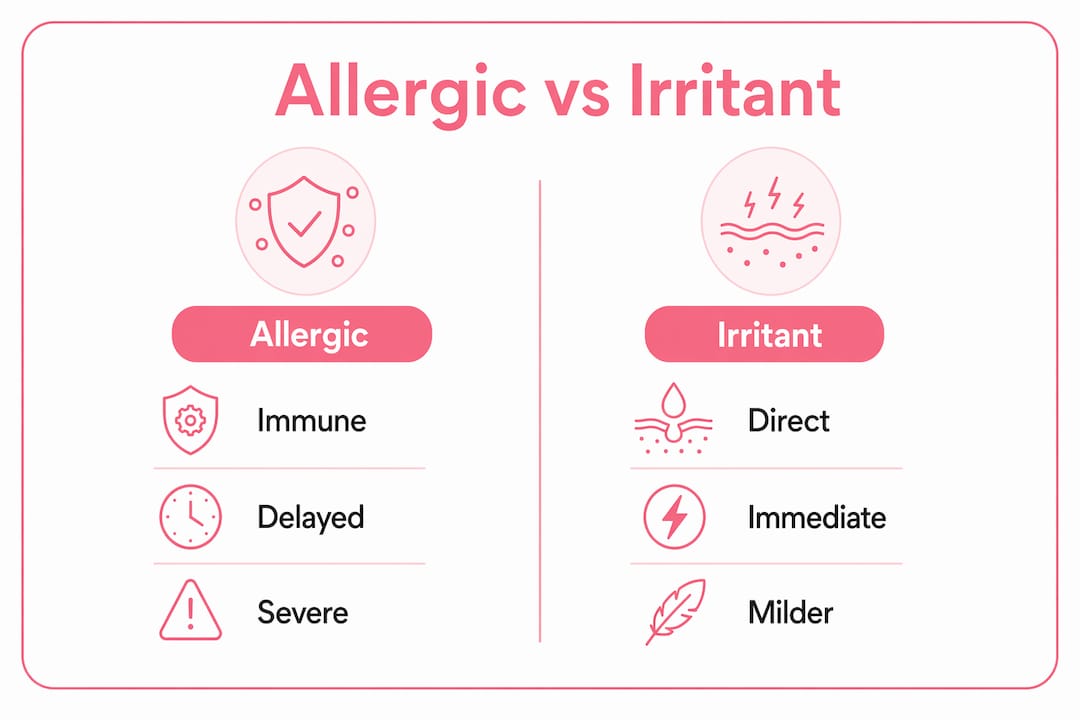
Patch testing helps you tell the difference between two distinct types of skin reactions, and that distinction changes how you respond.
| Feature | Allergic contact dermatitis | Irritant contact dermatitis |
|---|---|---|
| Cause | Immune-mediated response | Direct barrier damage |
| Onset | 24–72 hours after exposure | Often within minutes to hours |
| Spread | Can spread beyond contact area | Stays localized to contact area |
| Recurrence | Returns with re-exposure | May improve with barrier repair |
| Resolution | Requires allergen avoidance | Often resolves with product removal |
Patch testing differentiates these two reaction types by confining the exposure to a small area and allowing you to observe how the reaction behaves over time. An allergic reaction tends to persist and may spread slightly even after you stop applying the product. An irritant reaction typically clears quickly once you remove the offending product.
Pro Tip: If a reaction disappears within 24 hours of stopping product use, irritant contact dermatitis is the more likely cause. If redness or itching lingers for several days, an allergic mechanism is more probable. Either way, stop using the product and let your skin fully recover before testing anything new.
What to know when patch testing retinoids and acids
Active ingredients like retinoids, AHAs, BHAs, and vitamin C require extra care during patch testing. These ingredients carry a higher irritation potential than standard moisturizers or cleansers. Passing a patch test does not guarantee you will tolerate daily use at full strength.
Key considerations for patch testing actives:
- Start at low frequency. Retinoids and acids need slow introduction even after a clean patch test result. Begin with once or twice per week and build from there.
- Watch for delayed sensitization. Some reactions to actives appear after weeks of use, not days. A passed patch test is a green light to proceed cautiously, not a guarantee of permanent tolerance.
- Factor in photosensitivity. Retinoids and many acids increase your skin’s sensitivity to UV radiation. Daily SPF use is non-negotiable when introducing these ingredients.
- Avoid stacking actives. Testing one active at a time prevents confusion about which ingredient caused a reaction. Introducing multiple new products simultaneously makes it nearly impossible to identify the cause of irritation.
- Use a stable base routine. Keep your cleanser, moisturizer, and SPF consistent while testing a new active. A stable base gives you a reliable comparison point.
Gradual introduction after a passed patch test builds skin tolerance over time and significantly reduces long-term irritation risk. For guidance on which actives work well together, Spyraverified’s community-approved skincare products resource covers well-tested combinations that have earned consistent positive results.
Key Takeaways
Patch testing is the single most effective way to prevent contact dermatitis and identify skin incompatibilities before they cause widespread damage.
| Point | Details |
|---|---|
| 48-hour protocol is the standard | Apply, reapply on day two, and observe for a full 48 hours to catch delayed reactions. |
| All products need testing | Natural, fragrance-free, and “clean” products contain allergens that can trigger reactions. |
| Two reaction types require different responses | Allergic reactions persist after stopping use; irritant reactions resolve quickly with product removal. |
| Actives need slow introduction | Pass a patch test first, then build frequency gradually to reduce long-term irritation risk. |
| Skin sensitivity changes over time | Test every new product, even if you have used similar formulas before without issue. |
The habit most people skip until it’s too late
I have watched people spend weeks nursing a full-face breakout or a rash that covered their jawline, only to trace it back to a single new serum they introduced without testing. The frustration is real. So is the fact that 20 minutes of patch testing would have prevented the whole situation.
The temptation to skip testing is understandable. You are excited about a new product. You want results now. But the cost of skipping is almost always higher than the cost of waiting two days.
One mistake I see repeatedly is testing multiple new products at the same time. Someone adds a new toner, a new serum, and a new moisturizer in the same week, then wonders why their skin is reacting. You cannot isolate the cause when you have introduced three variables at once. Test one product at a time, always.
Seasonal changes also affect your results. Skin barrier compromise during winter increases irritation risk, which means a product you tolerated in summer may cause a reaction in january or february. Patch testing is not a one-and-done step. It is an ongoing practice that accounts for the fact that your skin is not static.
The most disciplined skincare routines I have seen belong to people who treat patch testing as automatic. They do not debate it. They do not skip it when they are in a hurry. They test every new product, every time, and their skin shows the results.
— Anni
Protect your skin with Spyraverified’s trusted resources
Spyraverified curates authentic Japanese and Asian beauty products that are often difficult to find outside their home markets. Every product in the catalog comes from verified manufacturers, which means you know exactly what you are applying to your skin.

Patch testing works best when you know what is in your products. Spyraverified’s guides on identifying your skin type and choosing Korean skincare give you the context to make smarter decisions before you even open a new bottle. When you are ready to build a routine with products you can trust, start at Spyraverified and shop with confidence.
FAQ
What is patch testing in skincare?
Patch testing is the process of applying a small amount of a product to a discreet skin area, typically the inner forearm or behind the ear, and observing for 48 hours to detect allergic or irritant reactions before full-face use.
How long does a patch test need to last?
A patch test requires at least 48 hours, including a reapplication on day two. A 24-hour test is insufficient because delayed immune-mediated reactions often appear between 24 and 72 hours after first exposure.
Do natural or fragrance-free products need patch testing?
Yes. Natural and fragrance-free products contain complex botanical ingredients and preservatives that can trigger both allergic and irritant reactions. The label does not determine your skin’s response.
Can you develop a reaction to a product you have used before?
Yes. Allergic sensitization can develop at any point, even after years of using a product without issue. Your immune response changes over time, which is why patch testing every new product introduction remains the safest practice.
Is patch testing necessary for retinoids and acids?
Patch testing is the required first step, but it does not replace a gradual introduction schedule. Retinoids and acids carry delayed sensitization and photosensitivity risks that require a slow, low-frequency buildup even after a clean patch test result.
