


Stop Overpaying: Compare Japan vs. U.S. Skincare Landed Costs
Drugstore Japanese skincare, especially sunscreen and basic lotions, typically costs significantly less when bought in Japan than when the same brand shows up on a U.S. shelf. Premium lines like SK-II sometimes run cheaper too, but not always. Shipping, customs, and importer markups can wipe out those savings fast, which means the real answer depends on the category and how you buy it.
TL;DR:
- Premium brands like SK-II price similarly across Japan and the U.S. since they target global markets, reducing potential savings.
- Import costs, customs, and formulating differences often outweigh potential savings unless buying from verified sources of domestic formulas.
- Currency fluctuations and tax-free shopping in Japan can enhance savings for direct buyers, especially for sunscreen and basic hydrating products.
- Authenticity matters more than the lowest price, as reformulated export versions sold online often lack the same ingredients and quality as domestic Japanese products.
Table of Contents
- Is Skincare Cheaper In Japan? A Category Breakdown
- Why Does Japanese Skincare Cost Less Than U.S. Skincare?
- How To Shop Japanese Skincare Without Losing The Savings
- Should You Buy From Japan Or Buy In The U.S.? A Quick Checklist
- How Have Japan-U.S. Skincare Prices Shifted Over Time?
- Why Do Cultural Preferences Affect What You Pay?
- A Publisher’s Take: Why Authenticity Matters More Than The Price Tag
- Where To Buy Authentic Japanese Skincare Without The Import Hassle
- Sources
Is Skincare Cheaper In Japan? A Category Breakdown
The honest answer is: it depends heavily on where a product sits on the shelf. Drugstore staples show the widest gap, while premium prestige brands often barely move.
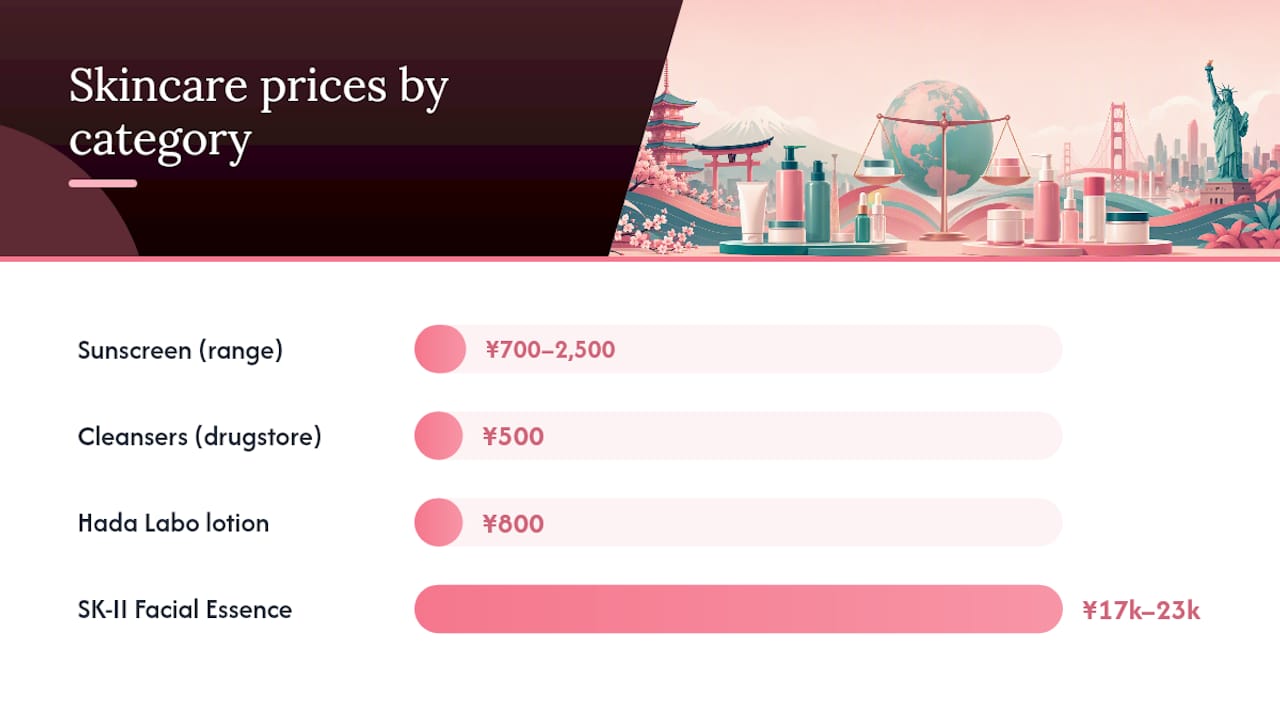
Sunscreen is where the price difference is most dramatic, and it is not just about cost. Japanese sunscreens run roughly ¥700 to ¥2,500 domestically, covering everything from basic drugstore SPF to elevated formulas like Canmake’s Mermaid Skin UV at around ¥770. The same category in U.S. stores, once it is imported and marked up, often lands at higher prices for a comparable tube. Part of that gap comes down to chemistry: Japanese sunscreen formulas rely on UV filters like Tinosorb S and Uvinul A Plus, neither of which is FDA-approved for use in the U.S. That is why Japanese SPF tends to feel lighter and less chalky, and why American retailers importing the real domestic version, rather than a reformulated export SKU, tend to charge more just to bring it in.
Cleansers and oil cleansers follow a similar pattern but with less drama. A drugstore option like Senka Perfect Whip retails in Japan for around ¥500, while the U.S. version of the same cleanser frequently sells for considerably more once it clears import and retail markup. Premium oil cleansers from brands like DHC or Shu Uemura show a smaller gap, often just a few dollars either direction, because those brands price closer to global standards from the start.
Toners and lotions, the Gokujyun-style hydrating essences that anchor most Japanese routines, tell a similar story. Hada Labo Gokujyun lotion runs about ¥800 in Japan, which converts to roughly $5.50. The same bottle at a U.S. Target or specialty beauty retailer typically costs $12 to $18.
Serums and premium essences are where the math gets less predictable. SK-II’s Facial Treatment Essence sells in Japan for roughly ¥17,000 to ¥23,000, while U.S. retail price for the same size sits significantly higher. Depending on the seller and exchange rate at the time, that puts Japan-based pricing lower. But this savings pattern does not hold across every premium brand. Some luxury Japanese labels price deliberately close to their U.S. counterparts because they are positioned as global prestige products, not budget imports.
Moisturizers land somewhere in the middle.
A few patterns worth remembering:
- Sunscreen and basic hydrating lotions show the largest domestic-vs-export price gaps.
- Prestige and luxury lines tend to price similarly across markets by design.
- Drugstore chains in Japan (Matsumoto Kiyoshi, Don Quijote) consistently undercut department stores and export retailers.
- Export versions sold through U.S. importers are sometimes reformulated, not just repriced, which affects the comparison entirely.
Why Does Japanese Skincare Cost Less Than U.S. Skincare?
The price gap is not random. It comes from five overlapping forces, and understanding them tells you when a deal is real versus when it is just currency noise.
Regulatory divergence is the biggest structural driver. Japan approves a wider range of UV filters and active ingredients than the FDA does, which means Japanese sunscreen and some treatment formulas simply cannot be sold in the U.S. in their original form. Brands either reformulate for export (adding cost) or skip the U.S. market for that specific product entirely, which limits supply and drives up the price of whatever version does make it stateside.
Domestic vs. export formulation strategy compounds this. Some brands intentionally sell one version in Japan and a different, often pricier, version abroad. That is not a manufacturing accident. It is a pricing strategy, and it means comparing a U.S. price tag to a Japanese one is sometimes comparing two different products.
Distribution and markup layers stack on top of that. A product moving from a Japanese manufacturer through an export distributor, then a U.S. importer, then a retailer, picks up margin at every stop. Drugstore chains in Japan skip most of that chain entirely, which is exactly why their prices stay low.
Currency timing matters more than most shoppers realize. A weaker yen makes every Japan-based purchase cheaper in dollar terms, even before accounting for the product’s list price. That swing changes month to month, so today’s “great deal” might look different in six months.
- Regulatory gaps limit which formulas legally reach U.S. shelves.
- Export-specific formulations often cost more to produce and price.
- Distribution layers add markup at each step from factory to shelf.
- Exchange rate swings shift the real dollar cost of buying direct from Japan.
- Tourist tax-free purchasing and in-store promotions give in-person buyers in Japan an extra edge U.S. shoppers cannot access remotely.
That last point deserves a beat of its own. Travelers buying at Japanese department stores like Isetan and Takashimaya can access tax-free purchasing on top of already-lower domestic prices, plus seasonal promotions and gift-with-purchase deals that simply do not exist in the U.S. retail environment.
How To Shop Japanese Skincare Without Losing The Savings
The sticker price in Japan means nothing until you calculate the landed cost, which is the product price plus shipping, plus customs, plus whatever markup a U.S. seller adds — understanding how per-milliliter pricing impacts your total spend can help you avoid overspending, as discussed in Travel-Size Cologne Is Costing You More Than You Think – SPRITZ™. A $6 toner that costs $14 to ship internationally is not a deal anymore.
- Add up the full landed cost before comparing. Take the Japan price, convert it, then add international shipping and any customs handling fee. Compare that total to the U.S. shelf price, not just the raw product cost.
- Buy from retailers who source authentic domestic formulas, not repackaged export versions. Export SKUs sometimes carry different concentrations or ingredient lists than what is sold in Japan, so “the same product” is not always the same product.
- Check expiration dates and batch codes. Imported skincare that sat in a warehouse or went through multiple resellers may have less shelf life left than a fresh domestic purchase, and Spyra Verified’s guide to Japanese beauty product expiry walks through what those codes mean.
- Cross-check prices across multiple sellers using a skincare price comparison tool or a beauty price tracker before committing, since retail markups vary wildly even within the U.S. market.
- Stock up on sunscreen, not serums. Sunscreen has a long shelf life and shows the biggest savings, making it a smart bulk buy. Treatment serums with active ingredients degrade faster and cost more to replace if you guessed wrong on a formula.
Pro Tip: Before buying a “steal” price on a Japanese serum from an unfamiliar seller, check whether the listing specifies a domestic Japanese SKU or an export version. A missing ingredient list or vague product description is usually the tell.
Should You Buy From Japan Or Buy In The U.S.? A Quick Checklist
Run through these five questions before adding anything to a cart, whether it is a Japan-based site or a U.S. retailer.
- Is this a domestic Japanese formula that never gets exported? If yes, buying direct usually pays off.
- Is it a drugstore staple, like sunscreen or a basic lotion, where the domestic-to-export gap is historically large?
- Will shipping and customs fees eat more than half the savings once you add them up?
- Can you wait for a U.S. sale or a verified importer restock instead of paying for slow international shipping?
- Do you care enough about the Japanese-specific texture or filter technology to pay a premium for the real thing?
| Situation | Better move |
|---|---|
| Domestic-only sunscreen or drugstore lotion | Buy from Japan or a verified importer |
| Premium prestige serum (SK-II, Shiseido) | Compare both markets, savings vary by seller |
| Need it this week | Buy domestically, even at a premium |
| Uncertain about seller authenticity | Choose a verified U.S. retailer over a marketplace listing |
How Have Japan-U.S. Skincare Prices Shifted Over Time?
Japanese drugstore pricing has stayed relatively stable in yen terms for years, since brands like Hada Labo and Senka target mass-market domestic shoppers who expect low, consistent prices. What has moved is the dollar conversion, swinging with exchange rates rather than any change in the products themselves.
On the U.S. side, prices have crept upward as more retailers import Japanese beauty brands and compete for a growing customer base. A decade ago, most Americans could only get J-beauty through specialty importers or personal shoppers, so prices carried a steep convenience tax. Wider retail distribution has closed some of that gap, but it has not eliminated it, since shipping and customs costs stay fixed no matter how popular a brand becomes.
Looking ahead, expect the drugstore-to-premium price split to persist rather than close. Japanese brands have little incentive to lower export prices when demand keeps rising, and U.S. retailers who invest in direct manufacturer relationships are better positioned to hold prices steady than those relying on secondhand importers. The businesses that source directly, rather than through layered resellers, are the ones most likely to pass real savings to U.S. shoppers over time.
Why Do Cultural Preferences Affect What You Pay?
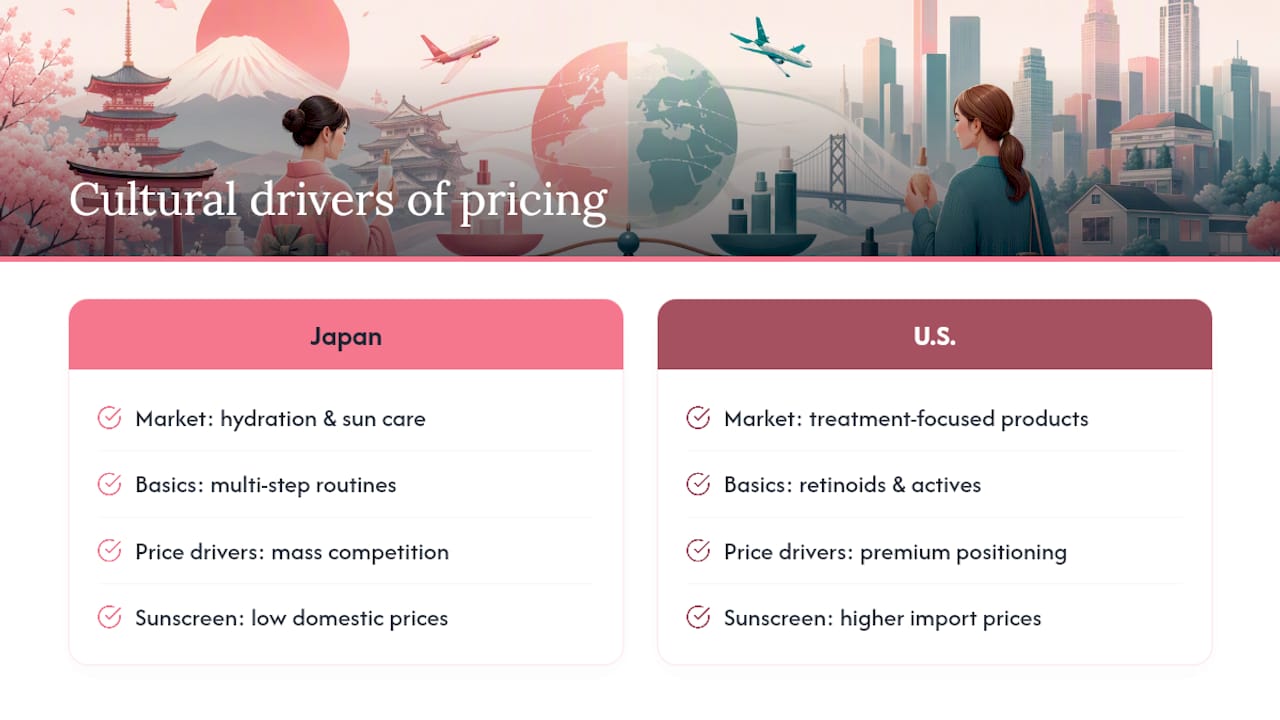
Japanese skincare culture prizes gentle, multi-step routines built around hydration and sun protection, which shapes what gets made cheaply and at scale. Sunscreen is treated as a daily essential rather than a seasonal purchase, so domestic competition keeps prices low across dozens of drugstore brands. That same cultural emphasis is exactly why the sunscreen category shows some of the widest price gaps once it crosses into the U.S. market.
American skincare culture, by contrast, has leaned toward treatment-focused products like retinoids, acids, and multi-active serums, which tend to carry higher price points regardless of country of origin. That difference in what each market considers a “basic” versus a “premium” product changes how the same category gets priced on each side.
Texture preference plays a role too. The lighter, less-chalky finish that Japanese UV filters produce has built real demand among American shoppers who find domestic sunscreen formulas heavy or greasy. That demand is strong enough that some buyers will pay a premium for the authentic Japanese version rather than settle for a reformulated export SKU, even when the price gap barely favors the import. Preference, in other words, sometimes matters more to the buyer than the math does.
A Publisher’s Take: Why Authenticity Matters More Than The Price Tag
The price comparisons matter, but they miss the bigger risk: reformulated export SKUs sold as “the real thing.” I write about Japanese beauty for Spyra Verified, where we partner directly with manufacturers to source domestic formulas rather than watered-down export versions. That sourcing relationship is what actually protects a shopper’s money, more than any price chart.
— Anni
Where To Buy Authentic Japanese Skincare Without The Import Hassle
Spyra Verified exists for the shopper who has read every price comparison and still isn’t sure the “deal” they found online is the real domestic formula. Spyra Verified sources directly from manufacturer partners in Japan, curates authentic domestic formulations rather than reformulated export versions, and ships to U.S. customers with the localized support that a random overseas marketplace listing simply cannot offer.
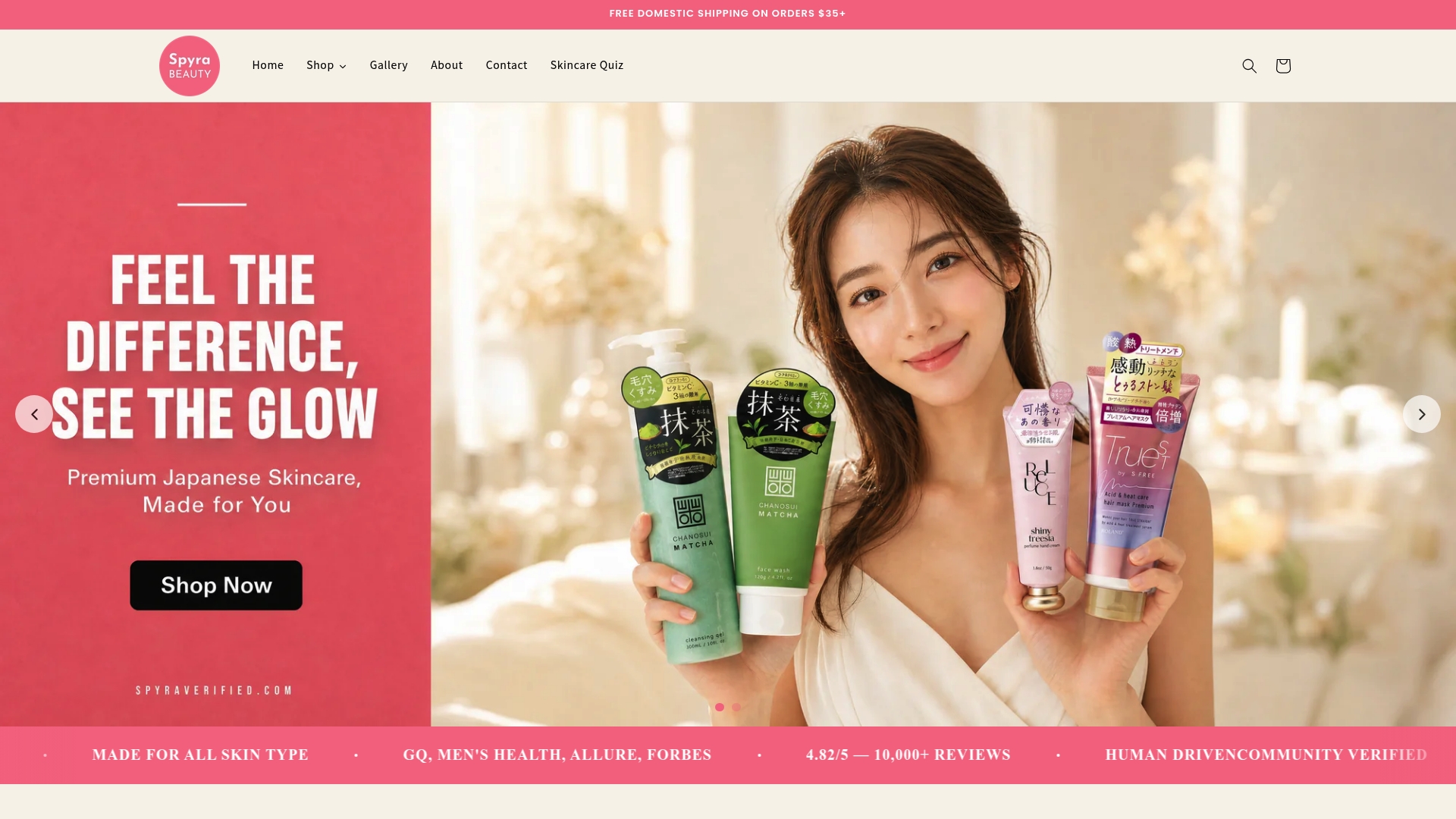
Choose Spyra Verified when authenticity is your priority, when you’d rather skip the customs guesswork entirely, or when you specifically want the domestic Japanese version of a sunscreen or serum rather than whatever export SKU shows up on a random reseller site. It’s also worth comparing formulation notes against Spyra Verified’s guide on Japanese vs. Korean skincare if you’re still deciding which approach fits your routine. Browse the Spyra Verified skincare collection to see current stock of verified domestic formulas and start building a routine sourced the right way.
Sources
- Japanese Beauty Products to Buy in Japan (Real Prices) | ClinicJapan
- Japan Skincare & Beauty Products: What to Buy and Why It’s Better (2026)
- Beauty Price Tracker
