


How to Transition to Japanese Skincare Safely
Transitioning to Japanese skincare means adopting gentle cleansing, layered hydration, and daily sun protection as the foundation of your routine. This approach, endorsed by board-certified dermatologist Dr. Jane Yoo and esthetician Emma Jinn, centers on prevention rather than correction. You build skin health gradually, not overnight. The result is a calmer, more resilient complexion over time. Whether you want to build a Japanese skincare routine from scratch or shift away from an aggressive Western regimen, the method is the same: start slow, stay consistent, and let your skin lead.
What products do you need to start a Japanese skincare routine?
Japanese skincare philosophy is defined by simplicity and function. Every product earns its place by supporting the skin barrier, not stripping it. The Japanese skincare routine centers on three pillars: cleansing, hydration, and sun protection.
Cleansing
Japanese cleansing typically uses an oil-based cleanser first to dissolve sunscreen and makeup, followed by a gentle foam or gel cleanser. The goal is thorough removal without disrupting the skin’s natural moisture barrier. Harsh sulfate-heavy cleansers common in Western routines have no place here.

Hydration layering
Hydration in Japanese skincare is built in layers, starting with lighter lotions and essences, then finishing with creams or emulsions. This sequence delivers deep moisture without a heavy or greasy finish. Think of it as stacking thin, absorbent layers rather than applying one thick cream.
Sun protection
Japanese sunscreens are lightweight, often water-based, and designed for daily wear. They are not an afterthought. They are the final and most protective step in any morning routine.
| Product type | Typical formulation | Role in routine |
|---|---|---|
| Cleansing oil or balm | Oil-based | Removes sunscreen and makeup |
| Foam or gel cleanser | Water-based | Deep cleans without stripping |
| Lotion or toner | Lightweight, watery | First hydration layer |
| Essence | Concentrated, thin | Boosts skin absorption |
| Emulsion or cream | Richer texture | Seals in moisture |
| Japanese sunscreen | SPF 30–50, PA+++ or higher | UV protection, daily use |
- Cotton pads help apply toners and essences evenly without waste.
- Facial mists work well for mid-day hydration refresh, especially in dry climates.
- A gentle cleansing gel like the Uji Matcha Pore Cleansing Gel from Spyraverified is a strong starting point for the cleansing step.
Pro Tip: Start with the most basic versions of each product type. A plain hydrating toner and a simple moisturizer will tell you more about your skin’s needs than a complex serum ever will.
How to gradually transition your routine to avoid irritation
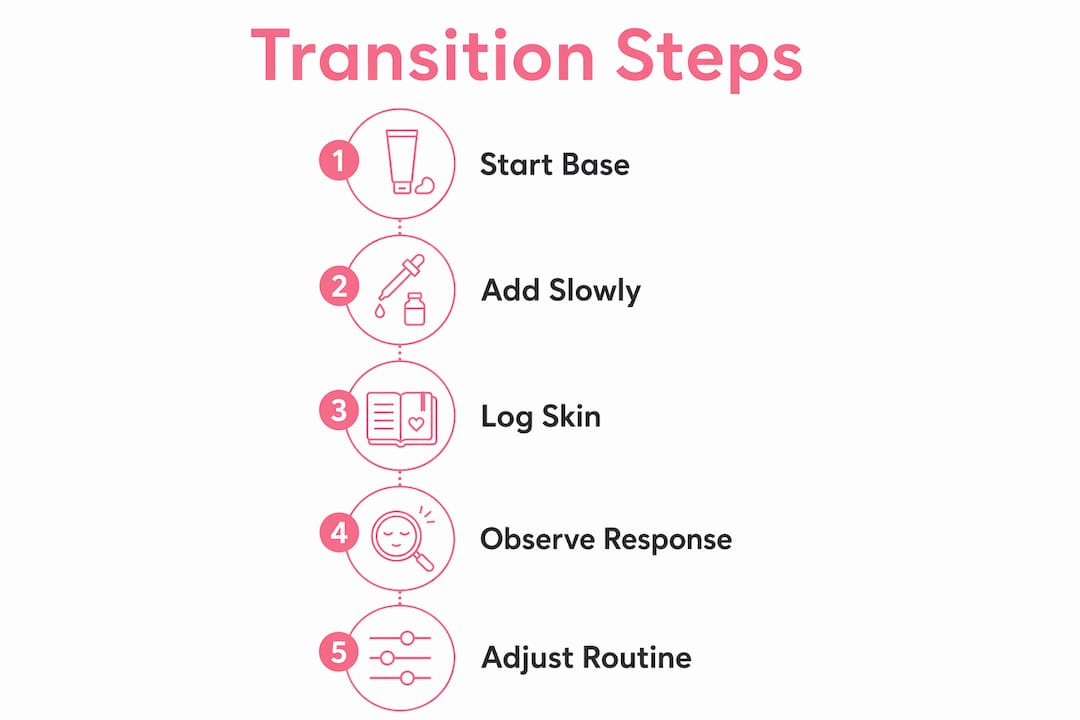
The safest way to switch to a Japanese skincare routine is to change one thing at a time. Stacking too many new products at once risks irritation and makes it impossible to identify what caused a reaction. A stepwise approach solves both problems.
The recommended method is to spend the first 10–14 days using only three products: a gentle cleanser, a basic moisturizer, and an SPF. This stabilizes your skin before you add anything new. Once your skin is calm and consistent, you can introduce the next layer.
- Days 1–14: Use only a gentle cleanser, a plain moisturizer, and a Japanese sunscreen. Let your skin adjust to the new formulations.
- Day 15: Add one new product, such as a hydrating toner or essence. Use it two to three times per week, not daily.
- Weeks 3–4: If no irritation appears, increase frequency gradually. Do not add a second new product until the first is fully tolerated.
- Introducing actives: Follow the one-active rule. Introduce only one active ingredient at a time, starting at once per week. Increase every two weeks only if your skin tolerates it well.
- Buffering: If an active causes mild sensitivity, apply your moisturizer first, then the active on top. This reduces direct contact with the skin barrier.
- Monitor reactions: Redness, stinging, or flaking that persists beyond three days signals a problem. Pause the new product and return to your stable base.
- Existing medicated treatments: You do not need to drop them. Separating barrier care from active treatments keeps both effective without conflict.
Pro Tip: Keep a simple skin log. Note what you applied, when, and how your skin felt the next morning. Patterns become obvious within two weeks.
Going slow when introducing new products avoids barrier damage and produces better long-term skin tolerance. Patience here is not optional. It is the method.
How do Japanese sunscreen ratings work?
Japanese sunscreen labels carry two ratings: SPF and PA. Most people understand SPF, but the PA system is less familiar outside Japan. Understanding both is non-negotiable for choosing the right product.
SPF measures protection against UVB rays, which cause sunburn. SPF 30 blocks approximately 97% of UVB rays, and SPF 50 blocks approximately 98%. The difference between them is small, but both require consistent reapplication to stay effective.
PA ratings measure UVA protection, the rays responsible for aging and deeper skin damage. The scale runs from PA+ (minimal) to PA++++ (highest available). Japanese PA ratings offer a clearer UVA protection measure than the U.S. FDA’s “broad-spectrum” label, which confirms UVA and UVB coverage but does not quantify UVA strength.
| Rating system | What it measures | Scale |
|---|---|---|
| SPF | UVB protection | SPF 15, 30, 50, 50+ |
| PA (Japan) | UVA protection | PA+ to PA++++ |
| Broad-spectrum (U.S.) | UVA + UVB coverage | Pass/fail, no UVA quantity |
For daily use, choose SPF 30 or higher with at least PA+++ for meaningful UVA defense. Apply sunscreen at least 15 minutes before sun exposure and reapply every two hours when outdoors. Use roughly a quarter teaspoon for your face and neck combined. That amount sounds like a lot, but most people apply far less and lose significant protection as a result.
- Chemical sunscreens absorb UV rays and tend to feel lighter on the skin. They suit oily or combination skin types well.
- Mineral sunscreens use zinc oxide or titanium dioxide to physically block UV rays. They work better for sensitive skin but may leave a white cast.
- Japanese formulations often blend both types for a finish that feels invisible on the skin.
For a deeper look at matching formulations to your skin type, Spyraverified’s guide on picking Japanese sunscreen covers the full selection process.
How to adapt your Japanese skincare routine through seasonal changes
Consistent cleansing, moisturizing, and sun protection stay fixed year-round. What changes with the seasons is the intensity of your hydration and the weight of your moisturizer. This is the core of what is seasonal skincare routine Japan practitioners follow.
Hydration products and layering increase as dryness begins, not after it sets in. Waiting until your skin feels tight or flaky means the barrier is already compromised. The Japanese approach is to adjust before symptoms appear.
- Spring and fall: Transition periods where humidity shifts. Swap a heavy cream for a lighter emulsion, or reduce the number of essence layers if your skin feels congested.
- Summer: Heat and humidity increase sebum production. A gel moisturizer or a lighter lotion often replaces a cream. Sunscreen reapplication becomes more frequent.
- Winter: Cold air and indoor heating strip moisture fast. Add an extra essence layer or switch to a richer cream. A hydrating facial mist used mid-day helps maintain moisture levels between steps.
Pro Tip: Do not change your entire routine when seasons shift. Swap one product at a time, just as you did during your initial transition. Your skin will tell you within a week whether the change is working.
Avoiding common skincare layering mistakes during seasonal shifts keeps your barrier intact and prevents the cycle of over-correction that many people fall into.
What common mistakes should you avoid during your transition?
Most problems during a skincare transition come from moving too fast. Changing one variable per phase is the single most effective way to keep your skin stable and identify any triggers quickly.
- Adding too many products at once: Introduce one product per phase. If three new products arrive at the same time, you cannot know which one caused a breakout or redness.
- Rushing active ingredients: Retinol, acids, and vitamin C all require a slow build. Starting at full frequency causes barrier damage that sets your progress back by weeks.
- Mistaking purging for irritation: Purging is a temporary increase in breakouts caused by cell turnover. It typically resolves within four to six weeks. Irritation, by contrast, shows up as persistent redness, stinging, or peeling.
- Abandoning your base routine: Your cleanser, moisturizer, and SPF are non-negotiable anchors. Never drop them to make room for a new product.
- Skipping sunscreen on cloudy days: UVA rays penetrate clouds and glass. Daily sun protection is a year-round habit, not a summer option.
Pro Tip: If your skin reacts badly to a new product, go back to your three-step base for a full week before trying again. Rebuilding the barrier first makes the next introduction far more likely to succeed.
When you are ready to add anti-aging actives, Spyraverified’s breakdown of Japanese anti-aging ingredients gives you a clear list of what works and why.
Key takeaways
The most effective way to transition to Japanese skincare is to start with a three-product base, introduce one new product at a time, and treat sun protection as a daily non-negotiable.
| Point | Details |
|---|---|
| Start with three products | Use a gentle cleanser, moisturizer, and SPF for 10–14 days before adding anything new. |
| Follow the one-active rule | Introduce one active ingredient at a time, starting at once per week, and increase slowly. |
| Decode sunscreen labels | Choose SPF 30+ with PA+++ or higher for meaningful UVA and UVB protection. |
| Adjust seasonally, not reactively | Increase hydration layers before dryness sets in, not after your barrier is already compromised. |
| Change one variable per phase | Swapping one product at a time makes it easy to identify what your skin tolerates. |
What I have learned from switching to a Japanese skincare approach
The biggest shift for me was accepting that prevention is the goal, not correction. Western routines often chase results fast, piling on actives and expecting visible change within days. Japanese skincare asks you to think in months, not weeks. That mental adjustment is harder than any product swap.
What surprised me most was how quickly my skin calmed down once I stripped back to the basics. A gentle cleanser, a hydrating toner, and a good SPF did more for my skin texture in three weeks than a full shelf of serums had done in months. The barrier was finally getting support instead of constant disruption.
Patience is not passive. You are actively watching your skin, adjusting one layer at a time, and building knowledge about what your skin actually needs. That awareness compounds over time. Small, consistent steps produce results that aggressive routines rarely sustain.
Stay flexible. Your skin in january is not your skin in august. The routine that works in winter may feel heavy by spring. Treat your routine as a living system, not a fixed prescription.
— Anni
Spyraverified’s Japanese skincare collection for your transition
Starting a new routine is easier when you have products that are already built around the principles you are learning.
Spyraverified curates authentic Japanese skincare products designed around gentle cleansing, layered hydration, and daily sun protection. The full skincare collection includes options suited to every stage of a transition, from first-time cleansers to targeted essences. If you are not sure where to begin, the skin quiz matches you with products based on your skin type and current concerns. Every product is sourced directly from Japanese and Asian manufacturers, so what you receive is the real formulation, not a reformulated export version.
FAQ
What is the Japanese skincare philosophy?
Japanese skincare philosophy centers on prevention, gentle barrier care, and consistent daily habits rather than aggressive correction. Esthetician Emma Jinn describes it as a routine built on gentle cleansing and hydration with no harsh steps.
How long does a transition to Japanese skincare take?
A safe transition takes a minimum of 10–14 days for the base routine to stabilize, with each new product requiring an additional two to four weeks before the next addition.
What does PA++++ mean on a Japanese sunscreen?
PA++++ is the highest UVA protection rating in Japan’s PA system. It offers significantly stronger UVA defense than PA+ and provides more specific UVA guidance than the U.S. broad-spectrum label.
Can I keep my current medicated skincare products during the transition?
Yes. Separating your barrier care steps from your medicated active treatments allows both to work effectively without causing additional irritation.
Do I need a different routine in winter versus summer?
The core steps stay the same year-round. You adjust moisturizer weight and the number of hydration layers based on seasonal humidity and temperature changes.
