

How to Manage Your Asian Beauty Product Rotation
Pull everything out of your cabinet, sort it into three piles (keep, toss, relocate), assign each keeper to a rotation slot, and track open dates in an app. That four-step loop is the entire system to manage your Asian beauty product rotation. The details below make it repeatable.
Quick-start checklist (under 15 minutes):
- Pull every product off the shelf and check the PAO symbol (the open-jar icon) against the date you opened it. Toss anything past its window.
- Move your daily cleanser, toner, and moisturizer to the front row. Push serums, exfoliants, and retinoids to a secondary zone.
- Relocate vitamin C serums, retinol, and facial oils to a cool, dark drawer outside the bathroom.
Key Takeaways
A repeatable rotation system requires three things in sequence: a clean, dated inventory; a fixed template you run for at least 4–8 weeks; and a tracker that surfaces expiry dates before products degrade.
| Point | Details |
|---|---|
| Inventory before organizing | Pull everything out, check PAO dates, and purge before buying a single organizer. |
| Use one template for 4–8 weeks | The 3-night or 4-2-4 template only shows results if you run it long enough to evaluate. |
| Store actives outside the bathroom | Vitamin C, retinol, and facial oils degrade faster in heat and humidity; move them to a cool drawer. |
| Track open dates and expiry | Use HadaBuddy, Beautistics, or ShelfCheck to log open dates and get reminders before PAO windows close. |
| Spyraverified for rotation-ready products | Spyraverified’s curated skincare collection offers authentic Asian actives with accurate labels to match your rotation slots. |
Table of Contents
- What is skin cycling, and why does it help your collection?
- How to inventory and purge your Asian-beauty collection
- How to build a rotation schedule you’ll actually follow
- What layering rules and ingredient conflicts should you know?
- How do you store Asian-beauty products to keep them effective?
- Physical organization hacks that make your rotation visible
- Which apps help you track your rotation and expiry dates?
- How should you adapt your rotation by skin type and season?
- What does a weekly reset and monthly audit look like?
- Evidence-based safety tips for managing actives
- How to safely add new products to an existing rotation
- The rotation advice most people get wrong
- Spyraverified makes it easier to build a rotation-ready shelf
- Sources
What is skin cycling, and why does it help your collection?
Skin cycling is a structured rotation method where you alternate strong active ingredients (exfoliants, retinoids) with recovery nights focused on hydration and barrier support. The term gained traction from Korean beauty culture, which has long treated the skin as something to work with rather than against. The practical payoff is real: your skin gets the actives it needs without the compounding irritation that comes from using them every night.
Beyond skin health, a rotation system does something most people overlook: it forces you to actually use what you own.
Benefits of a structured rotation:
- Reduced irritation from overusing exfoliants or retinoids back-to-back
- Cleaner feedback when you introduce a new product (you know what changed)
- Longer product life because you’re not opening five serums simultaneously
- Fewer duplicate purchases once you can see your full inventory
- Better results from actives because barrier-support nights let skin recover and absorb
Dermatologists and estheticians consistently recommend introducing one new product at a time and waiting 1–4 weeks before adding another. That timeline maps directly onto a rotation template: one new product per cycle, not per week.
Expect to see visible changes in texture and tone after 4–8 weeks of consistent cycling. Anything less and you’re evaluating noise, not signal.
How to inventory and purge your Asian-beauty collection
The most common mistake collectors make is buying organizers before they know what they actually own. Professional organizers recommend a full pull-out first: take everything off the shelf, counter, and drawer so you can see true volume. It’s almost always more than you expected.
Step-by-step sorting process:
- Pull every product out and group by category: cleansers, toners/essences, serums, moisturizers, SPF, treatments (exfoliants, retinoids), masks, and tools.
- Check each product’s PAO label. If you can’t remember when you opened it and it smells or looks off, toss it. PAO tracking is more reliable than manufacturing dates for deciding what’s still safe.
- Sort into three piles: Keep (within PAO, used regularly), Toss (expired, degraded, or caused irritation), Relocate (duplicates or items better stored outside the bathroom).
- For every keeper, note the category, open date, PAO window, how often you use it, and which rotation zone it belongs in.
- Return only the keepers to the shelf, organized by zone.
Inventory template fields to track:
- Product name and category
- Date opened
- PAO (6M, 12M, 24M)
- Estimated expiry date (open date + PAO)
- Frequency of use (daily, weekly, occasional)
- Assigned rotation zone (AM daily, PM active, PM recovery, weekly treatment)
Pro Tip: Don’t buy a single acrylic organizer until after the purge. Collectors routinely discover they need half the storage they assumed — and the wrong organizer wastes both money and counter space.
How to build a rotation schedule you’ll actually follow
Pick one template and run it for 4–8 weeks before judging whether it’s working. Switching templates every two weeks is the single biggest reason people never see results from Korean skin cycling frameworks.
The two most practical templates for Asian-beauty collections:
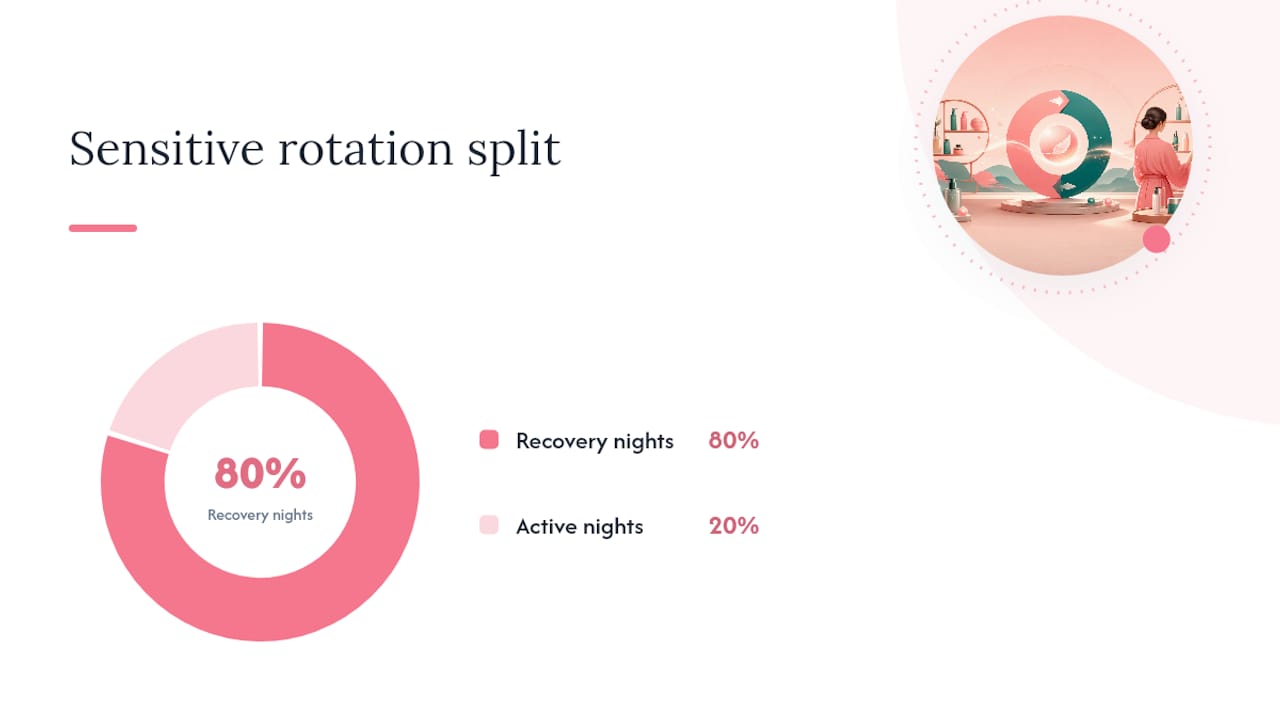
The 4-2-4 pattern (4 recovery nights for every 2 active nights) suits sensitive or barrier-compromised skin. The 3-night loop works well for skin that tolerates actives without much redness.
AM/PM split rule: Vitamin C, niacinamide serums, and SPF belong in the AM routine every day regardless of which PM night you’re on. The rotation applies to PM actives only.
Assigning products to slots:
- Exfoliant slot: one AHA (glycolic, lactic) or BHA (salicylic) product, not both on the same night
- Retinoid slot: start at the lowest available concentration; increase only after 4 weeks of tolerance
- Recovery slot: hydrating toner or essence, ceramide or peptide moisturizer, no actives
- Weekly treatment: sheet masks, sleeping packs, or a gentle enzyme mask
Track which night you’re on in a notes app or your skincare tracker. Missing a night doesn’t break the system; just pick up where you left off.
What layering rules and ingredient conflicts should you know?
The core rule is simple: one strong active per PM cycle slot, plus barrier support every recovery night. Stacking actives on the same night is where most irritation starts.
Combinations to avoid:
- Retinoids + AHA or BHA on the same night (doubles irritation risk without doubling benefit)
- Vitamin C (L-ascorbic acid) + benzoyl peroxide (they oxidize each other and reduce efficacy)
- Two exfoliants layered together (e.g., a glycolic toner followed by a BHA serum)
- Retinoids + physical scrubs on the same night
- High-concentration niacinamide directly over pure vitamin C (can cause temporary flushing in some skin types)
How to patch-test a new active:
- Apply a small amount to the inner forearm or behind the ear for two consecutive nights.
- Wait 48 hours and check for redness, itching, or swelling.
- If clear, apply to a small area of the face (jaw or cheek) for three nights before adding it to your full rotation.
- Watch for reaction signs over 1–4 weeks: persistent redness, stinging that doesn’t fade within 10 minutes, peeling beyond mild flaking, or breakouts in new areas.
- If any of those appear, pull the new product and return to recovery nights until skin stabilizes.
Texture layering order follows K-beauty logic: thinnest to thickest. Apply a watery essence first, then a serum, then a gel or lotion, then a cream. Oils go last in the PM routine. This sequence maximizes absorption and prevents heavier formulas from blocking lighter actives from reaching the skin.
For readers mixing Western and Eastern products in the same rotation, the same layering logic applies regardless of origin.
How do you store Asian-beauty products to keep them effective?
Sensitive actives degrade faster than most people realize. Vitamin C serums, retinol, facial oils, and fragrance-heavy products all suffer in a humid bathroom. Humidity and heat accelerate oxidation, which means a vitamin C serum stored on a steamy bathroom shelf may lose potency weeks before its PAO window closes.
Storage zones by product type:
- Bathroom (daily-use only): Cleanser, toner, SPF, moisturizer, body lotion
- Bedroom drawer or closet shelf: Vitamin C serums, retinol, facial oils, niacinamide serums, any product with a short PAO
- Beauty fridge (optional but useful): Sheet masks, eye creams, products with live cultures or peptides, anything that feels better cold
Signs a product has degraded:
- Vitamin C serum has turned orange or brown
- Moisturizer has separated or smells rancid
- Retinol product has an unusual sharp or chemical smell
- Texture has become grainy, watery, or lumpy compared to when you opened it
- Color has shifted significantly from the original
Any of these means toss it, regardless of the PAO window. The label assumes proper storage conditions.
Pro Tip: Write the open date on the bottom of every product with a fine-tip permanent marker the day you open it. Cross-referencing a mental note with a PAO symbol six months later is how products get used past their safe window.
For more on Japanese beauty product expiry and what U.S. buyers specifically need to know about date formats on Japanese packaging, Spyraverified’s blog covers the differences in detail.
Physical organization hacks that make your rotation visible
The organizing principle that makes rotation actually work: daily products at eye level and arm’s reach, weekly and occasional products one step further back. If you have to dig for your toner, you’ll skip it.
Hardware by use case:
- Acrylic risers and tiered organizers: Best for countertops where you want to see every product without moving anything. Use for your daily AM and PM lineup.
- Drawer dividers: Ideal for serums and treatments in the secondary zone. Keeps bottles upright and prevents the drawer from becoming a jumble.
- Lazy Susans (turntables): Work well in deep cabinets or under-sink storage where items at the back get ignored. Spin to access without unpacking.
- Small labeled bins: Group by rotation slot (AM actives, PM recovery, weekly treatments) rather than by product type. The label tells you which night to reach for it.
- Inside-door pockets: Good for flat items like sheet masks, travel sizes, or tools.
Zone mapping for common setups:
Countertop: Front row = daily AM/PM products. Back row = weekly treatments and backstock of one product at a time.
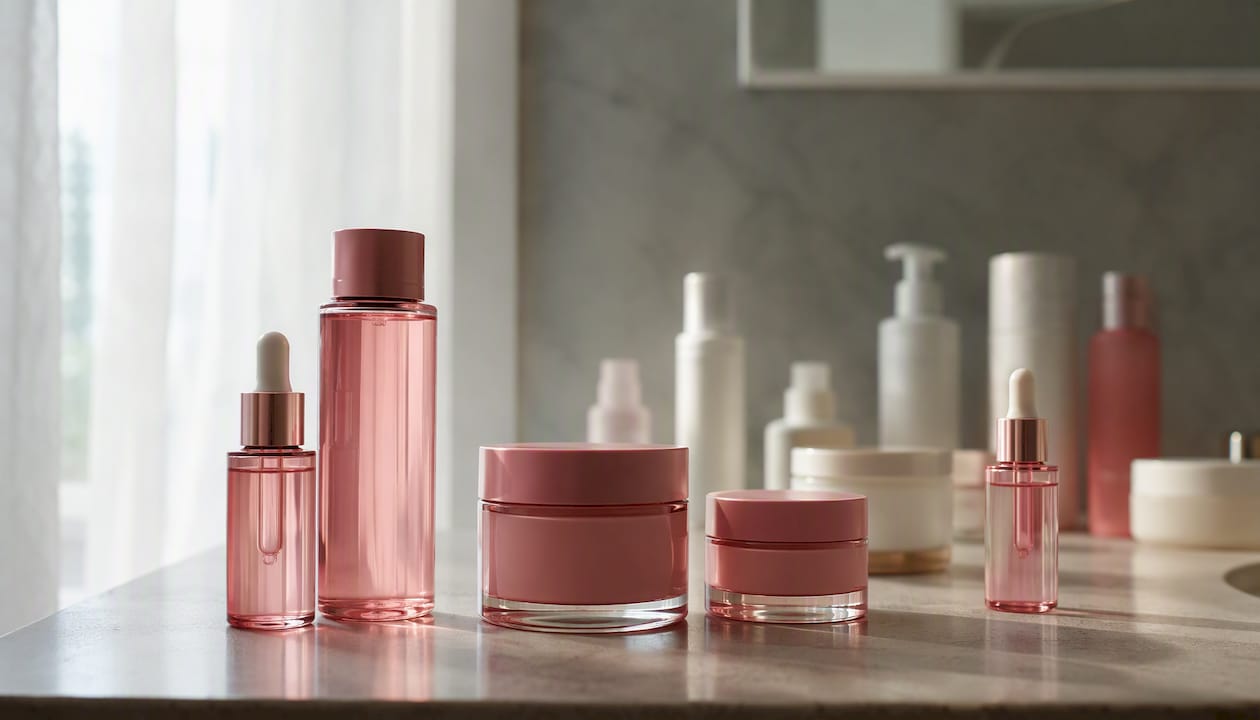
Medicine cabinet: Top shelf = daily AM (SPF, vitamin C if stable). Middle shelf = daily PM (cleanser, toner, moisturizer). Bottom shelf = weekly actives in labeled bins.
Small bathroom: Move everything except daily essentials off the counter. Use a compact caddy on the sink edge for the current week’s products and store the rest in a bedroom drawer. Kitchen organizers (small drawer inserts, stackable bins) work identically for beauty products and cost a fraction of dedicated acrylic sets.
Which apps help you track your rotation and expiry dates?
An inventory app with open-date tracking and expiry reminders removes the mental load of remembering which products are still good and which night you’re on. A simple spreadsheet works too, but apps with scanning features reveal unused products you’ve forgotten about.
| App | Key Features | Best For |
|---|---|---|
| HadaBuddy | Product scanning, personalized AM/PM routine builder from owned stock, weekly plans | Collectors who want a full routine built from what they already own |
| Beautistics | Product inventory, linked morning/evening routines, progress tracking, project-pan goals | Tracking use progress and finishing products before buying more |
| ShelfCheck | Photo-based product identification, expiry reminders, duplicate prevention | Busy collectors who want to catalog by photo without manual entry |
| Vani | Barcode/label scanning, PAO tracking, routine logging | Identifying which products are actually being used vs. sitting untouched |
DIY spreadsheet columns (if you prefer no app):
- Product name, brand, category
- Date opened
- PAO (months)
- Calculated expiry date (use a simple formula: open date + PAO months)
- Rotation slot (AM daily, PM active, PM recovery, weekly)
- Last used date
- Notes (reactions, texture changes)
Set a recurring phone calendar reminder every Sunday to check the spreadsheet. Five minutes once a week keeps the system current. For app users, connect expiry alerts to your phone’s native notification system so they surface alongside your regular reminders rather than getting buried in an app you open once a month.
How should you adapt your rotation by skin type and season?
Build your rotation from skin behavior, not ethnic labels. Skin behavior (oiliness, dryness, sensitivity, acne tendency, pigment response) is what determines which actives belong in which slot and how often to use them. Two people with identical backgrounds can have completely different rotation needs.
Scenario-based slot assignments:
Sensitive or reactive skin: Use the 4-2-4 template. Assign only one low-concentration active per cycle (lactic acid over glycolic, retinaldehyde over retinol). Skip the exfoliant slot entirely during the first two weeks and add it only after the recovery nights feel stable. Prioritize ceramide-heavy barrier creams every recovery night.
Acne-prone skin: BHA (salicylic acid) in the exfoliant slot is more useful than AHA for most acne-prone skin because it penetrates the pore lining. Alternate with a niacinamide serum on recovery nights rather than heavy creams. Avoid occlusive oils in the PM active slot.
Pigment-focused (melasma, post-inflammatory hyperpigmentation): Vitamin C in the AM daily slot every morning. Assign a retinoid to the PM active slot and a tranexamic acid or arbutin serum to one recovery night per cycle. SPF 30+ every morning without exception. For choosing Korean skincare that targets pigment specifically, Spyraverified’s guide covers ingredient-to-concern matching.
Seasonal adjustments:
- Winter: Swap gel moisturizers for cream or balm textures on recovery nights. Reduce chemical exfoliation from twice per cycle to once if skin feels tight or flaky. Add a hydrating essence layer before your serum.
- Summer: Return to lighter textures. Maintain or increase SPF vigilance. If you sweat heavily, a BHA in the exfoliant slot helps prevent congestion more than AHA.
- Transition months (March, October): Treat these as a reset period. Run two full recovery cycles before reintroducing any strong actives you paused.
What does a weekly reset and monthly audit look like?
A 15-minute weekly reset plus a monthly audit keeps the rotation from drifting back into chaos. Organization is a maintenance practice, not a one-time setup.
15-minute weekly reset (numbered checklist):
- Wipe down all surfaces and organizer trays with a damp cloth.
- Check the front-row products: are they the right ones for your current rotation week?
- Move any finished or nearly-finished products to the front so you use them up before opening backstock.
- Confirm which night of your template you’re on and update your tracker.
- Scan for any products that look or smell different from when you last used them.
- Restock one product at a time from backstock; never open a new product until the current one is finished or expired.
Monthly audit checklist:
- Check every product’s calculated expiry date against today’s date
- Smell and examine texture on anything within two months of expiry
- Move any heat-sensitive actives that have migrated back to the bathroom
- Log any skin reactions from the past month in your tracker and note which product was in the active slot when they occurred
- Reassess whether your current template still matches your skin’s behavior (seasonal shifts often show up here first)
Evidence-based safety tips for managing actives
Safety guidelines from dermatology and esthetician practice:
- Never layer two prescription-strength actives (tretinoin + a strong AHA) without professional guidance
- If you experience persistent redness, stinging beyond 10 minutes, or new breakouts after introducing an active, stop and run three full recovery nights before trying again at a lower concentration
- Avoid DIY high-concentration mixing (adding pure acids to existing products); the pH interactions are unpredictable
- If irritation is severe, persistent, or accompanied by swelling, consult a dermatologist rather than adjusting the rotation yourself
Spyraverified resources for safe rotation:
- The safe product testing guide covers patch-test steps and what to watch for over the first two weeks
- The Asian skincare certifications guide explains what product labels mean so you can verify concentration levels before assigning a product to an active slot
This article provides general skincare organization guidance. For persistent skin reactions, scarring, or medical skin conditions, consult a licensed dermatologist.
How to safely add new products to an existing rotation
The most common mistake when adding a new product is slotting it into an active night alongside an existing strong ingredient. That makes it impossible to know which product caused a reaction.
The right method is to introduce new products on recovery nights first. A recovery night has no actives competing for the same skin barrier, so any reaction is clearly tied to the new product. Run it for two full cycles (roughly one week in a 3-night template) before moving it to an active slot if that’s where it belongs.
A few practical rules:
- One new product per cycle. If you’re running a 3-night template, that means one new product every 1–2 weeks at most.
- Start with the lowest available concentration. A 0.025% retinol is a safer introduction than a 0.1% retinol, even if you’ve used retinoids before. Your skin’s current barrier state matters more than your history with the ingredient class.
- Log the introduction date. Without a date, you can’t accurately assess whether the 4-week tolerance window has passed.
- Don’t introduce two new products in the same week, even if one is “just a moisturizer.” New formulations can interact with existing actives in ways that aren’t obvious until the third or fourth use.
For identifying your skin type before deciding which new products to introduce, Spyraverified’s guide uses Asian skincare methods to assess behavior rather than relying on broad category labels.
The rotation advice most people get wrong
Most guides on skin cycling focus almost entirely on the schedule and almost nothing on the inventory side. The result is a beautifully structured 4-2-4 template applied to a shelf of 30 products, half of which are expired, duplicated, or stored in conditions that have already degraded the actives.
The schedule is the easy part. The hard part is knowing what you actually own, what’s still effective, and what belongs in which slot. A retinol that’s been sitting in a humid bathroom for 14 months may look fine but deliver almost nothing. A vitamin C serum that’s turned amber is an irritant, not an antioxidant.
The other thing most guides understate: the recovery nights are not filler. They’re where the actual skin repair happens. Collectors with large product libraries tend to treat recovery nights as an opportunity to test something new, which defeats the entire purpose of cycling. A recovery night with a ceramide moisturizer and nothing else is doing more work than a recovery night with four new products layered on top of each other.
Pick the simplest version of the system that you’ll actually maintain. A 3-night template tracked in a notes app beats a sophisticated spreadsheet you abandon after two weeks.
Spyraverified makes it easier to build a rotation-ready shelf
The hardest part of building a rotation isn’t the schedule. It’s sourcing actives you can trust, with clear ingredient lists and PAO labels that match what you’re tracking.
Spyraverified sources directly from Japanese and Asian manufacturers, so the products on its skincare collection are the same formulations sold in their home markets, not reformulated exports. That matters when you’re assigning a specific retinol concentration or AHA percentage to a rotation slot and need the label to be accurate. The blog also covers expiry, ingredient safety, and product testing in detail, so you can research a product before it goes into your rotation rather than after a reaction.
Browse the skincare collection, match products to your rotation slots using the templates in this article, and use HadaBuddy or Beautistics to log them the day they arrive.
Sources
- HadaBuddy
- Beautistics
- ShelfCheck
- Bathroom Beauty Organization Guide: Storage, Zones & Shelf Life (2026)
- Asian Skincare Routine: Complete Beginner Guide | knok
This article is general information, not a substitute for advice from a qualified doctor. Consult a qualified healthcare professional about your own circumstances before acting on anything here.
