


How to Test New Asian Skincare Products Safely
Patch testing is the standard clinical method for confirming whether a skincare product is safe for your skin before full use. When you test new Asian skincare products, you apply a small amount to a controlled area and observe your skin’s response over several days. Asian beauty formulations, from Korean actives like niacinamide and Centella asiatica to Japanese multi-form hyaluronic acid systems, are among the most evidence-backed in dermatology. That complexity makes structured testing non-negotiable. Skipping it risks reactions that a 30-second label scan will never predict.
How to test new Asian skincare products: what you need to know first
Asian beauty product testing is not just about avoiding rashes. It is about building a routine that actually works for your specific skin. Dermatologists confirm that Asian skincare routines emphasizing hydration and barrier support deliver effective results across a wide range of skin types. That finding matters because it shifts the goal from “does this product feel nice” to “does this product support my barrier without triggering a reaction.”
The industry term for this process is patch testing, sometimes called a controlled product trial. Both terms refer to the same protocol: apply, observe, and decide. Knowing the standard vocabulary helps you read dermatologist guidance and ingredient research with confidence. Throughout this article, both terms are used interchangeably.
One more thing to understand before you start: simplified routines of 3–5 products focused on photoprotection and barrier hydration are clinically validated. That means you do not need to test 12 products to build a great routine. You need to test the right ones, carefully.
What tools and preparations do you need before testing?
The right setup makes patch testing faster and more reliable. Gather these before you open a single new product:
- Clean cotton swabs or a small spatula for applying product without contaminating the jar
- Hypoallergenic medical tape to secure a small product sample if you are testing a leave-on formula under occlusion
- A clean, unbroken test site on your inner forearm or behind your ear
- Your current moisturizer and sunscreen for post-test skin care, since you should not disrupt your baseline routine during testing
- A simple log (a notes app works fine) to record the date, product name, and any observations each day
The difference between leave-on and rinse-off products changes how long you test. Leave-on products like serums, moisturizers, and eye creams require a longer observation window, typically 3–7 days of daily reapplication. Rinse-off products like cleansers and masks need only 24–48 hours because skin contact time is shorter.
Pro Tip: Never start testing a new product the day before an event or during a period of high stress. Stress hormones can increase skin sensitivity and muddy your results.
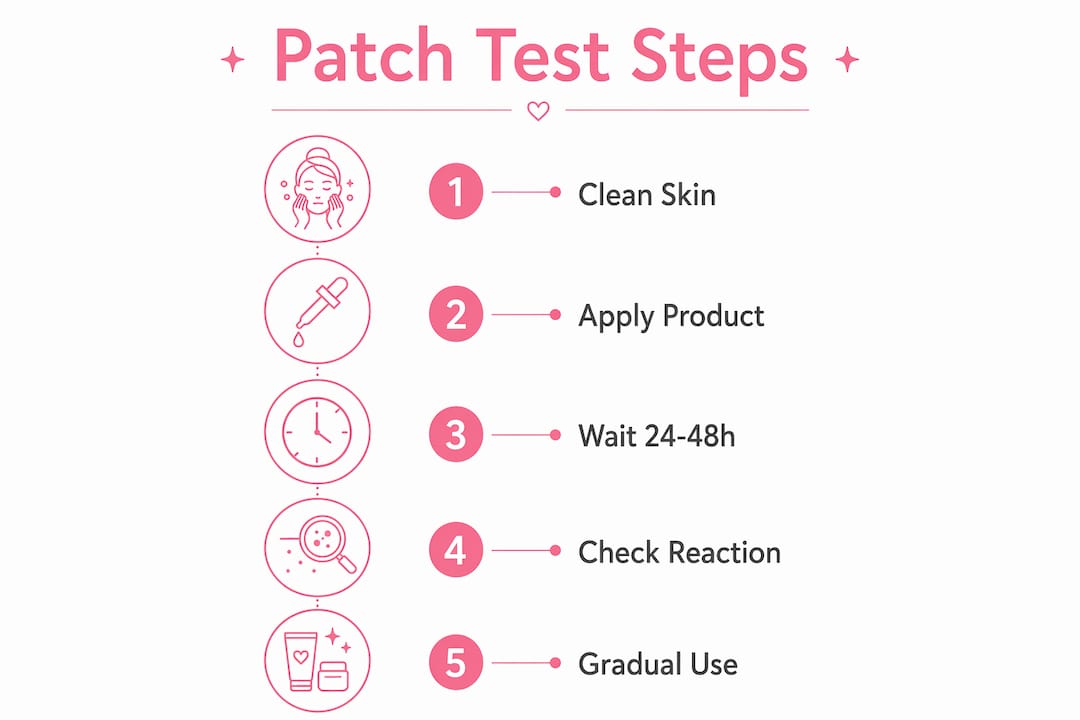
Clean skin is the baseline. Wash the test area with your regular cleanser and let it dry fully before applying anything new. Avoid introducing any other new products to your routine during the testing window. One variable at a time is the only way to get a clean read.
How to conduct a patch test for Asian skincare products
The patch test protocol is straightforward, but the details matter. Follow these steps exactly for reliable results.
- Wash your hands and the test site. Use your regular cleanser on the inner forearm or the skin behind one ear. Pat dry and wait five minutes.
- Apply a pea-sized amount of the product to the test area. Do not rub it in aggressively. A gentle press or light swipe is enough.
- Leave it undisturbed. For leave-on products, do not rinse. For rinse-off products, follow the product’s standard timing, then rinse as directed.
- Reapply once daily for 3–7 days. Repeated application over multiple days is the standard for detecting delayed reactions, which are common with actives like azelaic acid, PDRN, and NAD+.
- Check the site at 24 hours and 48 hours after the first application. Then check daily until the test period ends.
- Document what you see. Note any redness, swelling, itching, burning, or changes in texture. Photograph the site in consistent lighting if possible.
- Wait at least 24–48 hours between starting tests on different products. Testing one product at a time is the only way to identify which ingredient caused a reaction.
Patch testing remains essential despite brand claims. The only reliable way to identify a specific reaction is to restrict testing to one new product at a time with adequate observation intervals. No ingredient list, no matter how clean, eliminates this step.
Pro Tip: If you are testing a product with multiple hyaluronic acid forms, like Hada Labo’s Gokujyun Premium Lotion, which incorporates seven types of HA, give yourself the full 7-day window. Complex hydration systems can cause delayed congestion in some skin types.
The inner forearm is the preferred test site for most products. The skin behind the ear is more sensitive and better for testing products you plan to use near delicate facial areas. Patch testing on the face is discouraged because reactions near the eyes, nose, or mouth can be severe and highly visible.
How to evaluate your results and decide on usage
Reading your patch test results correctly is where most people go wrong. Not every sensation means rejection.
- Mild tingling in the first 60 seconds after applying an active like niacinamide or an AHA is normal. It fades quickly and does not indicate an allergy.
- Persistent burning, redness that lasts more than two hours, or raised skin signals irritation. Stop use and let the area recover before testing anything else.
- Itching, hives, or swelling indicate an allergic reaction. Discontinue immediately and consult a dermatologist if symptoms spread.
- No reaction after 7 days of daily application means the product is likely safe for broader use on your skin type.
Once a product passes the patch test, introduce it into your routine one step at a time. Apply it to a small area of your face for the first three days before going full-face. Monitor for two weeks before adding another new product. This approach lets you identify your skin type’s specific needs and build a routine that actually holds up.
Ingredients worth prioritizing in your tested lineup include niacinamide, Centella asiatica, and photoprotection. Clinical reviews validate these as evidence-backed actives that deliver visible improvement comparable to far more complex rituals. Asian sunscreens deserve special attention. Korean and East Asian sunscreen formulations outperform many American equivalents because their regulatory frameworks allow advanced UV filters not yet approved in the US market.
Most highly reviewed Asian skincare products are priced between $12 and $29, which means you can build a tested, effective routine without significant financial risk. Specialized single-ingredient products are growing in popularity precisely because they make patch testing simpler.
What common mistakes should you avoid during product trials?
Asian beauty product testing fails most often because of avoidable errors. Here is what to watch for:
- Testing multiple products at once. If you introduce a new serum and a new toner on the same day, you cannot know which one caused a breakout or reaction. Always test one product at a time.
- Patch testing on your face. The face is too sensitive and too visible for initial trials. Use the inner forearm or behind the ear every time.
- Trusting “natural” or “clean” labels. Botanical extracts and essential oils are among the most common causes of allergic skin reactions. A product being plant-derived does not make it low-risk.
- Skipping the observation period. Delayed reactions can appear on day four or five. Cutting the test short at 24 hours misses these entirely.
- Buying from unverified sources. Counterfeit Asian skincare products are a real problem in global markets. Sourcing from a verified retailer protects you from formulations that do not match the label.
Pro Tip: Before purchasing any new Asian skincare product, check the ingredient list against a reliable database like INCI Decoder or CosDNA. Knowing your known irritants before you test saves time and skin.
Building a simplified Japanese or Korean skincare routine of 3–5 tested products outperforms a complex 10-step layering system for most people. Complexity increases the number of potential irritants and makes it harder to identify what is working.
Key Takeaways
Structured patch testing is the single most reliable method for safely integrating new Asian skincare products into your routine without adverse reactions.
| Point | Details |
|---|---|
| Patch test every new product | Apply a pea-sized amount to your inner forearm and observe for 3–7 days before full use. |
| Test one product at a time | Waiting 24–48 hours between new trials is the only way to isolate reactions accurately. |
| Prioritize evidence-backed ingredients | Niacinamide, Centella asiatica, and advanced UV filters deliver clinically validated results. |
| Avoid face patch testing | Use the inner forearm or behind the ear to prevent visible and severe reactions. |
| Source from verified retailers | Authentic formulations from trusted sources match their labels and reduce unknown risks. |
What I have learned from years of testing Asian skincare
The most counterintuitive thing I have found about testing Asian skincare is that the products most likely to cause a reaction are not the ones with the longest ingredient lists. They are the ones marketed as the most natural. I have seen beautifully packaged botanical serums trigger contact dermatitis in people who had used synthetic actives for years without a single issue. The “clean beauty” label is not a safety guarantee. It is a marketing category.
What actually works is boring and methodical. One product. One week. One test site. I know that sounds slow when you are excited about a new haul from a Japanese brand, but the alternative is a compromised skin barrier and weeks of recovery. I have been there, and it is not worth it.
The other thing I would push back on is the idea that more steps equal better results. The best Korean skincare routines I have seen in practice are not 10-step systems. They are four or five products, each with a clear job, each tested individually before joining the lineup. Niacinamide for tone, Centella asiatica for barrier support, a well-formulated Asian sunscreen for protection. That is a complete routine. The innovation happening in Asian skincare right now, particularly around PDRN and NAD+, is genuinely exciting. But even the most exciting ingredient needs a patch test first.
— Anni
Spyraverified’s curated Asian skincare collection
Knowing how to test is only half the equation. You also need products worth testing.
Spyraverified sources directly from Japanese and Asian brand owners to bring you authentic formulations that match their labels exactly. Every product in the Spyraverified skincare collection is vetted for quality before it reaches you, which removes one of the biggest risks in Asian beauty product testing: counterfeit or mislabeled formulas. Whether you are building your first simplified routine or adding a targeted active, the catalog covers the evidence-backed categories that dermatologists actually recommend. Start with one product, patch test it properly, and build from there.
FAQ
What is patch testing in skincare?
Patch testing is a method of applying a small amount of a product to a controlled skin area and observing for reactions over 24–48 hours to 7 days. It is the standard protocol for confirming product safety before full facial use.
How long should I patch test an Asian skincare product?
Leave-on products like serums and moisturizers require 3–7 days of daily reapplication to detect delayed reactions. Rinse-off products like cleansers need only 24–48 hours of observation.
Can I patch test multiple products at the same time?
No. Testing one product at a time with at least a 24–48 hour gap between new trials is the only reliable way to identify which product or ingredient caused a reaction.
Are natural or botanical Asian skincare ingredients safer?
Not necessarily. Botanical extracts and essential oils are common causes of allergic skin reactions, regardless of how they are marketed. Every new ingredient requires a patch test, natural or synthetic.
Why are Asian sunscreens recommended over American ones?
Asian regulatory frameworks, particularly in Korea and Japan, allow advanced UV filter technologies not yet approved in the US market. This gives Korean and East Asian sunscreens superior UVA protection for most skin types.
