

Shop Japanese Scalp Serums Safely in the U.S.: 4 Types and Label Cues
If your scalp runs dry, sensitive, or reactive, start with a barrier-focused scalp-skincare essence and give it 8 to 12 weeks before judging results. If itch or oiliness is the main complaint, a medicated tonic will calm things faster, though it won’t rebuild density on its own. Patch test either one on your inner arm first, then use the sections below to match your scalp to the right category.
TL;DR:
- The most effective serum category depends on your scalp condition, with medicated tonics for oiliness, scalp-skincare essences for dryness, and quasi-drug formulas for persistent thinning.
- Consistent use for at least 8 to 12 weeks is necessary to evaluate results, with thicker growth formulas requiring up to 16 weeks for visible changes.
- Avoid stacking products with overlapping actives to minimize irritation and maximize effectiveness, and always give your scalp time to respond before escalating potency.
- Authentic Japanese serums are identified by clear ingredient lists, the quasi-drug label, genuine packaging, and matching manufacturing codes, not by price discounts from unverified sources.
- Lifestyle factors such as diet, water quality, and stress levels significantly influence scalp treatment results, so proper habits complement the use of serums for best outcomes.
Table of Contents
- What Are the Main Types of Japanese Scalp Serums?
- How Do the Four Serum Types Compare?
- Which Serum Type Fits Your Scalp?
- How Do You Apply a Scalp Serum Correctly?
- What Ingredients Should You Actually Look For?
- Quasi-Drug vs. Cosmetic: Why the Label Matters
- When Will You See Results, and What Should You Watch For?
- Why Trust This Guide on Japanese Scalp Care?
- How Can You Tell an Authentic Japanese Serum From a Counterfeit?
- What Are Some Well-Regarded Japanese Scalp Care Formulations?
- What Lifestyle Factors Affect How Well a Serum Works?
- How Should You Store Japanese Scalp Serums?
- The One Habit That Actually Determines Results
- Where to Find Authentic Japanese Scalp Serums
- Sources
- FAQ
What Are the Main Types of Japanese Scalp Serums?
Japanese hair care splits into four distinct formula categories, and mixing them up is the single biggest reason shoppers end up disappointed. Retailers and ingredient guides consistently divide scalp treatments into four types, each built for a different job. Confusing a cooling tonic with a follicle-targeting serum is like buying mouthwash and expecting it to fix a cavity. Both live in the same aisle, but they solve different problems.
- Medicated tonic: A thin, alcohol-based liquid designed for immediate scalp comfort. It typically leans on menthol and botanical extracts for a cooling, tingling sensation, and it cleans and refreshes rather than rebuilding hair density. You’ll recognize it by its watery pour and sharp, minty scent, closer to a toner than a treatment.
- Growth or circulation serum: A slightly thicker liquid or gel-serum hybrid aimed at stimulating blood flow to the follicle. These often contain ginseng, capsicum, or vitamin derivatives, and the sensory cue is a warming or mild tingling feeling rather than a cooling one.
- Medicated or quasi-drug essence: This is the most clinically framed category, formulated around actives like adenosine that carry government-recognized growth-support claims. Texture tends to be a bit more viscous, and packaging usually flags the formula prominently as medicated.
- Scalp-skincare essence: A leave-in, daily-use formula that pairs barrier ingredients like ceramides and amino acids with growth-supporting complexes. It feels closer to a face serum: lightweight, slightly silky, and meant for gentle daily layering rather than occasional spot treatment.
The scalp-as-skin philosophy behind that last category has been gaining traction across Japanese hair care, treating the scalp less like a patch of skin you tolerate and more like a surface you actively maintain, the same way you’d treat your face. If you’re curious how that logic plays out in a full routine, the Japanese scalp tonic breakdown walks through how tonics and treatment serums typically get combined.
How Do the Four Serum Types Compare?
Here’s the quick version, side by side, so you’re not guessing at trade-offs on the shelf.
A few things matter more than the price tag. Potency and tolerability move in opposite directions: the quasi-drug essence is the most likely to produce a measurable change in hair count, but it’s also the most likely to irritate a sensitive scalp if you jump in at full strength. Layering is fine in most routines. Applying a medicated quasi-drug essence underneath a cosmetic scalp-skincare essence is a common pairing, since the essence’s ceramides can offset some of the dryness the active ingredient causes.
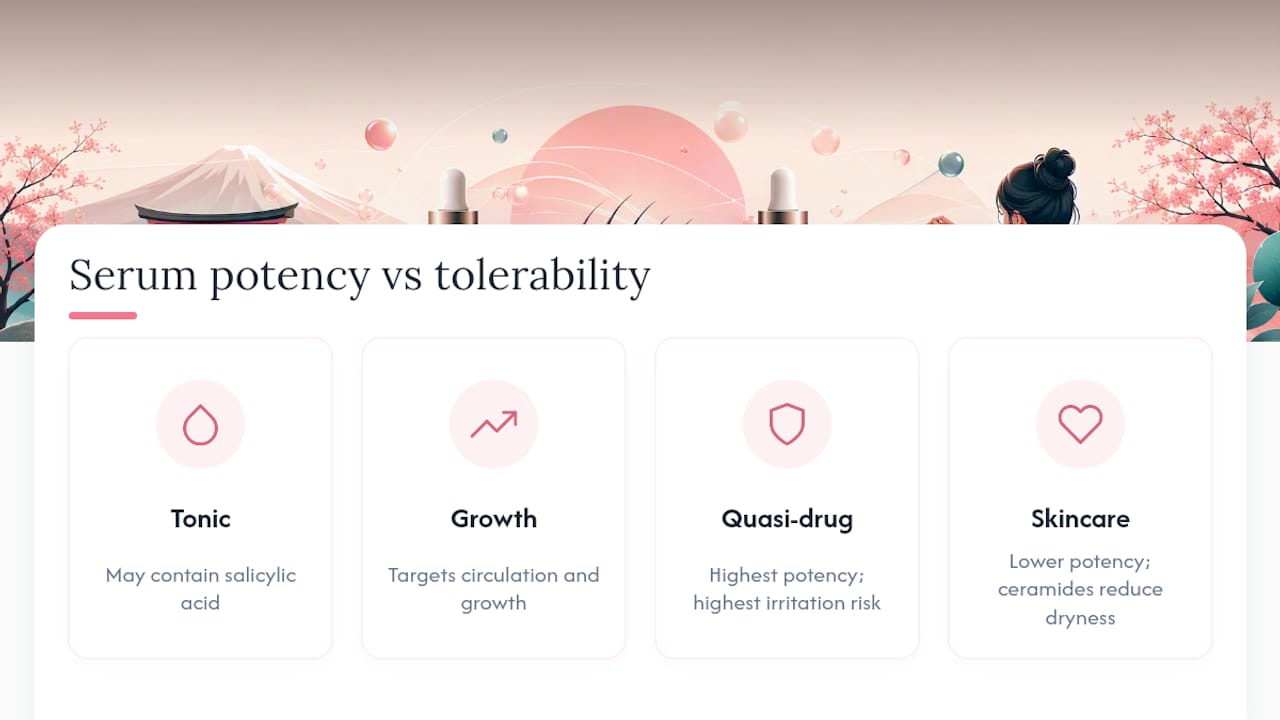
What you shouldn’t do is stack two medicated products with overlapping actives, like a salicylic-acid tonic under an adenosine essence, since that doubles your irritation risk without doubling your results. Start with the gentlest formula that addresses your main complaint, and only add potency when you have a specific, persistent concern the gentle option isn’t solving.
Which Serum Type Fits Your Scalp?
Run through this in under a minute before you buy anything.
- Identify your scalp’s dominant condition. Is it oily and itchy, dry and reactive, or otherwise calm but visibly thinning?
- Match condition to category. Oily or itchy scalps do best starting with a medicated tonic. Dry or sensitive scalps should start with a scalp-skincare essence. Visible thinning with no irritation points toward a growth serum or medicated quasi-drug essence.
- Check your shedding pattern. Seasonal or stress-related shedding that resolves on its own doesn’t need a medicated essence. Thinning that’s been steady for months, especially along the part line, is the case where the quasi-drug category earns its higher price and higher potency.
- Set a trial window and stick to it. Give any new product 8 to 12 weeks minimum before switching. Quitting after two weeks tells you nothing.
- Escalate only if needed. If your target concern (itch, oiliness, visible thinning) hasn’t improved after the trial window, move up one category rather than jumping straight to the strongest option.
Pro Tip: Keep a one-month buffer between trying a new medicated essence and starting any other active scalp treatment, including strong exfoliating shampoos. Overlapping actives make it nearly impossible to tell which ingredient is causing an improvement or an irritation.
See a dermatologist if you notice scarring, patchy bald spots, sudden clumps of shedding, or scalp pain. Those are signs of a condition a serum alone won’t fix, and self-treating for months before getting checked can delay real diagnosis and treatment.
How Do You Apply a Scalp Serum Correctly?
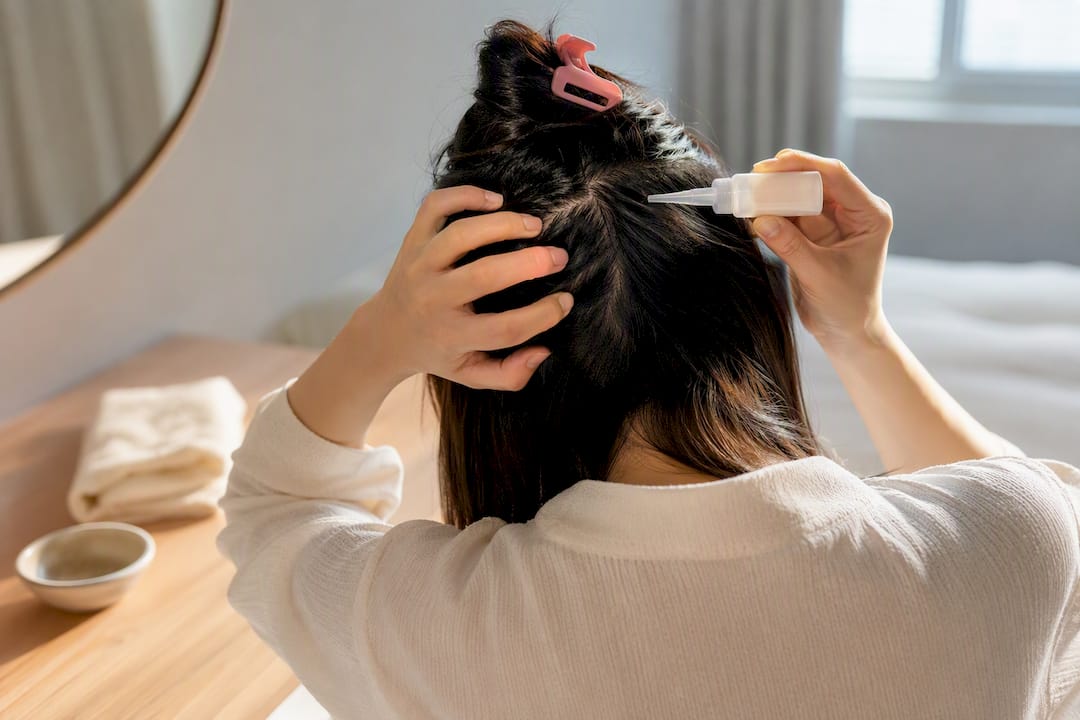
Application technique matters almost as much as the formula itself. Apply to a clean, dry or towel-dried scalp, never over a full head of styling product, since buildup blocks absorption before the serum ever reaches the follicle.
- Part your hair into small sections, about one inch wide, working across the whole scalp rather than just the crown.
- Dispense a few drops or a light pump directly onto the scalp at each part, not onto the hair strands themselves.
- Use your fingertips, not fingernails, to massage each section for roughly 1 to 2 minutes in small circular motions. This helps distribute the product and supports circulation.
- Move methodically from the front hairline back to the crown, then down toward the nape, so no section gets skipped or double-dosed.
- Most tonics and essences are designed for once or twice daily use; medicated quasi-drug essences often call for once or twice daily as well, but always check the label since dosing varies by brand.
Pair your serum with a clarifying shampoo once or twice a week to prevent product buildup, and use a lightweight conditioner on the strands rather than the scalp so you’re not undoing the absorption work. Avoid applying a new active serum on the same day you use a strong exfoliating scalp scrub. Combining two aggressive steps in one session is a common way people accidentally irritate a scalp that was otherwise adjusting just fine.
Pro Tip: If you use both a morning tonic and an evening essence, apply the thinner, more watery product first and let it fully absorb (roughly ten minutes) before layering the thicker essence on top.
For a broader look at sequencing scalp steps with the rest of a hair routine, this scalp care routine breakdown covers the order of operations in more detail.
What Ingredients Should You Actually Look For?
Reading a Japanese ingredient list gets a lot easier once you know what each active is actually doing.
- Menthol: Produces the cooling, tingling sensation common in tonics. It doesn’t rebuild density. That tingle is sensory feedback, not proof the product is working on your follicles.
- Salicylic acid: A mild exfoliant that helps clear built-up sebum and dead skin from the scalp surface, often paired with follicle-targeted actives in medicated tonics with menthol and herbal extracts to improve overall scalp comfort.
- Adenosine: One of the more research-backed actives in quasi-drug essences, associated with supporting follicle activity over sustained use.
- T-flavanone: A plant-derived compound frequently listed alongside adenosine in medicated hair tonics targeting follicle-focused and exfoliating actions.
- Redensyl-like peptide complexes: Newer additions in growth serums, intended to support the hair growth cycle at the follicle level.
- Ceramides and amino acids: The backbone of scalp-skincare essences, working to reinforce the scalp’s moisture barrier rather than target the follicle directly.
- Ethanol and other solvents: Common in tonics to help actives penetrate quickly, but also the main reason tonics can feel drying with overuse on already-sensitive scalps.
Adenosine, T-flavanone, and salicylic acid tend to show up specifically in quasi-drug formulas, while ceramides and amino acids dominate cosmetic-classified essences. That split isn’t arbitrary. Japan’s quasi-drug system reserves certain actives for products that have to prove a therapeutic effect, which is part of why those formulas carry stronger claims and, often, a higher chance of mild irritation during the first few weeks.
If you have a history of scalp sensitivity, patch test any new active on the inside of your forearm for 48 hours before applying it to your scalp, and introduce one new product at a time so you can trace the source of any reaction.
Quasi-Drug vs. Cosmetic: Why the Label Matters
The single most useful label cue in Japanese hair care is the 医薬部外品 mark, a small rectangular box printed on packaging that signals quasi-drug status. This designation allows a product to make medicated claims around preventing hair loss or promoting growth, claims a standard cosmetic is not permitted to make on its packaging.
Here’s what to look for when you’re comparing two similar-looking bottles:
- Check for the phrase “医薬部外品” or its English equivalent, “medicated,” printed near the ingredient list or brand name.
- Look at how the ingredient order is presented. Quasi-drugs often flag their active ingredient separately from the rest of the formula.
- Treat the 30 second label check recommended by Japanese retail guides as a habit: confirm quasi-drug status before assuming a product can legally claim to regrow hair.
The quasi-drug mark is a genuinely useful trust signal, but it’s not a personal guarantee. Regulatory approval means a formula met a bar for demonstrated effect in testing, not that it will work identically for your scalp, your genetics, and your specific pattern of thinning.
When Will You See Results, and What Should You Watch For?
Patience is the part most people skip, and it’s the part that determines whether you judge a product fairly.
- Cosmetic maintenance formulas (scalp-skincare essences, most tonics): expect to evaluate results over 8 to 12 weeks of consistent use.
- Quasi-drug actives: plan on a longer runway, commonly 12 to 16 weeks or more, since measurable hair-count changes take longer to show up than surface comfort does.
- Track progress with consistent photos taken under the same lighting, plus a rough part-width measurement every few weeks. Shedding counts on your brush or shower drain are useful too, but only as a trend over weeks, not a single day’s snapshot.
- Stop immediately if you notice severe redness, burning, or breakout-like bumps. Mild tingling from a tonic is normal; persistent pain is not.
- Rotate responsibly. If you’re layering a medicated essence with a cosmetic one, give your scalp a few product-free days per week to reset, especially if you’re new to active ingredients.
Judging a serum after ten days is the most common reason people abandon a product that would have worked if they’d stuck with it.
Why Trust This Guide on Japanese Scalp Care?
Spyra Verified works directly with Japanese and Asian beauty manufacturers rather than sourcing through unverified resellers, which is how it confirms products match their original formulation and labeling before they reach a U.S. shopper’s cart. That direct-partner model also means localized support on packaging and ingredient transparency, which matters more in scalp care than almost any other beauty category, since a mislabeled active can mean an unexpected irritation.
This guide draws on Anni’s focus on Japanese and Korean scalp and hair care, which shapes the practical, category-first approach used throughout, prioritizing what a formula actually does over what its marketing implies.
Before you buy from any cross-border retailer, run through this short checklist:
- Confirm the full ingredient list is listed in English or clearly translated, not just the front-of-bottle marketing copy.
- Check whether the product carries a quasi-drug or “medicated” claim, and make sure that claim matches what the retailer’s description promises.
- Verify the package language and batch details match what a legitimate Japanese retailer would show, not a generic stock photo.
How Can You Tell an Authentic Japanese Serum From a Counterfeit?
Counterfeit scalp serums tend to give themselves away through small inconsistencies, not obvious red flags. Start with the packaging text itself: authentic Japanese products typically show precise, professionally translated ingredient lists, often with the original Japanese text still visible alongside an English or Spanish overlay sticker. A counterfeit frequently has garbled translation, missing manufacturer details, or an ingredient list that’s suspiciously short compared to the brand’s official listing.
Check the batch code and manufacturing details against the brand’s own website when possible. Legitimate Japanese cosmetics and quasi-drugs carry a traceable lot number, while counterfeits often omit this or print a code that doesn’t match any real format. Pricing is another tell. If a serum that normally retails for $35 to $50 is listed at a fraction of that price with “free shipping from overseas,” treat it as a warning sign rather than a bargain.
Texture and scent consistency matter too. If you’ve used a formula before and a new bottle smells noticeably different or has a thinner or thicker texture than you remember, stop using it and contact the seller. Buying through retailers who source directly from manufacturers, rather than third-party marketplace listings with no verifiable seller history, remains one of the more reliable ways to avoid this problem entirely. A direct-partnership sourcing model exists specifically to close that gap for U.S. shoppers who don’t have easy access to verify a Japanese brand’s authenticity on their own.
What Are Some Well-Regarded Japanese Scalp Care Formulations?
Rather than chasing a single “best” bottle, it helps to know what a well-built version of each category actually looks like, since that’s what you should compare any product against.
A strong medicated tonic delivers a clean, immediate cooling sensation without an overpowering fragrance, and lists menthol alongside a recognizable botanical extract like ginger or citrus rather than a long list of synthetic fragrance compounds. A well-formulated growth or circulation serum should feel lightweight enough to use daily, with a clear vitamin derivative or ginseng extract high in the ingredient list, not buried near the bottom.
The best medicated quasi-drug essences clearly display the 医薬部外品 mark, list adenosine or a comparable recognized active near the top of the ingredient panel, and come with clear usage instructions for frequency and amount. Scalp-skincare essences worth considering tend to lead with ceramides or amino acids and pair them with a humectant like hyaluronic acid, keeping the formula gentle enough for daily use without a strong medicinal scent.
Across all four categories, the common thread in genuinely well-made Japanese formulations is restraint: a short, purposeful ingredient list built around one or two proven actives rather than a crowded label trying to claim everything at once.
What Lifestyle Factors Affect How Well a Serum Works?
A serum is one input in a system, and ignoring the rest of that system is the fastest way to feel like your product “isn’t working” when the real issue is somewhere else.
Diet plays a bigger role than most people expect. Chronic low iron or protein intake shows up in hair thinning regardless of what you apply topically, so a serum layered on top of a nutrient deficiency will underperform no matter how good the formula is. Stress operates similarly. High cortisol over extended periods is a well-documented driver of shedding, and no scalp essence can fully offset months of poor sleep or chronic stress.
Water quality and washing habits matter more in scalp care than in most beauty categories. Hard water and hot showers strip natural oils faster, which can undercut a barrier-focused scalp-skincare essence before it has a chance to work. Switching to lukewarm water for the final rinse is a small change with a real payoff.
Sun exposure and humidity also shift how a product performs. A rich, occlusive essence that feels great in a dry winter climate can feel heavy and pore-clogging in a humid summer, which is one reason some people rotate between a lighter tonic in summer and a more emollient essence in winter. Treating your serum as part of a broader routine, alongside sleep, diet, and gentle washing habits, is what actually determines whether 12 weeks of consistent use pays off.
How Should You Store Japanese Scalp Serums?
Most Japanese scalp serums are formulated without heavy synthetic preservatives, which makes them more sensitive to heat, light, and air exposure than a typical drugstore hair product. Store bottles in a cool, dry spot away from direct sunlight. A bathroom cabinet works better than an open shower shelf, where humidity and temperature swings degrade actives like adenosine faster than the label’s shelf-life estimate assumes.
Keep the cap tightly closed between uses, especially for dropper or pump bottles, since repeated air exposure oxidizes certain botanical extracts and can shorten the product’s effective life well before its printed expiration date. Once opened, most tonics and essences are best used within 6 to 12 months, though the exact window varies by brand and should be checked on the box, since some medicated essences list a shorter open-jar period than cosmetic formulas do.
Watch for changes in scent, color, or texture as your practical expiration signal. A tonic that suddenly smells sharper or more alcohol-forward than usual, or an essence that’s separated or turned cloudy, has likely degraded past the point of reliable use, regardless of what the printed date says. When in doubt, replace rather than risk applying an oxidized active to a scalp you’re trying to treat gently.
The One Habit That Actually Determines Results
If there’s one thing worth taking from this guide, it’s that consistency beats potency almost every time. A scalp-skincare essence used every day for 12 weeks will usually outperform a stronger quasi-drug essence used sporadically for two. Start gentle, especially if your scalp is dry or reactive, and reserve the medicated quasi-drug category for concerns that have genuinely persisted past a full trial window.
The temptation is always to reach for the strongest-sounding product first. Resist it. Give your scalp the time a formula actually needs to work, track your progress honestly, and don’t confuse a tingling sensation with proof of results.
— Anni
Where to Find Authentic Japanese Scalp Serums
Spyra Verified’s hair care collection is built around direct partnerships with Japanese manufacturers, so you’re browsing formulas sourced the way the brand intended, not a marketplace guess.
Whichever type you land on, medicated tonic, growth serum, quasi-drug essence, or scalp-skincare essence, a few habits protect you on any storefront, not just this one. Confirm the packaging shows a complete, legible ingredient list rather than a partial front-label summary. Check for the quasi-drug or “medicated” marking if the listing claims growth or thinning-prevention benefits, and make sure that claim is backed by the actual label, not just the product description. And compare pricing against what the brand charges directly. A steep discount on an imported Japanese serum is usually a sign to look closer, not to buy faster.
If you’re building out a fuller barrier-first routine alongside your scalp serum, the skincare collection carries complementary formulas worth browsing while you’re there.
Sources
For readers who want to dig into label conventions and ingredient specifics directly, the Kiwabi guide to Japanese hair growth serum types and its companion piece on quasi-drug versus cosmetic classification cover the regulatory and formula distinctions in more depth. Earth Corporation’s product page for its medicated tonic is a useful real-world example of how active ingredients get listed on packaging.
- Japanese Hair Growth Serum Types Explained | Kiwabi
- Incent Medicated Hair Growth Tonic Unscented 190 g | Earth Corporation
FAQ
What Is a Good Japanese Hair Regrowth Serum to Start With?
For most people with no severe scalp issues, a scalp-skincare essence with ceramides and amino acids is the gentlest starting point. If thinning has persisted for months, a medicated quasi-drug essence with adenosine is the category built for that concern specifically.
How Do You Choose the Right Scalp Serum?
Match the formula to your dominant scalp condition: medicated tonics for itch or oiliness, scalp-skincare essences for dryness or sensitivity, and growth or quasi-drug essences for visible, persistent thinning. Give any choice 8 to 12 weeks before switching.
What Are Some Good Scalp Care Products From Japan?
Look for products that clearly state their category (tonic, growth serum, quasi-drug essence, or scalp-skincare essence) and list a recognizable active like adenosine, T-flavanone, or ceramides near the top of the ingredient panel. Retailers like Spyra Verified curate these directly from Japanese manufacturers to confirm authenticity.
Is Japanese Scalp Treatment Good for Hair Growth?
Quasi-drug essences with actives like adenosine carry government-recognized growth-support claims and are formulated specifically for that purpose, though results typically take 12 to 16 weeks of consistent use to become measurable. Cosmetic-classified tonics and essences support scalp health and comfort but aren’t designed to make the same regrowth claims.
How Long Does It Take to See Results From a Scalp Serum?
Cosmetic maintenance formulas need about 8 to 12 weeks of daily use to judge fairly, while quasi-drug actives often need 12 to 16 weeks. Judging any serum sooner than that usually leads to abandoning a product that would have worked with more patience.
