


Emulsion vs Lotion: Which One Does Your Skin Need?
An emulsion is a stable blend of oil and water held together by emulsifiers; a lotion is a low-viscosity version of that same structure, designed for quick, fluid application. If your skin runs oily or combination, a lightweight oil-in-water (O/W) emulsion is your best daily bet. If your skin leans dry or sensitive, a richer lotion or cream will hold moisture longer.
Quick picks by situation:
- Oily or acne-prone skin: lightweight O/W emulsion, morning and night
- Dry or mature skin: a richer lotion with emollients, or step up to a cream
- Japanese routine (any skin type): apply a hydrating lotion first, then layer an emulsion over it
- Hot, humid climate: emulsion only; skip the lotion layer to avoid heaviness
Pro Tip: When shopping for Japanese or Asian skincare on Spyraverified, filter by “emulsion” or “milk” to find O/W formulas that absorb fast and work under SPF without pilling.
Table of Contents
- What does “lotion” actually mean in skincare?
- What is an emulsion in cosmetics?
- How do emulsion and lotion compare side by side?
- Which one should you use for your skin type?
- How to layer lotion and emulsion in your routine
- What’s actually in these formulas?
- Common misconceptions and when emulsions fall short
- Key Takeaways
- The part most skincare guides skip
- Authentic Japanese emulsions and lotions, ready to shop
- Useful sources for further reading
What does “lotion” actually mean in skincare?
The word “lotion” means different things depending on which beauty tradition you’re working from, and that gap causes real confusion.
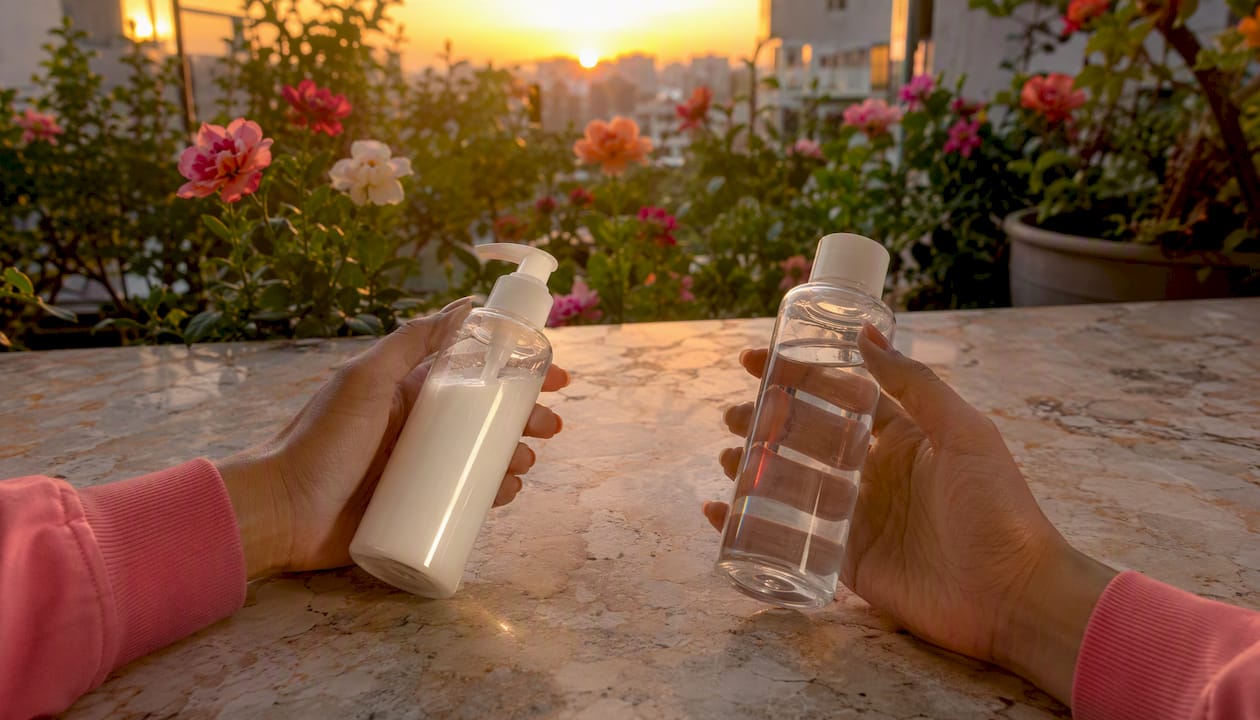
In Western dermatology, a lotion is a low-viscosity topical preparation designed for quick coverage over larger skin areas. Most commercial body and face lotions are oil-in-water emulsions stabilized by ingredients like cetearyl alcohol. They’re thinner than creams, spread easily, and absorb without much residue.
In Japanese beauty, “lotion” (化粧水, keshousu) means something closer to a toner: a watery, hydrating liquid applied right after cleansing to prep skin for the steps that follow. It’s not a moisturizer in the Western sense. This distinction trips up a lot of people who are new to J-Beauty, because a Japanese lotion and an American lotion are genuinely different products.
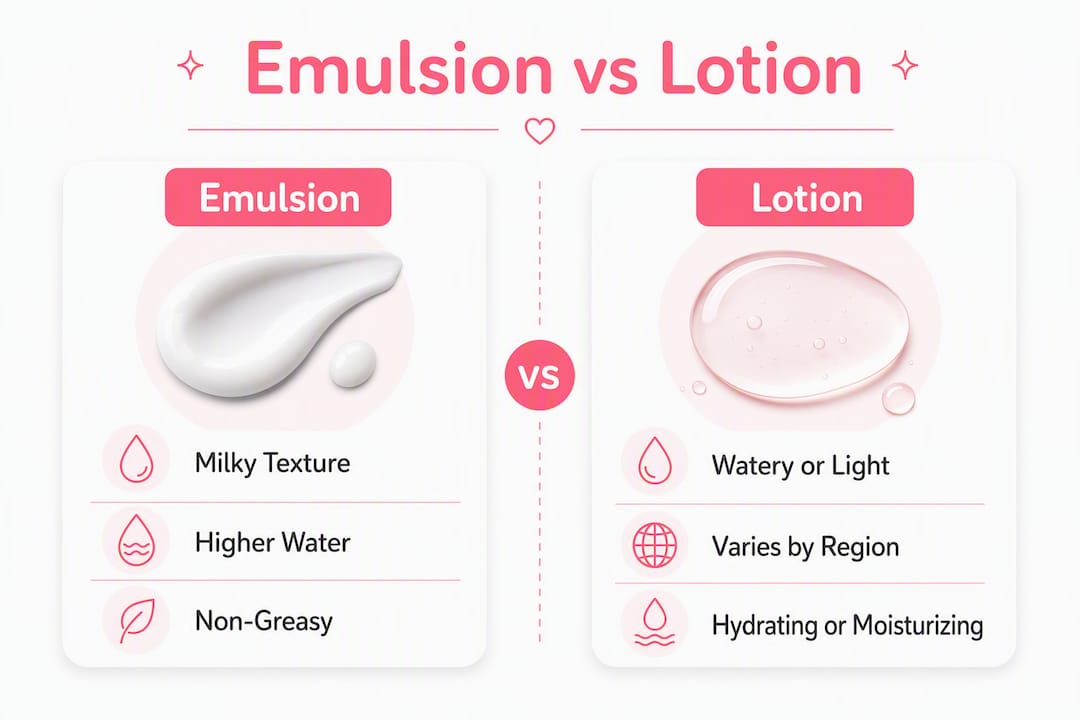
Typical Western lotion actives include humectants like glycerin and sodium hyaluronate, plus light emollients such as dimethicone or isopropyl myristate. The formula stays fluid because the oil phase is kept low relative to water. In a standard routine, a Western lotion usually comes after cleansing and toning, before any serum or heavier moisturizer.
What is an emulsion in cosmetics?
Technically, an emulsion in skincare is a stable mixture of oil and water that would otherwise separate, held together by an emulsifier molecule. The emulsifier has one end that bonds to water and one that bonds to oil, keeping the whole system uniform.
The O/W vs. W/O distinction comes down to which phase surrounds the other:
- Oil-in-water (O/W): water is the continuous phase; oil droplets are dispersed through it. Feels light, absorbs fast, leaves little residue. Most face milks and daily moisturizers use this structure.
- Water-in-oil (W/O): oil is the continuous phase; water droplets sit inside it. Feels richer, more occlusive, and slower to absorb. Better for very dry or compromised skin barriers.
- Marketing note: products labeled “milk,” “fluid,” “essence,” or “light moisturizer” are often O/W emulsions by chemistry, even when the word “emulsion” never appears on the label.
The sensory profile of a typical O/W emulsion is milky, slightly cool on application, and non-greasy. That fast absorption is why emulsions work so well under makeup or sunscreen. A W/O formula, by contrast, tends to feel more like a balm or rich cream and is better suited to nighttime use or very cold, dry climates.
How do emulsion and lotion compare side by side?
The core difference between a lotion and an emulsion is viscosity and oil content, but the practical impact shows up in how each one feels and performs on your skin.
| Dimension | Emulsion (O/W) | Lotion (Western) |
|---|---|---|
| Texture / viscosity | Milky, fluid to semi-fluid | Fluid, slightly thicker than water |
| Oil-to-water balance | Low oil, high water (>45% aqueous phase) | Low to moderate oil in water |
| Absorption speed | Fast; minimal residue | Fast to moderate; light residue possible |
| Occlusivity | Low to moderate | Low to moderate (varies by formula) |
| Best for skin types | Oily, combination, normal | Normal to dry, combination |
| Routine placement | After lotion/toner; before heavier cream | After cleansing/toning; before emulsion or cream |
| Key pros | Lightweight, layerable, makeup-friendly | Broad coverage, easy to apply, widely available |
| Key cons | May not occlude enough for very dry skin | Oil content varies widely; some feel heavy |
A few points worth unpacking from that table:
- The difference between lotion and emulsion is often more about marketing convention than chemistry. Both are emulsions by structure; “emulsion” as a product label usually signals a lighter, more intentional formulation.
- Occlusivity is where they diverge most meaningfully. Neither a lotion nor a standard O/W emulsion creates a strong barrier seal. If your skin loses moisture quickly, you’ll likely need a cream or an occlusive ingredient on top.
- In a Japanese layering routine, the “lotion” and “emulsion” steps are distinct products with distinct jobs: the lotion hydrates, the emulsion lightly seals.
Which one should you use for your skin type?
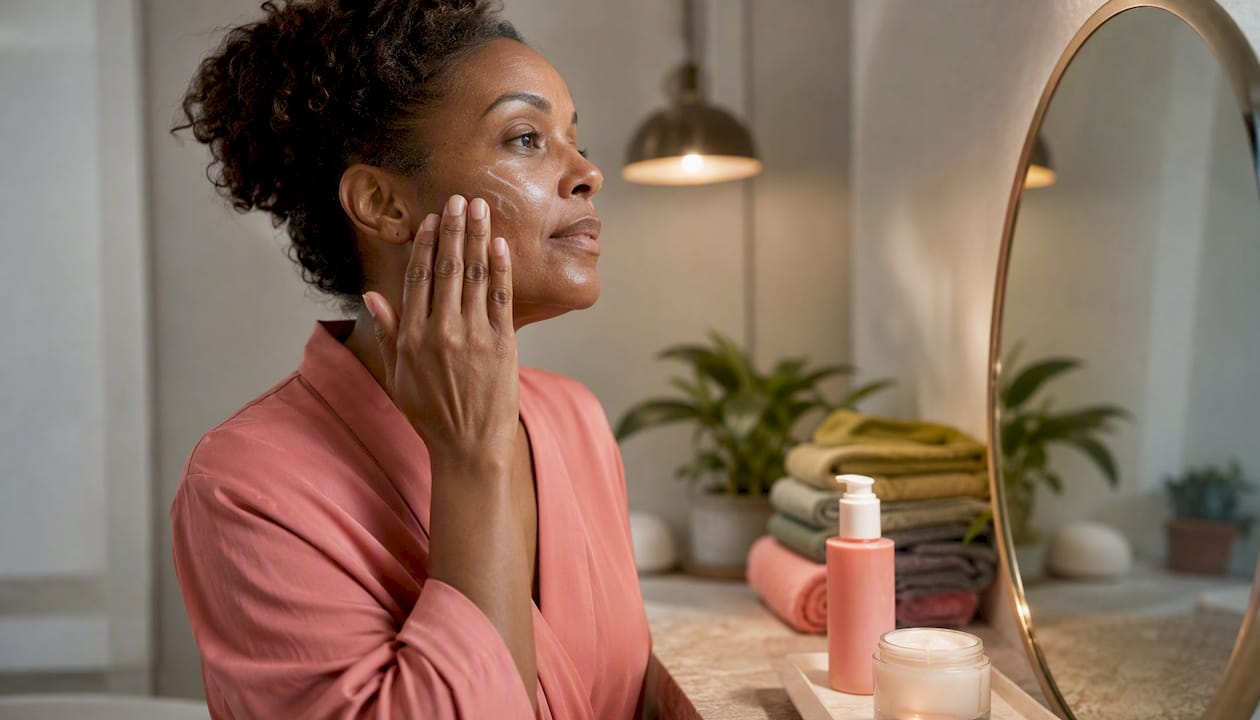
Skin type is the fastest way to narrow down the choice. Climate and season matter too, but start here.
| Skin type | Best texture | Why it works |
|---|---|---|
| Oily / acne-prone | Lightweight O/W emulsion | Low oil content won’t clog pores; absorbs before sebum builds |
| Combination | O/W emulsion or light lotion | Hydrates dry zones without overloading the T-zone |
| Normal | Either; personal preference | Both formats provide adequate hydration |
| Dry | Richer lotion or W/O emulsion | Higher oil content supports the moisture barrier |
| Very dry / mature | Cream or W/O emulsion | Needs stronger occlusion to prevent transepidermal water loss |
| Sensitive | Fragrance-free lotion or emulsion | Fewer potential irritants; patch test first |
Practical recommendations by concern:
- Acne-prone skin: stick to O/W emulsions labeled non-comedogenic. A skincare routine for acne-prone skin often works best when the moisturizing step is as light as possible.
- Mature skin: an emulsion alone usually won’t cut it overnight. Layer it under a richer cream, or switch to a W/O formula in colder months.
- Sensitive skin: fragrance and certain emulsifiers are the most common triggers. Choose minimal-ingredient formulas and avoid anything with added perfume.
- Hot, humid summers: drop the lotion layer and use only an emulsion. In cold, dry winters, add a lotion or cream on top of your emulsion to reinforce the barrier.
When to choose a cream instead: if your skin still feels tight or flaky after using a lotion or emulsion, the formula isn’t occlusive enough. A cream’s higher oil content creates a stronger seal and is the right call for severely dry or barrier-compromised skin.
How to layer lotion and emulsion in your routine
The rule is simple: thinner, more water-based products go first; heavier, more occlusive ones go last. That sequence lets each layer absorb properly without interference.
The Japanese approach makes this explicit. You apply a hydrating lotion (keshousu) to damp skin right after cleansing, press it in gently, then follow with an emulsion to lock that hydration in place. J-Beauty guides consistently recommend this sequence because the lotion saturates the skin with water-soluble actives, and the emulsion’s light oil phase slows evaporation without feeling heavy.
Practical application tips:
- Use about 3–5 drops of lotion or a small pump; press it into skin with your palms rather than rubbing, which reduces friction and improves absorption.
- Wait 20–30 seconds between layers. You don’t need to wait until skin is fully dry, but applying the next product immediately can dilute the previous one.
- For makeup days, finish with your emulsion and skip any additional cream. The lighter finish won’t interfere with foundation or SPF.
Pro Tip: If your emulsion is pilling under sunscreen, try patting instead of spreading, and give it a full 60 seconds to set before applying SPF. Pilling almost always comes from layering too fast, not from the products themselves. For more on avoiding layering mistakes, the Spyraverified blog has a dedicated guide.
What’s actually in these formulas?
Formulation is what determines how a product feels and performs, and the ingredient list tells you more than the label does.
The continuous phase and emulsifier type set everything else. When the aqueous phase makes up more than 45% of the total formula weight and the emulsifier is hydrophilic (water-loving), an O/W emulsion forms. Drop the water below that threshold and use a lipophilic emulsifier, and you get a W/O structure. That single ratio shift changes how the product feels, how fast it absorbs, and how much it occludes.
Key ingredient categories and what they do:
- Emulsifiers: cetearyl alcohol, polysorbate 20, lecithin. They hold oil and water together and affect texture and skin feel.
- Humectants: glycerin, sodium hyaluronate, panthenol. They draw water into the skin and are the primary hydration drivers in most O/W emulsions and light lotions.
- Emollients: caprylic/capric triglyceride, squalane, isopropyl myristate. They soften skin and fill gaps in the surface layer without heavy occlusion.
- Occlusives: shea butter, petrolatum, beeswax. They sit on top of skin and physically slow water loss. More common in creams and W/O emulsions than in light lotions.
Statistic to know: O/W emulsions generally form when the aqueous phase makes up the largest portion of the total formula weight, above the mid-range proportion indicated by formulation guidelines, according to Pharmlabs at UNC. Products with a water-heavy ingredient list (water listed first, followed by glycerin and humectants before any oils) are almost always O/W.
Reading an ingredient list as a shortcut: if the first five ingredients are water, glycerin, and light esters, you’re looking at an O/W emulsion regardless of what the label calls it. If oils or waxes appear in the top three, expect a richer, more occlusive feel.
Common misconceptions and when emulsions fall short
The biggest myth is that “emulsion” always means lighter than “lotion.” Not true. A W/O emulsion can be richer than many lotions. The label reflects regional naming conventions and marketing as much as actual texture.
The second misconception is that a lotion and an emulsion are chemically distinct categories. They’re not. Most commercial lotions are O/W emulsions by formulation; the word “lotion” just signals a thinner, more fluid consistency intended for broad coverage.
Where emulsions genuinely fall short: for severely dry or mature skin, a lightweight O/W emulsion won’t provide enough occlusion to prevent transepidermal water loss overnight. Those skin types need either a W/O emulsion or a cream with meaningful occlusive content. Expecting a face milk to do the job of a barrier cream is the most common mismatch between product and skin need.
On allergies and sensitivities: emulsifiers like cetearyl alcohol and polysorbate 80 occasionally cause contact reactions in sensitive individuals, as do fragrance compounds used to mask the smell of raw ingredients. If you’re introducing a new lotion or emulsion, patch test on your inner arm for 48 hours before applying it to your face. The American Academy of Dermatology recommends this for any new topical product, particularly for those with a history of eczema or contact dermatitis.
One more thing worth saying plainly: “fragrance-free” and “unscented” are not the same. Unscented products can contain masking fragrances that still trigger reactions. If sensitivity is a concern, look specifically for “fragrance-free” on the label.
Key Takeaways
Emulsions and lotions are both oil-in-water structures, but formulation ratios, oil content, and regional naming conventions determine which one actually fits your skin and routine.
| Point | Details |
|---|---|
| Formulation drives feel | O/W emulsions, which have a higher proportion of water relative to oil, absorb fast and suit oily skin; W/O formulas are richer and more occlusive. |
| Lotion means different things | Western lotions are fluid moisturizers; Japanese “lotions” are hydrating prep steps applied before an emulsion. |
| Layer thinner before thicker | Apply lotion first, then emulsion, then cream if needed; reversing the order reduces absorption and causes pilling. |
| Emulsions have limits | Lightweight O/W emulsions may not occlude enough for very dry or mature skin; those types need a cream or W/O formula. |
| Spyraverified for curated picks | Spyraverified’s skincare collection features authentic Japanese and Asian emulsions and lotions sourced directly from brand partners. |
The part most skincare guides skip
The lotion-vs-emulsion conversation gets muddled because the beauty industry uses both words loosely, and most explainers stop at “emulsions are lighter.” That’s technically true for O/W formulas, but it misses the more useful point: the distinction that actually matters for your routine isn’t the label, it’s the oil-to-water ratio and the emulsifier type.
What I find most underestimated is the Japanese layering logic. The reason the lotion-then-emulsion sequence works so well isn’t just about texture order. It’s about saturation. The watery lotion step floods the skin with humectants before the emulsion’s light oil phase slows evaporation. You’re not just stacking products; you’re running a two-stage hydration process. Most Western routines skip the lotion step entirely and wonder why their moisturizer isn’t doing enough.
The other thing worth saying: if you’ve been using a “lotion” and finding it too heavy, check whether it’s actually a W/O formula with oils high on the ingredient list. Switching to a labeled “emulsion” might not solve the problem if the new product has a similar oil ratio. Read the list, not the label.
For anyone building a routine from scratch, the practical starting point is simple: pick an O/W emulsion as your baseline moisturizer, add a Japanese-style hydrating lotion underneath it if your skin feels dehydrated, and only add a cream on top if your skin still feels tight after 20 minutes. Most people need less than they think.
Authentic Japanese emulsions and lotions, ready to shop
The gap between knowing which formula you need and actually finding an authentic version of it is where most shoppers get stuck. Generic drugstore options rarely specify O/W or W/O on the label, and the ingredient lists can be hard to decode without context.
Spyraverified’s curated skincare collection is sourced directly from Japanese and Asian brand partners, which means the products are authentic and the formulation details are accurate. You’ll find lightweight O/W emulsions, hydrating Japanese-style lotions, and fragrance-free options across multiple price points. If you’re starting out, look for smaller sizes or trial formats to test a new texture before committing to a full bottle. Spyraverified ships globally and provides localized support, so you’re not navigating import uncertainty on your own. Browse the skincare collection, filter by texture or concern, and pick one product to trial for two weeks before adding anything else to your routine.
Useful sources for further reading
- Topical Products: Emulsions and Delivery — NCBI Bookshelf
- Emulsions: Preparation & Stabilization — Pharmlabs (UNC)
- What Is an Emulsion in Skincare and How Does It Work? — Formula Chemistry
- Chemistry of Emulsions — Rockefeller University
- Lotion — Wikipedia
- Emulsion vs. Lotion in Cosmetics: Key Differences — ProductDif
- How to Pick a Moisturizer — American Academy of Dermatology
