


Tranexamic Acid Skincare: Evidence Backed Asian Serums to Buy
Topical tranexamic acid is an effective, generally well-tolerated treatment for melasma and post-inflammatory hyperpigmentation. Start with a 2%–5% topical formulation used daily, and expect visible improvement in roughly 8 to 12 weeks. Oral tranexamic acid works faster in some cases but carries clotting risks and belongs under a dermatologist’s supervision, not in a self-directed routine.
TL;DR:
- Topical tranexamic acid at 2% to 5% leads to significant melasma and hyperpigmentation improvements within 8 to 12 weeks, with 40-50% reduction reported in studies.
- It works upstream by calming inflammatory and vascular signals, making it more effective for stubborn, recurrent pigmentation, especially when other treatments fail.
- Use TXA serums on dry skin before moisturizers, avoid combining with active exfoliants on the same night, and always finish with sunscreen to prevent UV-triggered pigmentation.
- Oral tranexamic acid can act faster but has systemic risks, including clotting issues, and should only be used under medical supervision after thorough screening.
- Combining TXA with tyrosinase inhibitors like vitamin C, alpha arbutin, and niacinamide improves results compared to using any ingredient alone, especially for melasma and PIH.
Table of Contents
- How does tranexamic acid work in skincare?
- What does the clinical research actually show?
- How do you use tranexamic acid in a skincare routine?
- Is tranexamic acid safe, and how does it differ from oral use?
- Tranexamic acid vs. niacinamide, vitamin C, and alpha arbutin
- What results should you expect, and by when?
- An editorial take on tranexamic acid’s real place in a routine
- Where to find authentic tranexamic acid products
- Selected studies and reviews for further reading
How does tranexamic acid work in skincare?
Tranexamic acid (TXA) is a synthetic derivative of the amino acid lysine, originally developed as a medication to control bleeding. In skincare, it works on a completely different pathway than most brightening ingredients you already know.
Ingredients like hydroquinone, vitamin C, and alpha arbutin mainly block tyrosinase, the enzyme that produces melanin. TXA does something upstream of that. It blocks plasmin, an enzyme activated by ultraviolet light and inflammation that triggers melanocytes into overdrive. By interrupting the plasmin/plasminogen pathway, TXA calms both the inflammatory and vascular signals that drive melasma and post-inflammatory hyperpigmentation (PIH), rather than just slowing pigment production after the fact.
That distinction explains why TXA tends to help stubborn, recurrent pigmentation that hydroquinone alone doesn’t fully control, especially melasma tied to hormonal shifts or heat exposure. It also has mild antiangiogenic effects, meaning it can reduce the fine redness and dilated capillaries that often sit underneath melasma patches.
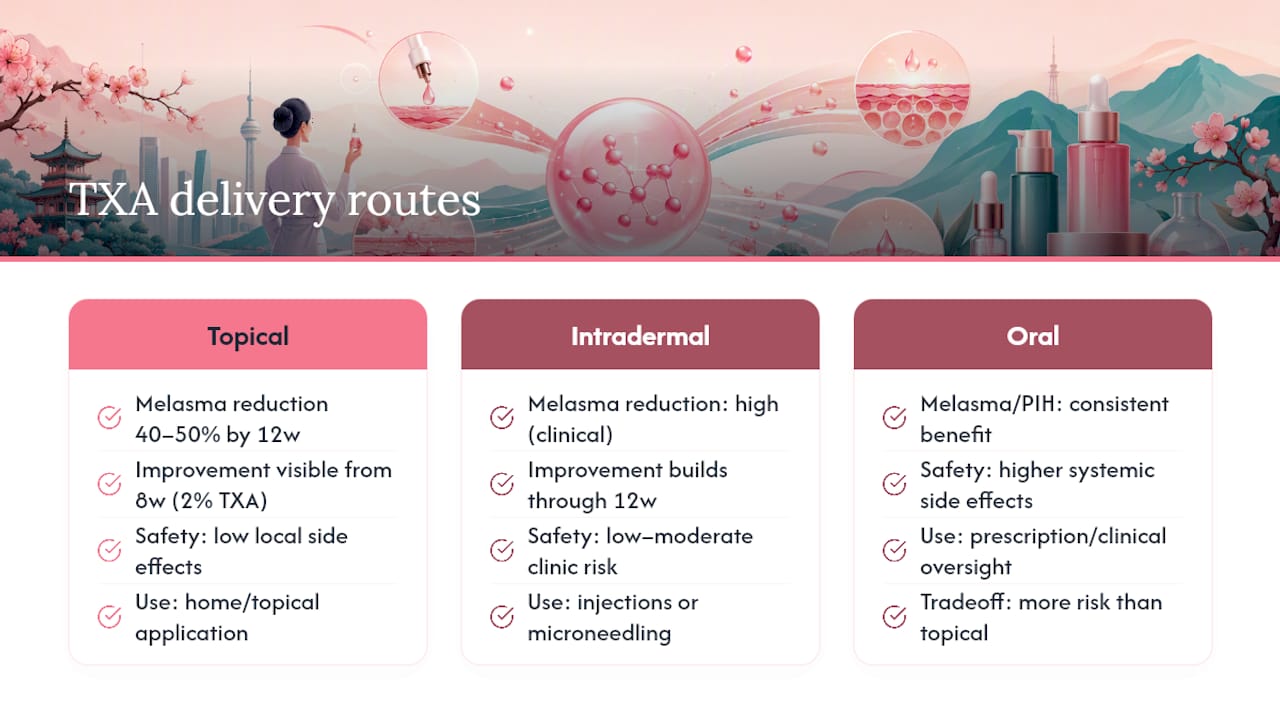
TXA reaches the skin through three main routes:
- Topical: serums, creams, and essences applied directly, the most common and lowest-risk format for home use.
- Oral: tablets taken systemically, more potent but with real cardiovascular considerations.
- Intradermal: injected by a dermatologist directly into affected skin, often used for stubborn melasma that resists topical treatment.
Each route reaches the same biological target, but the risk and intensity scale up considerably as you move from topical to oral to injected.
What does the clinical research actually show?
The numbers behind tranexamic acid are more solid than most “brightening” ingredients on shelf labels. Controlled studies show topical tranexamic acid can reduce melasma severity by roughly 40% to 50% within 12 weeks of consistent daily use. That’s a meaningful shift for a condition notorious for resisting treatment.
By the numbers: Topical 2% tranexamic acid has shown measurable improvement in sun-related hyperpigmentation in as little as 8 weeks in small clinical studies, with more pronounced melasma-specific results building through week 12.
A literature review on TXA for hyperpigmentation found consistent benefit across topical, intradermal, and oral delivery for both melasma and PIH, with topical and intradermal routes generally preferred for their safety profile. Intradermal injections, administered in a clinical setting, often deliver the best balance of results versus risk, which is part of why dermatologists reach for microneedling or injection sessions in resistant cases rather than defaulting straight to oral pills.
A systematic review focused specifically on post-inflammatory hyperpigmentation reached a similar conclusion: topical and intradermal TXA produced significant PIH reduction with markedly fewer side effects than oral dosing. Compared to hydroquinone, which remains effective but carries long-term concerns around ochronosis with prolonged use, and laser treatments, which can occasionally trigger rebound pigmentation in darker skin tones, topical TXA offers a lower-risk entry point that doesn’t foreclose other treatments later.
None of this means TXA is a miracle fix. It means the evidence base is unusually strong for a cosmetic active, built on actual controlled trials rather than marketing claims.
How do you use tranexamic acid in a skincare routine?
Getting results from TXA comes down to concentration, consistency, and what you pair it with. Most effective topical products land between 2% and 5%. Lower concentrations (around 2%) suit sensitive or reactive skin and still show measurable benefit within 8 weeks. Higher concentrations (4% to 5%) tend to appear in serums aimed at moderate to severe melasma and usually require a longer runway to judge results.
Here’s a simple sequence to follow:
- Cleanse and let skin dry completely; TXA serums absorb better on a fully dry face.
- Apply your TXA serum to bare skin, before heavier creams or oils, so the actives penetrate rather than sitting on top of a moisture barrier.
- Follow with a lightweight moisturizer to lock it in.
- In the morning, always finish with broad-spectrum sunscreen, since UV exposure is one of the main triggers TXA is trying to counteract in the first place. A mineral SPF suited to melanin-rich skin makes this step easier to stick with daily.
- Use nightly at first, then adjust frequency based on tolerance.
Patch-test any new TXA product on your inner arm for 48 hours before applying it to your face, especially if you’re combining it with other actives for the first time.
Pro Tip: Don’t apply a strong AHA or BHA peel in the same routine as TXA. Give it a few hours of buffer, or alternate nights, since stacking acids with TXA on freshly exfoliated skin can spike irritation without adding extra brightening benefit. A gentle AHA serum used on alternating evenings works better than layering everything at once.
Is tranexamic acid safe, and how does it differ from oral use?
Topical tranexamic acid has a genuinely low irritation profile compared to older brightening agents. Most people tolerate it well, with occasional mild dryness or a brief tingling sensation on first use that typically resolves within a week or two. If irritation persists beyond that, dropping to every-other-night application usually solves it.
Oral tranexamic acid is a different conversation entirely. It’s a real medication, not a cosmetic ingredient, and it carries systemic risks that topical use doesn’t. Reported issues include:
- Gastrointestinal upset and changes to menstrual flow
- Rare but serious clotting events, particularly in people with existing risk factors
- Dangerous interactions with estrogen-containing birth control, which independently raises clotting risk
Oral dosing in published studies ranges from 250 mg to 1,500 mg per day, taken anywhere from 2 weeks to 6 months, and that range alone signals how much oral TXA needs to be individualized by a clinician rather than self-dosed. Anyone with a personal or family history of blood clots, or anyone pregnant or breastfeeding, should treat oral TXA as off the table without direct medical screening. Reports of thromboembolic events are rare but real enough that dermatologists routinely order clotting-risk screening before prescribing it. Topical use avoids nearly all of this risk, which is exactly why it’s the sensible starting point for almost everyone.
Tranexamic acid vs. niacinamide, vitamin C, and alpha arbutin
These ingredients aren’t competing for the same job, which is why so many routines end up using more than one. TXA works upstream, calming the inflammatory and vascular signals that push melanocytes into overproduction. Vitamin C and alpha arbutin work downstream, directly inhibiting tyrosinase, the enzyme that actually builds melanin. Niacinamide sits somewhere in between, interfering with melanin transfer to skin cells while also strengthening the skin barrier.
Because they hit different points in the same pathway, layering them tends to outperform using any single ingredient alone. Clinicians who treat melasma regularly note that combining an anti-inflammatory active like TXA with a tyrosinase inhibitor produces better outcomes than relying on one mechanism in isolation.
A practical split that works for a lot of routines:
- Morning: vitamin C or another antioxidant serum, to blunt UV-driven melanin formation during the day, followed by sunscreen without exception.
- Night: tranexamic acid, to dampen inflammation-driven pigment signaling during overnight repair.
- As tolerated: alpha arbutin or niacinamide layered in, either alongside TXA at night or on alternating evenings if skin runs sensitive.
Vitamin C tends to shine for sun-induced spots and general dullness. Alpha arbutin is a gentler, slower tyrosinase inhibitor that suits sensitive skin. TXA is the one to reach for specifically when melasma or PIH keeps coming back despite other treatments. If you’re already running a vitamin C serum in the morning, adding TXA at night is a low-friction way to cover both ends of the pigment pathway. Retinoids generally play fine with TXA, though it’s smart to introduce one new active at a time.
What results should you expect, and by when?
Patience matters more with TXA than with most brightening ingredients, mainly because it’s working on inflammation and vascular signaling rather than bleaching pigment directly. Here’s a realistic way to track it:
- Weeks 1 to 4: little visible change; skin should tolerate the product without ongoing irritation.
- Weeks 8 to 12: this is when most people notice a real shift, consistent with the 40% to 50% melasma reduction reported in controlled studies over that window.
- Beyond 12 weeks: continued gradual fading, plus a lower relapse rate if sunscreen stays consistent.
Take a photo in the same lighting and same spot every two weeks rather than judging progress in the mirror day to day, since pigment fades unevenly and daily comparisons are misleading. If you see no change at all by week 12, that’s the point to loop in a dermatologist rather than pushing higher concentrations on your own.
Once pigment improves, maintenance matters as much as the initial treatment. Daily sunscreen isn’t optional, and dropping to a lower TXA frequency (two to three nights a week) once results plateau is usually enough to hold the gains.

An editorial take on tranexamic acid’s real place in a routine
The biggest misconception about tranexamic acid is treating it like a stronger vitamin C. It isn’t. It’s solving a different problem, and expecting it to work like a tyrosinase inhibitor sets people up to quit right when it’s about to start working.
Save oral TXA for a conversation with a dermatologist, not a supplement aisle decision. When Spyra Verified curates skincare formulations, we look closely at labeled active percentages, ingredient transparency, and sourcing from manufacturers with a track record, because a “brightening serum” with no stated TXA concentration tells you nothing about whether it can actually deliver the results the research supports.
— Anni
Where to find authentic tranexamic acid products
Some retailers source Japanese and Asian skincare directly from the brands that make it, which matters most with an active ingredient like TXA where concentration and formulation quality decide whether it actually works. You’re not gambling on a relabeled product with a vague ingredient list.

Genuine customer reviews on the product page are worth a scan too, since real usage patterns tend to surface irritation issues faster than a marketing description will.
Browse the curated skincare collection to compare tranexamic acid serums alongside the tyrosinase inhibitors and sunscreens that make them work better. If you’re building out a full brightening routine rather than a single product, that’s the fastest way to see formulations that are actually built to pair with each other.
Selected studies and reviews for further reading
- The Use of Tranexamic Acid in Dermatology, covering mechanism and topical efficacy data
- Tranexamic Acid for Hyperpigmentation Disorders, a literature review comparing routes of delivery
- Efficacy and Best Mode of Delivery for TXA in PIH, a systematic review on post-inflammatory hyperpigmentation
- Oral Tranexamic Acid in Hyperpigmentation Disorders, reviewing oral dosing and safety data
Talk to a dermatologist before starting oral tranexamic acid for any pigmentation concern.
