


PA Rating Sunscreen: What U.S. Shoppers Need to Know
PA rating stands for Protection Grade of UVA, and the plus signs you see on a label (PA+ through PA++++) tell you how much UVA protection a sunscreen provides. More plus signs mean more protection. For U.S. shoppers, the immediate move is simple: prioritize a “Broad Spectrum” label with SPF 30 or higher (the FDA’s standard), then treat PA as a useful bonus signal when it appears on imported products.
Three things to check before you buy:
- Broad Spectrum + SPF 30 minimum — the FDA-required floor for meaningful UVA and UVB coverage
- Higher PA ratings for extended outdoor use — especially relevant on Japanese or Korean imports
- Reapplication every two hours — no PA tier or SPF number holds without it
Key Takeaways
PA rating (Protection Grade of UVA) uses plus signs to indicate UVA protection strength, and U.S. shoppers should pair it with a “Broad Spectrum SPF 30+” label for complete sun protection.
| Point | Details |
|---|---|
| PA tiers and UVA-PF | PA tiers reflect increasing UVA-PF values as mapped in the ISO 24443 standard, with more pluses indicating higher protection levels. |
| U.S. labeling standard | The FDA uses a broad-spectrum pass/fail test, not PA stars; “Broad Spectrum” is the required U.S. signal. |
| When PA matters most | Seek PA+++ or PA++++ for extended outdoor exposure, pigmentation-prone skin, or high-altitude environments. |
| Reapplication is non-negotiable | No PA tier sustains protection without reapplication every two hours or after water exposure. |
| Spyraverified for PA products | Spyraverified carries authentic Asian sunscreens with verified PA ratings for U.S. shoppers. |
Table of Contents
- Why UVA protection matters more than most people realize
- What each PA level actually means on the label
- How PA ratings are actually tested
- How PA compares to SPF and what the U.S. uses instead
- How to use PA ratings when you’re actually shopping
- Where you’ll actually see PA ratings in the U.S. market
- Common myths about PA ratings that can get you burned
- A note on balancing PA with U.S. sunscreen best practices
- Authentic PA-labeled sunscreens, sourced directly
- Sources
Why UVA protection matters more than most people realize
SPF gets all the attention, but it only measures protection against UVB rays, the ones responsible for sunburn. UVA rays are a different problem. They penetrate deeper into the skin, reaching the dermis where collagen lives, and they don’t announce themselves with a burn. Peer-reviewed research links UVA exposure directly to photoaging, hyperpigmentation, and DNA damage that contributes to skin cancer risk.
Here’s the practical gap: a sunscreen with SPF 50 can still leave you poorly protected against UVA if the formula isn’t balanced. That’s exactly why separate UVA metrics—like PA ratings and the FDA’s Broad Spectrum test—exist.
Key distinctions:
- UVB causes sunburn, contributes to skin cancer, and is what SPF measures
- UVA causes tanning, photoaging, and pigmentation; penetrates glass and clouds
- Both contribute to long-term skin cancer risk, which is why broad-spectrum protection covering both wavebands matters
The FDA and major dermatology organizations agree: UVA coverage is not optional for effective sun protection.
What each PA level actually means on the label
The PA system originated in Japan and is now widely used across Asian markets. Each tier corresponds to a range of UVA Protection Factor (UVA-PF), which correlates with the Persistent Pigment Darkening (PPD) method used in clinical testing.
| PA Tier | UVA Protection Level | Typical UVA-PF / PPD Range |
|---|---|---|
| PA+ | Some UVA protection | 2 or more |
| PA++ | Moderate UVA protection | 4 or more |
| PA+++ | High UVA protection | 8 or more |
| PA++++ | Very high UVA protection | 16 or above |
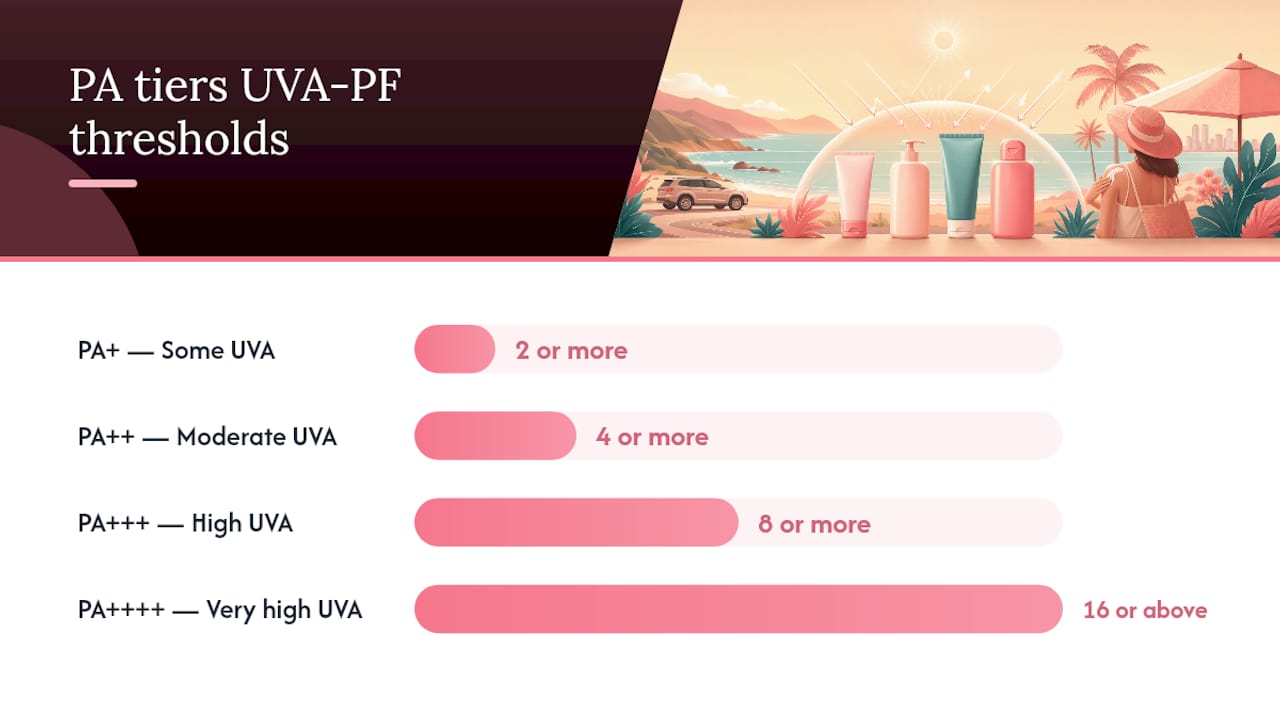
These ranges align with the framework described in ISO 24443:2021, the international standard for in-vitro UVA photoprotection testing, and are used in industry and regulatory guidance derived from COLIPA and ISO methods.
Pro Tip: If a product shows a PA tier but doesn’t print the actual PPD or UVA-PF number, you can still use the tier as a relative guide. Higher PA ratings on Japanese or Korean sunscreens generally indicate stronger UVA coverage. When in doubt, check the brand’s technical page or certificate of analysis, which reputable manufacturers often publish.
How PA ratings are actually tested
The PA system is backed by real measurement science, not marketing. Two main approaches are used: in-vivo PPD testing and in-vitro UVA-PF testing under ISO 24443:2021.
In-vivo PPD (Persistent Pigment Darkening): A human subject has sunscreen applied to skin, which is then exposed to UVA radiation. The minimum UVA dose required to produce visible pigment darkening (with sunscreen) is divided by the dose needed without sunscreen. The result is the PPD factor, which maps directly to PA tiers.
In-vitro UVA-PF (ISO 24443): This lab-based method measures how much UVA radiation a sunscreen film absorbs using a PMMA (polymethyl methacrylate) plate. The spectral absorbance curve is analyzed, and a UVA-PF value is calculated. ISO 24443 specifies that these in-vitro values correlate with in-vivo PPD results, making the method a reliable and more reproducible alternative to human testing.
The in-vitro approach is now the industry standard for most markets because it’s faster, more consistent, and doesn’t require human subjects. That said, both methods test sunscreen under controlled lab conditions, typically at a standard application thickness of 2 mg/cm². Most people apply far less than that in real life, which is one reason why the labeled protection level rarely translates perfectly to real-world use.
A few practical limits worth knowing:
- Lab testing assumes uniform, adequate application — real-world application is uneven
- Water, sweat, and rubbing degrade protection faster than lab conditions suggest
- The PA tier reflects the formula’s potential, not what you actually get on a rushed morning
How PA compares to SPF and what the U.S. uses instead
SPF and PA measure completely different things. SPF (Sun Protection Factor) quantifies protection against UVB-induced sunburn. PA quantifies protection against UVA-induced pigment darkening. A product can have SPF 50 and PA+ — high UVB protection, minimal UVA coverage. Or SPF 30 and PA++++. The numbers don’t move together automatically.
In the United States, the FDA doesn’t use the PA system at all. Instead, it requires a broad-spectrum pass/fail test under 21 CFR 201.327(j). A sunscreen that passes can be labeled “Broad Spectrum SPF [number].” One that fails cannot make UVA protection claims.
The FDA’s 2011 final rule explicitly rejected a star-based UVA rating system, citing concerns that multiple competing rating systems would confuse consumers. The agency’s position: a proportional relationship between UVA protection and SPF, confirmed by the broad-spectrum test, is sufficient for labeling purposes. A separate UVA star rating was deemed unnecessary.
What this means for U.S. shoppers:
- “Broad Spectrum” on a U.S. label is the regulatory signal that UVA coverage is present and proportional to SPF
- PA ratings on imported products are not FDA-regulated but are based on real testing and can be read as supplemental UVA information
- No PA label on a U.S. product doesn’t mean poor UVA protection — it may simply mean the brand followed FDA labeling conventions
The Cleveland Clinic’s guidance reinforces this: for most U.S. consumers, “Broad Spectrum SPF 30+” is the baseline to prioritize, with PA serving as a useful extra data point on imports.
How to use PA ratings when you’re actually shopping
Knowing what PA means is one thing. Using it at the shelf or online is another. Here’s how to put it into practice without overcomplicating your routine.
The baseline checklist:
- Look for “Broad Spectrum” on any U.S.-sold product — this is non-negotiable
- SPF 30 minimum for daily use; SPF 50 for extended outdoor time
- PA+++ or PA++++ when you’re buying an Asian import and plan to be outside for hours
- Water-resistant (40 or 80 minutes) if you’re swimming or sweating heavily
- Reapply every two hours, or immediately after toweling off
When PA tier matters more:
- Pigmentation-prone skin, melasma, or post-inflammatory hyperpigmentation — UVA is the primary driver, so PA++++ is worth seeking out
- Beach days, hiking, or any extended outdoor exposure where cumulative UVA dose is high
- Vacations in high-altitude or equatorial locations where UVA intensity increases
When a lower PA tier is acceptable:
- Short indoor commutes with minimal window exposure
- Overcast winter days in northern U.S. cities where UVA intensity is lower (though UVA does penetrate clouds)
Pro Tip: Check the active ingredients alongside the PA tier. Zinc oxide and titanium dioxide (physical/mineral filters) block both UVA and UVB by nature. Chemical filters like avobenzone, Tinosorb S, or Uvinul A Plus are specifically designed for UVA absorption. A PA++++ product built on avobenzone or Tinosorb S is likely to deliver on its label claim more consistently than one relying on a single, less stable UVA filter.
Where you’ll actually see PA ratings in the U.S. market
Walk into a CVS or Target and you won’t find PA ratings on most shelves. The PA system is standard in Japan, South Korea, China, and much of Southeast Asia, where regulatory frameworks require or encourage UVA-specific labeling. U.S. domestic brands follow FDA conventions and print “Broad Spectrum” instead.
PA ratings show up in the U.S. primarily on imported products, which is exactly where they’re most useful as a supplement to broad-spectrum claims. A few label patterns you’ll encounter:
- PA tier printed prominently on the front panel alongside SPF (common on Japanese and Korean sunscreens)
- PPD or UVA-PF values listed on the technical or ingredient page rather than the front label
- “PA++++” as a marketing highlight on Asian beauty e-commerce listings, sometimes without the underlying PPD value
For U.S. shoppers buying Japanese sunscreens, the PA tier is a reliable guide because Japanese manufacturers test to rigorous standards and the PA system is formally regulated there. Korean sunscreens follow similar discipline, as covered in depth in this Korean sunscreen review.
One practical note: when importing Asian sunscreens, check the manufacture and expiry dates on packaging. Labeling conventions differ, and understanding Japanese beauty product expiry can help you avoid buying product that’s past its effective window.
Common myths about PA ratings that can get you burned
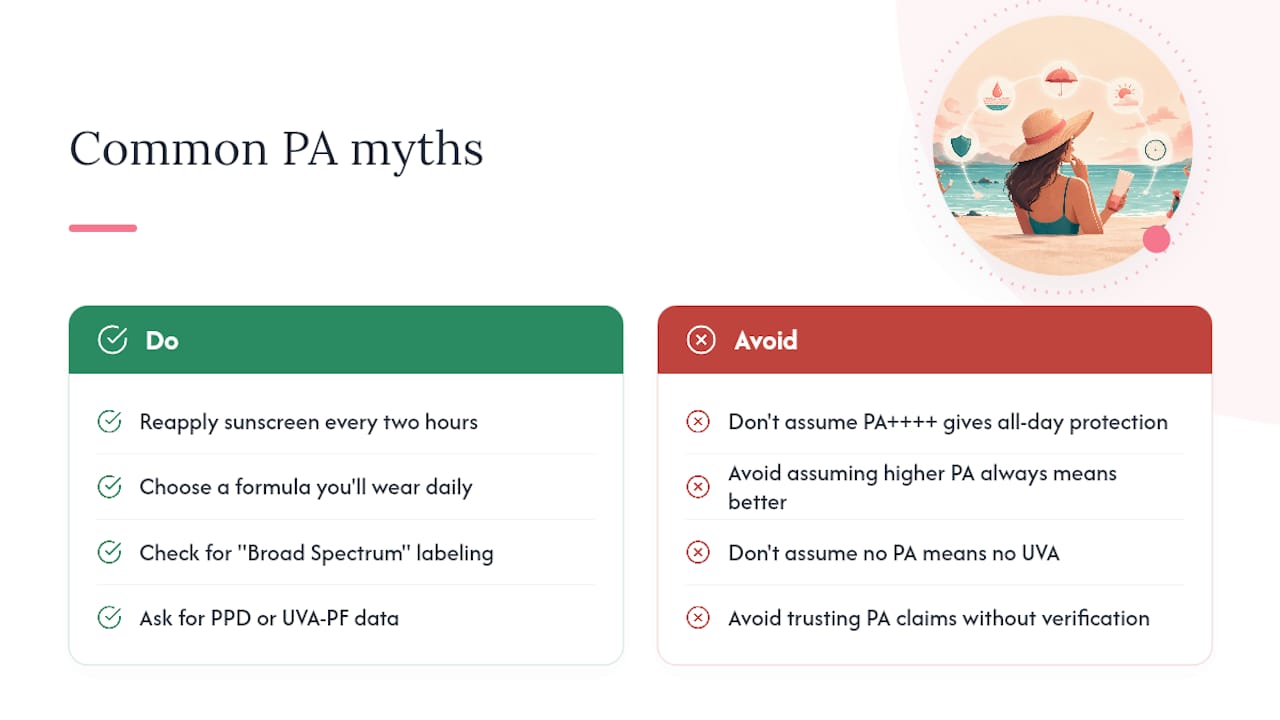
Myth: PA++++ means all-day UVA protection without reapplication. It doesn’t. PA++++ means the formula tested at UVA-PF 16 or above under lab conditions with a 2 mg/cm² application. Apply less than that (which most people do), sweat, swim, or rub your face, and that protection degrades. No PA tier changes the two-hour reapplication rule.
Myth: Higher PA always means better sunscreen. PA measures one dimension: UVA protection. A PA++++ sunscreen with poor UVB coverage, a greasy texture you won’t wear daily, or an unstable formula is worse in practice than a PA+++ product you’ll actually use consistently.
Myth: If a product doesn’t show a PA rating, it has no UVA protection. U.S. brands use “Broad Spectrum” instead. A domestic sunscreen labeled “Broad Spectrum SPF 50” has passed the FDA’s UVA test and provides proportional UVA coverage — it just doesn’t express that as a PA tier.
Myth: PA ratings are standardized globally. The PA system originated in Japan and is most rigorously regulated there. Other markets adopt it with varying consistency. Some brands print PA tiers based on internal testing without third-party verification. When buying from less-established sources, the PA claim is only as reliable as the brand behind it.
Pro Tip: If a brand prominently advertises a PA tier but won’t disclose the PPD or UVA-PF value behind it, that’s worth noting. Reputable manufacturers, especially Japanese ones, typically have test data available. A PA++++ claim backed by a published UVA-PF of 20+ is more credible than one with no supporting figure.
A note on balancing PA with U.S. sunscreen best practices
The PA system is genuinely useful, but it’s easy to let it become a distraction from the basics. In the U.S. market, “Broad Spectrum SPF 30+” remains the single most important label signal for most people. PA adds a layer of UVA specificity that matters most for skin types prone to pigmentation, for long outdoor exposures, and for anyone who wants to go beyond the regulatory minimum.
The smarter approach isn’t to chase the highest PA tier available. It’s to find a sunscreen you’ll wear every day, apply generously, and reapply on schedule. A PA+++ product used correctly beats a PA++++ product applied once and forgotten. Spyraverified’s community-approved skincare selection reflects exactly that philosophy: products verified through real use, not just label claims.
Authentic PA-labeled sunscreens, sourced directly
Spyraverified brings authentic Japanese and Asian sunscreens to U.S. shoppers who want PA-labeled products without the guesswork of gray-market imports. Every product is sourced directly from partnered manufacturers, so the PA tier on the label reflects actual tested performance, not a marketing estimate.
The Uji Matcha Sunscreen Cream SPF 50+ PA++++ is a strong example: high SPF, PA++++ UVA coverage, and a water-resistant formula built for real outdoor use. Browse the full skincare collection to find PA-labeled options across skin types and textures, all verified for authenticity and shipped globally. If you’ve been reading labels and wondering whether the PA claim is real, that’s the question Spyraverified is built to answer.
Sources
- FDA — Labeling and effectiveness testing of sunscreen drug products (guidance)
- ISO 24443:2021
- 35620
- Ncbi
- Skincancer
- Health
This article is general information, not a substitute for advice from a qualified doctor. Consult a qualified healthcare professional about your own circumstances before acting on anything here.
