


2% Alpha Arbutin: What Asian Skincare Shoppers Should Know
Alpha-arbutin is an effective, generally well-tolerated brightening ingredient that fades dark spots when used at the right concentration and paired with daily sunscreen. Regulatory guidance from the European Commission’s SCCS caps face cream use at 2%, and most people see visible change with consistent use over several weeks, not overnight.
TL;DR:
- Alpha-arbutin is more potent and stable at inhibiting tyrosinase than beta-arbutin, which is why most modern formulations favor the alpha isomer.
- Regulatory guidelines limit alpha-arbutin to 2% in face creams to reduce risks, with higher concentrations unlikely to improve results and potentially increase hydroquinone exposure.
- Alpha-arbutin works gradually by blocking melanin production and reducing skin inflammation, with visible improvements usually appearing after about 8 to 12 weeks of consistent use.
- Effective products disclose specific alpha-arbutin concentrations, use stable pH levels, and include delivery technology to ensure active absorption into the skin.
- Combining alpha-arbutin with actives like kojic acid or niacinamide enhances brightening outcomes, especially when used in well-formulated serums applied after cleansing and before sunscreen.
Table of Contents
- What Is Arbutin in Skincare, and Why Does Alpha Beat Beta?
- How Arbutin Works: Tyrosinase Inhibition, Antioxidants, and Calmer Skin
- Does Arbutin Actually Work? What the Clinical Trials Show
- Is Arbutin Safe? SCCS Limits and Side Effects to Know
- Building an Arbutin Skincare Routine That Actually Works
- How to Choose a Good Arbutin Product Without Guessing
- Why Trust This Guide: Author and Publisher Background
- How We Think About Arbutin Formulations
- Where to Find Real Alpha-Arbutin Formulations Worth Trying
- Sources
What Is Arbutin in Skincare, and Why Does Alpha Beat Beta?
Arbutin is a glycosylated form of hydroquinone. That sounds alarming until you understand what it means: the hydroquinone molecule is bonded to a sugar group, which changes how it behaves in the skin entirely. Instead of flooding pigment cells the way pure hydroquinone does, arbutin releases its active component slowly and in far smaller amounts, which is why it carries a gentler risk profile.
There are two isomers you’ll see on ingredient lists: alpha-arbutin and beta-arbutin. They look similar on paper, but they don’t perform the same way on skin. Beta-arbutin occurs naturally in plants like bearberry, cranberry, and blueberry leaves, and it’s been used in traditional skin-lightening preparations for generations. Alpha-arbutin, by contrast, is typically produced synthetically or through enzymatic conversion in a lab, and it’s structurally more stable.
That stability translates directly to performance. Laboratory research comparing the two isomers found alpha-arbutin can be significantly more potent at inhibiting tyrosinase than beta-arbutin, the enzyme responsible for triggering melanin production. This is the main reason cosmetic chemists have largely shifted formulations toward the alpha form over the past decade, even though beta-arbutin is technically the “natural” version.
Here’s what separates the two isomers in practical terms:
- Alpha-arbutin is more resistant to enzymatic breakdown once absorbed, which means it stays active in the skin longer.
- Beta-arbutin breaks down more readily, sometimes releasing hydroquinone at a faster rate.
- Alpha-arbutin is the isomer most modern serums and creams list by name, often with a stated percentage.
- Beta-arbutin shows up more in older or “natural extract” style formulations, sometimes just labeled “arbutin” or “bearberry extract.”
- Regulatory bodies have set different concentration ceilings for each isomer precisely because their behavior in skin differs.
If you’re scanning an ingredient label and want the more predictable, better-studied option, look specifically for “alpha-arbutin” rather than a generic “arbutin” listing. Vague labeling is one of the more common ways formulators cut corners, and it makes it harder to know what concentration or isomer you’re actually applying.
How Arbutin Works: Tyrosinase Inhibition, Antioxidants, and Calmer Skin
Arbutin’s core mechanism is tyrosinase inhibition. Tyrosinase is the enzyme that kicks off melanin synthesis inside melanocytes, converting the amino acid tyrosine into the pigment that eventually shows up as a dark spot on your skin. Block or slow that enzyme, and you slow new pigment formation at the source, rather than just bleaching existing color.
Research on α-arbutin’s effects on UVB-induced skin damage found something worth paying attention to beyond straightforward tyrosinase blocking: the ingredient also reduced inflammatory cytokines including IL-1β, IL-6, and TNF-α in animal models, and appeared to support collagen (COL-1) expression. That matters because inflammation itself is a major trigger for pigmentation. A sunburn, a breakout, an aggressive extraction at the facialist’s office, all of these inflame skin, and that inflammation can signal melanocytes to overproduce pigment as a defensive response. This is why post-inflammatory hyperpigmentation lingers long after the original irritation heals.
So arbutin isn’t working through a single lever. A review of arbutin’s depigmenting properties frames this as a two-part effect: it directly interrupts melanin production through enzyme inhibition, and it indirectly reduces the inflammatory signals that would otherwise keep telling melanocytes to make more pigment. Most single-action brightening ingredients only manage one side of that equation.
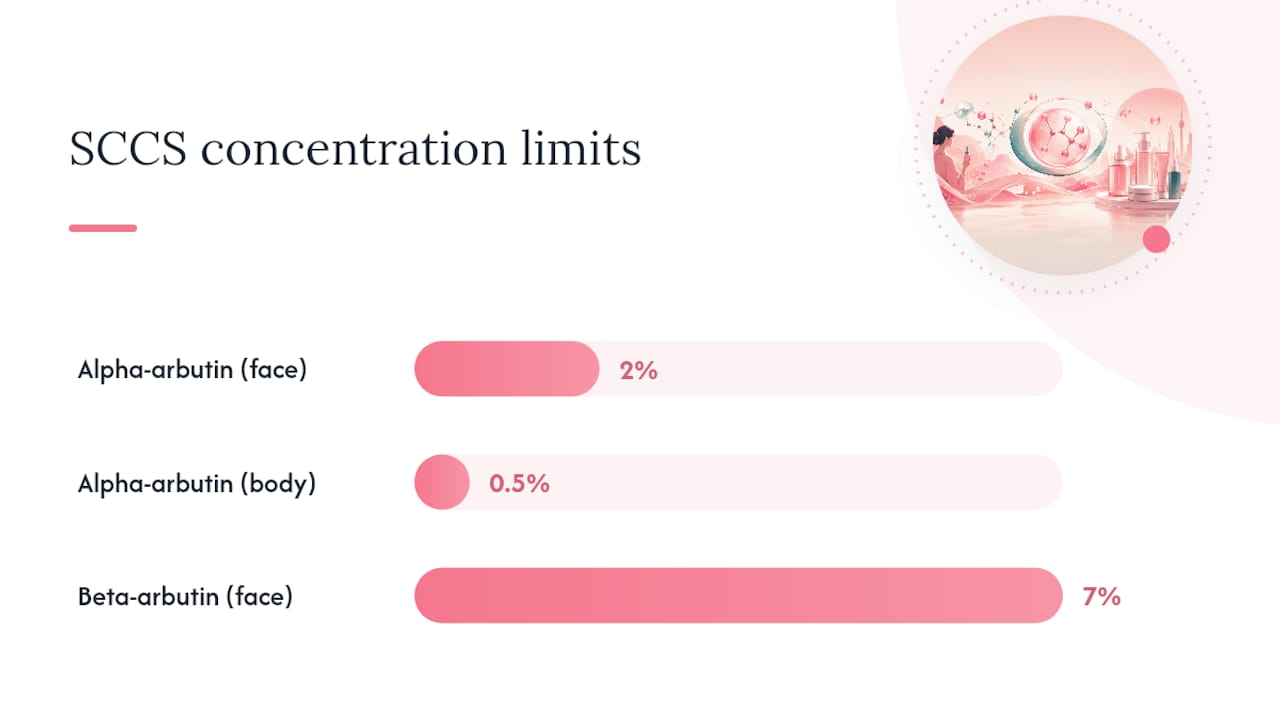
Quick fact check: SCCS guidance sets alpha-arbutin’s maximum recommended concentration at 2% in face creams and 0.5% in body lotions, a limit set specifically because higher concentrations don’t reliably improve results and may increase the risk of residual hydroquinone exposure.
There’s a real formulation limit worth understanding, though. Alpha-arbutin is highly hydrophilic, meaning it’s attracted to water rather than oil, and that property makes it harder for the molecule to cross the skin’s lipid-rich outer barrier. This isn’t a flaw exactly, it’s just a formulation puzzle. It’s part of why:
- Serums with a well-designed delivery system tend to outperform basic creams at the same stated percentage.
- Some brands use encapsulation or permeation enhancers to help the molecule actually reach active melanocytes rather than sitting on the surface.
- pH matters more than most consumers realize, since arbutin’s stability shifts outside a roughly 5 to 7 range.
- Storage conditions affect potency over time; heat exposure during shipping or storage can degrade the ingredient before it ever touches your skin.
None of this means arbutin is fragile or unreliable. It means the formulation around the active ingredient carries real weight, which is exactly why concentration numbers alone don’t tell the whole story on a product label.
Does Arbutin Actually Work? What the Clinical Trials Show
Yes, with real caveats worth understanding before you buy anything. Clinical and split-face trials consistently show reductions in melanin index and visible improvement in conditions like melasma and lentigines when arbutin is used correctly, and tolerability tends to run better than harsher depigmenting agents according to a systematic review of arbutin’s antimelanogenic properties.
One of the more compelling data points for anyone specifically dealing with melasma comes from a randomized split-face study. Researchers compared a cream containing 5% alpha-arbutin plus 2% kojic acid against a triple combination cream, the kind of prescription-strength formula that typically includes hydroquinone, a retinoid, and a corticosteroid together. The alpha-arbutin and kojic acid combination produced clinically comparable improvement in melanin index and melasma severity scores, but with fewer adverse events and lower recurrence during follow-up.
That result matters for anyone who has been told triple combination cream is the only real option for melasma. It suggests a gentler alpha-arbutin pairing can get you into similar territory without the rebound pigmentation and irritation that often follows when patients stop using triple combination therapy.
That doesn’t mean arbutin replaces prescription treatment for every case. Triple combination creams still tend to work faster for severe, entrenched melasma, and dermatologists often reach for them first in stubborn cases. What the split-face data supports is a different use case entirely: arbutin as a maintenance strategy after initial treatment, or as a first-line option for people with mild to moderate pigmentation who want to avoid the irritation and rebound risk that comes with stronger agents.
Combination formulations show up again and again in the research as a theme worth noting. Pairing alpha-arbutin with complementary actives, kojic acid, tranexamic acid, or niacinamide, tends to outperform single-ingredient products in clinical outcomes. The mechanism study on α-arbutin and UVB damage points to this same pattern: because different brightening actives interrupt melanin production at different points in the pathway, stacking them (carefully) produces a more complete block than any one ingredient working alone.
A few other patterns worth flagging from the broader evidence base:
- Improvement tends to be gradual rather than dramatic, and reviewers consistently describe arbutin as slower-acting than prescription hydroquinone.
- Device-assisted protocols, pairing topical arbutin with laser or light-based treatments, show promise in some clinical settings, though this route requires professional supervision rather than a home routine.
- Recurrence after stopping treatment appears to be less severe with arbutin-based regimens compared to some stronger prescription options, based on the split-face melasma trial above.
- Melanin index reduction has been documented across multiple trial designs, not just isolated case reports, which strengthens confidence in the finding.
If you’re comparing arbutin against kojic acid specifically, know that the two often work better together than as substitutes for each other. Kojic acid comes from fungal fermentation and also inhibits tyrosinase, but through a slightly different binding mechanism, which is exactly why the combination trials above showed such solid results. Versus vitamin C, the comparison is less about competition and more about complementary roles: vitamin C leans harder into antioxidant protection and collagen support, while arbutin focuses more precisely on the enzyme driving pigment production.
Is Arbutin Safe? SCCS Limits and Side Effects to Know
Arbutin carries a favorable safety profile within regulatory limits, but “within limits” is the operative phrase. The SCCS safety opinion sets alpha-arbutin at a maximum of 2% in face creams and 0.5% in body lotions, while beta-arbutin, being less potent per unit, gets a higher ceiling of 7% in face creams. The same opinion flags hydroquinone contamination as the real concern to watch, since arbutin can theoretically break down into trace hydroquinone, and the guidance calls for keeping that contamination at unavoidable trace levels, ideally under 1 part per million.
That contamination risk sounds scarier than it typically plays out in practice. Reputable manufacturers test for hydroquinone residue as a matter of quality control, and the trace levels involved are a different order of magnitude entirely from the concentrations used in prescription hydroquinone treatments, which can run 4% or higher under medical supervision. Still, it’s a legitimate reason to favor products from manufacturers who formulate transparently rather than vague “natural lightening complex” blends with no stated percentages.
Statistic to remember: SCCS guidance draws a clear line between the two isomers, capping alpha-arbutin at 2% for face use versus 7% for beta-arbutin, a fourfold difference that reflects how much more potent the alpha form is at the enzyme level.
Here’s what to actually watch for once arbutin is in your routine:
- Mild irritation or stinging on first use, particularly for people with already-compromised or reactive skin barriers.
- Rare contact dermatitis, more likely in poorly formulated or high-concentration products than in products staying within SCCS guidance.
- Increased sun sensitivity is not well documented as a direct arbutin effect, but any active treatment for pigmentation demands strict sunscreen use, since UV exposure is the single strongest trigger for new melanin production.
- Theoretical hydroquinone exposure from breakdown, which is why buying from brands that test and disclose formulation quality matters more than chasing the highest percentage on the shelf.
- Interaction with broken or compromised skin, since arbutin (like most actives) should be avoided on open wounds, active eczema flares, or freshly exfoliated skin that hasn’t recovered.
Before working arbutin into a full routine, patch test on your inner arm for 24 to 48 hours, particularly if you have a history of sensitive skin or contact allergies. If you’re pregnant, breastfeeding, or managing diagnosed melasma that hasn’t responded to over-the-counter options, a conversation with a dermatologist before starting any tyrosinase inhibitor is the safer route, since hormonal pigmentation sometimes requires a different treatment sequence entirely.
Building an Arbutin Skincare Routine That Actually Works
Order matters more than most routines admit. Arbutin performs best as a serum step, applied after cleansing and any water-based toner, but before heavier creams or oils that could block penetration. Because it’s hydrophilic, it needs contact time on slightly damp, clean skin to have a real shot at absorption before you layer anything occlusive on top.
Here’s a routine sequence that respects both the science and everyday practicality:
- Cleanse with a gentle, non-stripping cleanser, morning and night.
- Apply arbutin serum to clean, slightly damp skin, giving it a minute or two to absorb before the next step.
- Layer complementary actives like niacinamide or tranexamic acid, both of which pair well with arbutin’s mechanism without canceling it out.
- Moisturize to lock in hydration and support the skin barrier, since a compromised barrier makes any active less effective and more irritating.
- Finish with broad-spectrum sunscreen every morning, no exceptions, since new UV exposure will keep generating the same pigment you’re trying to fade.
Frequency runs once or twice daily for most alpha-arbutin serums, though people with sensitive skin sometimes start at once daily and build up. If you’re also using exfoliating acids or retinoids, alternating nights rather than stacking everything at once helps prevent the irritation that undermines consistency, and consistency is what actually drives results here.
Pro Tip: Give arbutin at least one full skin cycle before judging it. Most people check for hair-trigger results within two weeks and give up right when the ingredient is starting to work. Photograph your skin in the same lighting every two weeks instead of checking daily, since day-to-day fluctuation from hydration and lighting will mask the actual trend.
On the compatibility side, niacinamide, tranexamic acid, and kojic acid all layer well with alpha-arbutin, and the clinical evidence on combination formulations suggests these pairings often outperform arbutin alone. If your routine already includes an AHA serum for texture, space it on alternate days from arbutin rather than layering both at once, since stacking exfoliation with a brightening active raises irritation risk without necessarily speeding results.
Realistic timeline: most people notice initial change around week 8, with more visible improvement by week 12, based on how clinical trials describe arbutin’s gradual action. This isn’t a fast ingredient, and rushing it by overusing product or skipping sunscreen tends to backfire rather than accelerate anything. Speaking of sunscreen, choosing the right formula for your skin type and climate genuinely affects how well it protects your progress, which is worth getting right rather than treating as an afterthought; a guide on picking Japanese sunscreen covers the texture and filter differences that make daily use easier to stick with.
How to Choose a Good Arbutin Product Without Guessing
Label literacy is the single biggest skill that separates people who get results from people who waste money on vague “brightening” claims. The most useful thing you can do before buying is check whether the label specifies “alpha-arbutin” by name and states an actual percentage, rather than burying it in a proprietary-sounding “lightening complex.”
Formulation quality shows up in a few checkable details:
- A stated concentration, ideally sitting at or near the 2% SCCS ceiling for face products, since this is where most clinical research has actually tested the ingredient.
- pH and stability language on the brand’s ingredient or technical page, since alpha-arbutin degrades outside a roughly 5 to 7 pH range and loses potency when exposed to heat during storage.
- Complementary actives listed by name, kojic acid, tranexamic acid, or niacinamide, rather than vague blends, since the clinical evidence for arbutin’s best results comes from combination formulas, not solo use.
- Delivery technology disclosed, such as encapsulation or a stated permeation-enhancing vehicle, since alpha-arbutin’s hydrophilic nature makes basic formulation choices matter more than usual.
- Packaging that limits light and air exposure, since arbutin is sensitive to degradation and an opaque, airless pump outperforms a clear jar over the life of the product.
Red flags worth walking away from: any product claiming “instant” or “dramatic overnight” brightening (the biology doesn’t support that timeline), a listing that says only “arbutin” with no isomer specified, and any brightening serum sold with zero mention of sunscreen anywhere in the brand’s guidance. That last one is a real tell, since a brand that understands the ingredient will always mention sun protection, because they know arbutin’s results depend on it.
If you’re stacking arbutin with a tranexamic acid serum for a more aggressive pigmentation approach, check that both products state their concentrations clearly, since combination safety data assumes standard, tested percentages rather than mystery blends.
Why Trust This Guide: Author and Publisher Background
This guide was written by Anni for Spyraverified, drawing on peer-reviewed clinical research, SCCS regulatory guidance, and published review literature rather than marketing claims.
Our editorial team curates authentic Japanese and Asian beauty products, sourcing directly from partnered manufacturers rather than resellers, with an emphasis on formulations that have real evidence behind their claims.
For readers who want to keep exploring related brightening strategies, Spyraverified’s editorial coverage includes guidance on tranexamic acid formulations, sunscreen selection for different skin types, and AHA serum use, all written with the same research-first approach applied here. The goal across this coverage stays consistent: help shoppers understand what they’re actually buying, not just what the packaging promises.
How We Think About Arbutin Formulations
Most brightening ingredients get marketed on vibes: a percentage on the front of the bottle and a promise of glow. What actually separates a well-made alpha-arbutin serum from a mediocre one rarely shows up on the front label at all. It’s in the pH, the delivery system, and whether the manufacturer bothered to test for hydroquinone residue rather than just assuming trace conversion won’t matter.
That’s the lens Spyraverified applies when evaluating the Japanese and Asian formulations it brings to market: does the brand disclose concentration, does the formulation account for alpha-arbutin’s hydrophilic nature, and does the product page treat sunscreen as part of the conversation rather than an unrelated afterthought. A serum that hits 2% alpha-arbutin but ignores pH stability is not meaningfully better than one that’s honest about sitting at 1%.
Self-care covers a lot of ground here, arbutin is genuinely one of the gentler, more forgiving tools for evening out tone. But it has limits. Diagnosed melasma that hasn’t responded to consistent over-the-counter use, pigmentation that appeared suddenly without an obvious trigger, or any dark spot that’s changing shape or color, all of those belong in front of a dermatologist, not a shopping cart.
If you’re browsing formulations, check the product page for the actual alpha-arbutin percentage and whatever the brand discloses about complementary actives before you buy. That transparency, more than any brand name, is the real signal of a formulation worth trusting.
— Anni
Where to Find Real Alpha-Arbutin Formulations Worth Trying
Finding a well-formulated alpha-arbutin product outside Japan and South Korea usually means wading through resellers who can’t confirm sourcing or concentration. Spyraverified works directly with partnered manufacturers, which means the brightening serums and creams in its catalog come with clearer formulation details than you’ll typically get from a generic online marketplace listing.
Browse the skincare collection and check each product page for the specifics that actually matter: whether alpha-arbutin is named specifically, what percentage is disclosed, and which complementary actives, kojic acid, niacinamide, tranexamic acid, are paired alongside it. Those details tell you more about whether a formula will work than any star rating ever will. If a routine change is on your radar, start there, compare a couple of formulations side by side on percentage and pairing, and add the one that matches what your skin actually needs to your cart.
Sources
- Safety of alpha‑arbutin and beta‑arbutin in cosmetic products - Public Health (European Commission)
- The Effect of α‑Arbutin on UVB‑Induced Damage and Its Underlying Mechanism (PMC, 2024)
- PubMed: Early enzymatic studies comparing arbutin isomers
This article is general information, not a substitute for advice from a qualified doctor. Consult a qualified healthcare professional about your own circumstances before acting on anything here.
