


The Role of Peptides in Skincare: 2026 Guide
Peptides are defined as short chains of amino acids that act as chemical messengers, signaling skin cells to produce collagen, elastin, and hyaluronic acid. The role of peptides in skincare goes far beyond surface hydration. A meta-analysis of 19 randomized controlled trials with 1,341 participants showed peptides produce nearly significant reductions in skin roughness and measurable improvements in brightness. Dermatologists recognize peptides as non-invasive anti-aging agents with a minimal side effect profile. Clinically supported types like GHK-Cu and Matrixyl 3000 have moved peptides from marketing buzzword to evidence-backed ingredient.
How do peptides work in skincare to improve skin appearance?
Peptides function as chemical messengers that tell fibroblasts, the cells responsible for building skin structure, to ramp up protein production. When collagen breaks down naturally with age, the resulting fragments act as distress signals. Peptides mimic those signals, prompting the skin to respond as if repair is needed. The result is increased collagen and elastin synthesis without any physical injury to the skin.
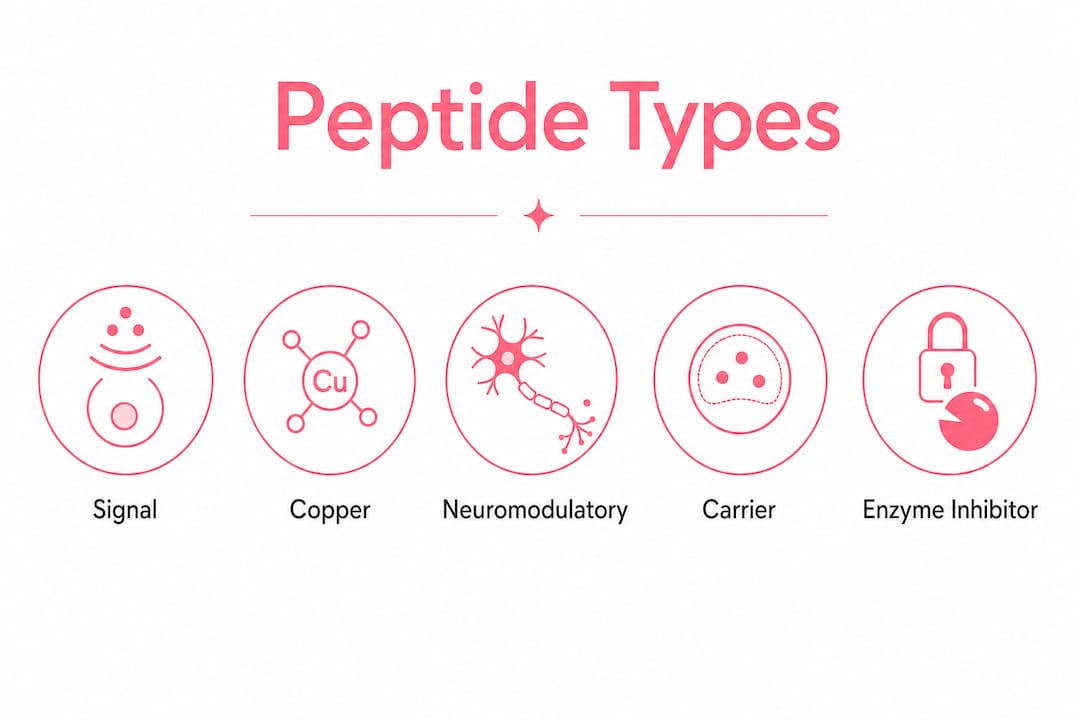
Three distinct mechanisms explain how different peptides improve skin:
- Signal peptides (matrikines) bind to fibroblast receptors and directly stimulate collagen and elastin production. Matrixyl 3000, a palmitoyl tripeptide combination, is the most studied example.
- Neuromodulatory peptides work at the neuromuscular junction to reduce muscle contraction, softening expression lines over time.
- Carrier peptides deliver trace minerals like copper to the skin, supporting enzymatic repair processes.
Each mechanism targets a different layer of the aging process. That is why combining peptide types in a single formulation often outperforms a single-peptide product.
Peptides also support the skin barrier by reducing inflammation and increasing ceramide production. A stronger barrier retains moisture more effectively, which directly improves skin texture and plumpness. Skin that holds hydration well reflects light more evenly, which explains the brightness improvements seen in clinical trials.
Pro Tip: Apply your peptide serum to slightly damp skin right after cleansing. Damp skin absorbs active ingredients faster, and peptides reach fibroblasts more efficiently when the stratum corneum is hydrated.
What are the main types of peptides used in skincare?
Not every peptide delivers the same result. The type you choose should match your primary skin concern, whether that is deep wrinkles, loss of firmness, or uneven tone.
Signal peptides
Signal peptides are the most widely researched class. Matrixyl 3000, a combination of palmitoyl tripeptide-1 and palmitoyl tetrapeptide-7, reduces wrinkle depth and volume after 12 weeks of consistent use. Clinical trials confirm its synergistic action when both peptides are present together. Signal peptides work best in leave-on formulas like serums and creams where they have prolonged contact with the skin.
Copper peptides
GHK-Cu is the most clinically validated copper peptide. A randomized double-blind trial showed significant improvements in skin density and thickness after 12 weeks of twice-daily use compared to placebo. GHK-Cu also carries antioxidant properties, neutralizing free radicals that accelerate collagen breakdown. It is one of the few peptides with evidence strong enough to satisfy dermatologists who demand human trial data.
Neuromodulatory peptides
Argireline is the best-known peptide in this class. Randomized trials show a 17–20% reduction in dynamic wrinkles after 30 days of twice-daily topical use. Argireline works by limiting the release of neurotransmitters that trigger facial muscle contractions. The effect is modest compared to injectable neuromodulators, but it is measurable and carries no downtime.
| Peptide type | Key example | Primary benefit |
|---|---|---|
| Signal peptide | Matrixyl 3000 | Collagen and elastin stimulation |
| Copper peptide | GHK-Cu | Skin density, antioxidant repair |
| Neuromodulatory | Argireline | Dynamic wrinkle reduction |
| Carrier peptide | GHK (without copper) | Mineral delivery, enzymatic support |
What should you know about peptide formulations?
A peptide’s effectiveness depends as much on how it is formulated as on the peptide itself. Peptides are large, hydrophilic molecules that struggle to cross the stratum corneum on their own. Palmitoylation solves this problem by attaching a fatty acid chain to the peptide, making it lipophilic enough to penetrate the skin’s outer layer and reach the dermis where fibroblasts live. This modification is why palmitoyl-prefixed peptides appear so often in clinically tested products.

Ingredient compatibility matters more with peptides than with most actives. Copper peptides are destabilized by strong acids and high concentrations of Vitamin C applied at the same time. Mixing them in the same step reduces the effectiveness of both. The fix is simple: apply copper peptides in the evening and Vitamin C in the morning, or separate them by at least 30 minutes.
Product format also affects results. Serums and ampoules deliver higher peptide concentrations with less dilution than rinse-off products. If you want to understand how ampoule formats work, they are specifically designed for maximum active ingredient contact time. Creams and lotions are effective for overnight use when the skin is in repair mode.
Peptides pair well with retinol and antioxidants. Experts recommend using peptides alongside retinol because peptides buffer some of retinol’s irritation while amplifying collagen-building effects. For a full picture of how retinol and peptides complement each other, the interaction is one of the most productive pairings in anti-aging skincare.
- Use peptide serums as a base layer before heavier creams.
- Avoid mixing copper peptides with AHAs or high-dose Vitamin C in the same application step.
- Choose leave-on formats for maximum absorption.
- Apply peptides consistently for at least 8–12 weeks before evaluating results.
Pro Tip: If you use both a Vitamin C serum and a copper peptide product, apply Vitamin C in the morning and the copper peptide at night. This schedule protects the stability of both ingredients and lets each work at its peak.
Are peptides safe and suitable for all skin types?
Peptides are among the safest active ingredients in skincare. Dermatological consensus confirms that peptides are well tolerated with a very low incidence of irritation or allergic reaction. When adverse events do occur, they are almost always tied to other ingredients in the formula, such as preservatives or fragrance, rather than the peptide itself. This makes peptides one of the few actives suitable for daily, long-term use without a tolerance-building phase.
Sensitive skin types benefit particularly from peptide-based routines because peptides do not disrupt the skin barrier the way acids or retinoids can. People with reactive skin who cannot tolerate exfoliants or strong retinol concentrations often find peptides give them a path to meaningful anti-aging results without flare-ups.
A few practical points for anyone starting a peptide routine:
- Patch test any new peptide product on the inner arm for 24 hours before full application. Patch testing is especially worth doing if the formula contains multiple actives alongside the peptide.
- Check the full ingredient list for known sensitizers like alcohol denat or synthetic fragrance, which are more likely to cause reactions than the peptide itself.
- Pregnant or nursing individuals should consult a dermatologist before starting any new active ingredient, including peptides.
Not all peptide formulations are equally effective. Products backed by human clinical trials deliver measurably better results than those relying on in-vitro data or marketing claims alone. When evaluating a product, look for clinical trial references on the brand’s site or the peptide ingredient’s published research record.
Key Takeaways
Peptides work because they signal fibroblasts to produce collagen and elastin, and clinical evidence confirms their effectiveness when the right peptide type is matched to a well-formulated, penetration-enhanced product.
| Point | Details |
|---|---|
| Peptides signal collagen production | GHK-Cu and Matrixyl 3000 have the strongest human trial evidence for skin density and wrinkle reduction. |
| Penetration determines effectiveness | Palmitoylation makes peptides lipophilic enough to cross the stratum corneum and reach dermal fibroblasts. |
| Ingredient compatibility matters | Avoid applying copper peptides and high-dose Vitamin C or AHAs in the same step to preserve stability. |
| Safe for daily long-term use | Adverse events are rare and almost always linked to non-peptide formula ingredients, not the peptide itself. |
| Consistency drives results | Clinical trials show meaningful improvements after 8–12 weeks of consistent twice-daily use. |
What I’ve learned from years of watching peptides go from niche to mainstream
I’ve watched peptides go from a niche dermatology topic to the ingredient everyone is asking about. The enthusiasm is warranted, but the marketing has outpaced the science in too many cases.
The most common mistake I see is people buying a product because it says “peptide complex” on the label without checking which peptides are actually in it. Broad claims without named ingredients are a red flag. GHK-Cu and Matrixyl 3000 have published human trial data. Many other peptides do not. That gap matters when you are deciding where to spend money.
The second mistake is expecting fast results. Peptides are not instant-gratification ingredients. The 12-week timelines in clinical trials are real. People who quit after three weeks and declare peptides ineffective have not given the biology enough time to respond. Collagen synthesis is a slow process by design.
What I find genuinely exciting about peptides is their compatibility with almost every other active. You can layer them with retinol, antioxidants, and niacinamide without the compatibility headaches that come with acids. For anyone building a multi-step anti-aging routine, peptides are the ingredient that ties everything together without adding irritation risk.
My honest recommendation: start with one well-formulated peptide serum containing either GHK-Cu or Matrixyl 3000, use it consistently for three months, and then evaluate. The results will speak clearly enough.
— Anni
Peptide-infused skincare from Spyraverified
Spyraverified curates skincare from Japanese and Asian brands that take formulation seriously, including products built around clinically supported peptide complexes. These are not brands that slap “peptide” on a label. They are manufacturers with documented ingredient sourcing and formulation expertise that meets the standards the research demands.

If you are ready to put what you have read into practice, the Spyraverified skincare collection brings together peptide-infused serums, creams, and treatments that are difficult to find outside their home markets. Each product is authenticated and ships directly, so you get the real formulation, not a gray-market substitute. Browse by skin concern and find the peptide product that fits your routine.
FAQ
What is the role of peptides in skincare?
Peptides act as chemical messengers that signal skin cells to produce collagen, elastin, and hyaluronic acid, reducing wrinkles and improving skin firmness and texture over time.
How long does it take for peptides to show results?
Clinical trials consistently show meaningful improvements after 8–12 weeks of twice-daily use. Quitting before that window closes gives an inaccurate picture of effectiveness.
Are peptides effective for anti-aging?
Yes. A meta-analysis of 19 randomized controlled trials confirmed that topical peptides reduce skin roughness and improve brightness with minimal adverse events.
Can you use peptides with retinol and Vitamin C?
Peptides pair well with retinol and can buffer some of its irritation. Apply Vitamin C in the morning and copper peptides at night to avoid destabilizing either ingredient.
Are peptides safe for sensitive skin?
Peptides are among the safest actives available. Dermatological evidence shows very low irritation rates, with reactions almost always caused by other formula ingredients rather than the peptide itself.
