

Avoid 15% Tariffs: Buy Japanese Skincare via US Fulfillment
For most American shoppers, the fastest and cheapest way to get authentic Japanese skincare is through a US-fulfilled retailer or an official brand storefront, not a package shipped straight from Tokyo. Since the 2025 removal of the low-value shipment exemption, direct Japan orders now routinely pick up customs processing and added duties at the border. Order from Japan only when the product is genuinely exclusive, and go in knowing the extra cost and wait.
TL;DR:
- Buying from US-fulfilled retailers or brand storefronts often avoids customs duties and results in faster delivery, typically within one to seven days.
- Direct orders from Japan face about a 15% tariff impact, increasing costs and delivery time, and are justified mainly for exclusives or regional products.
- Forwarding services are rarely cost-effective unless consolidating multiple items, as they add handling fees, international shipping, and duties on top of each other.
- Due to the suspension of the de minimis exemption, nearly all international shipments now risk customs processing and duty charges, raising total costs for direct Japan orders.
- Always verify product authenticity by checking the seller’s origin, lot codes, packaging, and prices; US-based sourcing reduces counterfeit and expired product risks.
Table of Contents
- How Should You Ship Japanese Skincare to the USA?
- What Do Tariffs and Customs Mean for Your Order Now?
- How Do You Cut Shipping Costs and Delays?
- How Can You Tell if Japanese Skincare Is Authentic?
- How Do You Order Japanese Skincare Safely From the US?
- Why Trust This Guide on Shipping Japanese Skincare
- Why US Fulfillment Should Be Your Default, Not Your Backup
- Shop Authentic Japanese Skincare With US Delivery
- Sources
How Should You Ship Japanese Skincare to the USA?
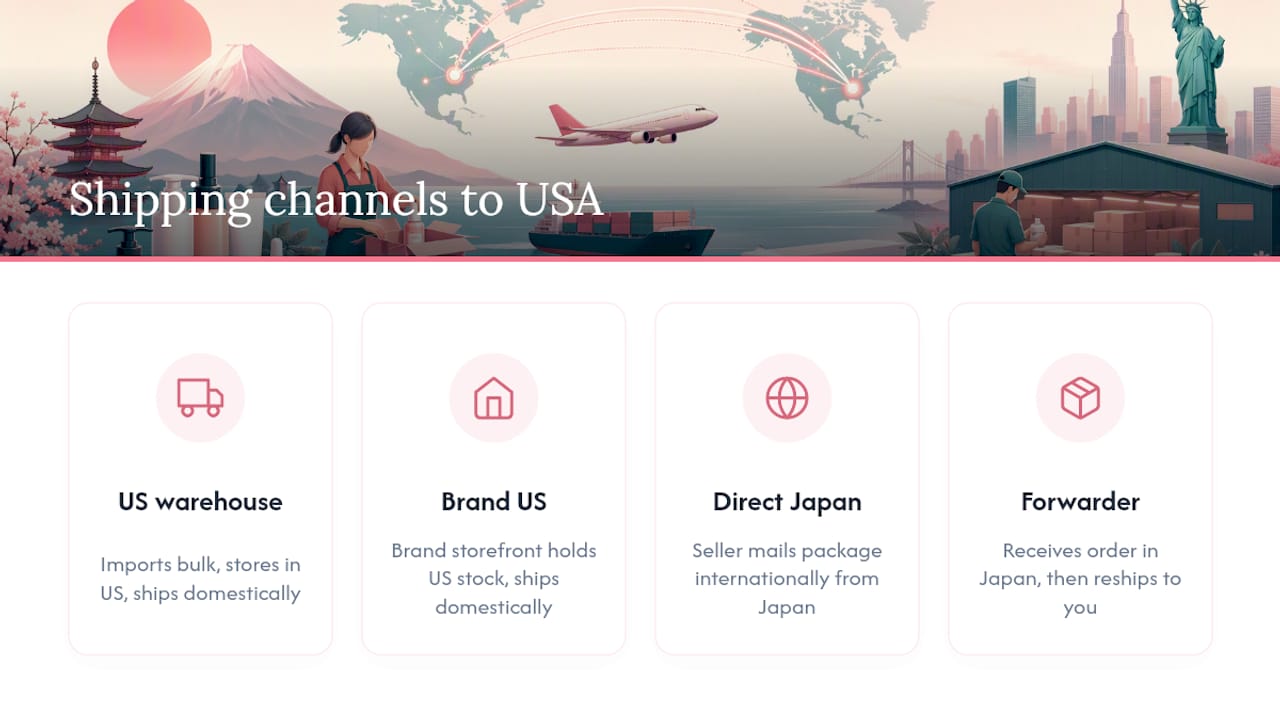
Four channels get Japanese skincare to your door, and each one fits a different situation. Picking the wrong one is how a $28 serum turns into a $45 headache with a two-week wait attached.
US-warehouse retailers import in bulk, hold stock domestically, and ship your order the same way any American e-commerce site does. Brand-direct US storefronts work similarly. Shipping straight from Japan means ordering from a Japanese retailer or marketplace that mails the package internationally. Forwarding and proxy services sit in the middle: you order in Japan, a service receives it, then reships it to you.
US-fulfilled retailers: the default choice
A retailer that imports products wholesale and warehouses them stateside has already paid duties as part of the bulk import. That’s why buying from a site like this typically means no per-order customs fee and no surprise charge waiting at your door. It also means faster delivery: domestic orders from a US-based warehouse commonly arrive in one to seven business days, compared to the two-to-four-week window that’s typical for international parcels working through customs clearance.
This is the model retailers like Spyraverified run on, sourcing directly from Japanese and Asian manufacturers, then fulfilling from US inventory. If the product you want is in stock through a channel like this, it’s almost always your best option on cost, speed, and authenticity risk all at once.
When ordering direct from Japan actually makes sense
Some products never leave Japan. Limited runs, regional exclusives, and seasonal collaborations from brands that haven’t set up US distribution simply aren’t available any other way. In those cases, ordering direct from a Japanese retailer is your only path.
The tradeoff is real. Community pricing guides now estimate a rough 15% tariff impact on many Japanese beauty imports shipped directly to US buyers, on top of international shipping costs and a longer transit window. A $50 order can land closer to $65 once duties, shipping, and processing are added in. Treat that math as a rough planning estimate, not a quote. Actual duty assessments vary by product category and declared value.
Forwarding services: useful, but the fees stack
A forwarding or proxy service lets you buy from Japanese retailers that don’t ship internationally at all, which is genuinely useful for niche brands or drugstore finds you can’t get elsewhere. The catch is that you’re paying for three separate legs: the service’s own handling fee, international shipping from Japan to the forwarder’s US address, and any customs duty assessed on arrival.
Those costs are additive, not overlapping, and they add up fast on a single-item order. Forwarding tends to make financial sense only when you’re consolidating several items into one shipment, spreading that fixed handling fee across more product. For genuinely rare, Japan-only exclusive brands, it’s often the only route, so budget for it accordingly rather than treating it as a bargain.
A quick decision checklist
- Availability: is the exact product sold through a US-fulfilled retailer or brand storefront? Check there first.
- Urgency: can you wait two to four weeks, or do you need it inside a week?
- Total landed cost: add shipping, likely duty, and any forwarding fee before comparing to the US price.
- Authenticity risk: US-fulfilled retailers with direct manufacturer relationships carry the lowest risk of counterfeits.
What Do Tariffs and Customs Mean for Your Order Now?
The single policy shift driving most of this guide is the suspension of the de minimis exemption, which used to let low-value shipments enter the US duty-free. As of August 29, 2025, that exemption no longer applies, and international parcels of essentially any value can now be subject to customs processing and duty assessment.
Practically, that means the $20 sunscreen you used to order from a Japanese drugstore site without a second thought can now arrive with an added charge you weren’t expecting, sometimes collected by the carrier before delivery, sometimes billed separately after the fact.
What changed: Before August 2025, shipments under a set low-value threshold entered the US without customs duties. After the exemption’s suspension, that protection is gone, and nearly all international parcels now face potential duty assessment, regardless of order size.
Market reporting on the Japanese beauty sector has tracked the downstream effect: higher landed costs for direct-to-consumer imports, and a growing shift among buyers toward US-based purchasing channels as the more predictable option. That’s not a subtle trend. It’s showing up in how brands and retailers are restructuring their US distribution.
Here’s what that looks like on an actual order. A $60 cart of Japanese skincare shipped direct from Japan, once you apply the roughly 15% tariff estimate that guides in this space are now using, plus standard international shipping in the $10 to $15 range, can land closer to $79 to $84 by the time it clears customs. The same cart bought through a US-fulfilled retailer skips the duty line entirely, because that cost was already absorbed in the wholesale import stage, long before your order was placed.
That’s the mechanism worth understanding: a retailer importing a pallet of product pays duty once, on the bulk shipment, then prices it into the retail cost. You never see a separate customs bill because there isn’t one waiting for you. Buying from a US warehouse doesn’t make duties disappear. It just means someone else already paid them, and paid a lower effective rate doing it at volume.
Before you check out anywhere, look for three things on the product page or at cart: where the item ships from, whether the seller notes anything about import duties or customs, and whether an estimated total (including any duty) is shown before you pay. If none of that is visible and the order is shipping internationally, assume there’s a decent chance of an added charge on arrival.
How Do You Cut Shipping Costs and Delays?
Consolidation is the easiest lever you have if you’re ordering from Japan at all. Combining three separate $20 orders into one $60 order means paying one shipping fee and, if duty applies, one duty assessment instead of three. International shipping from Japan often runs $12 to $20 flat regardless of package weight within a reasonable range, so tripling your order size without tripling your shipping cost is a straightforward win.
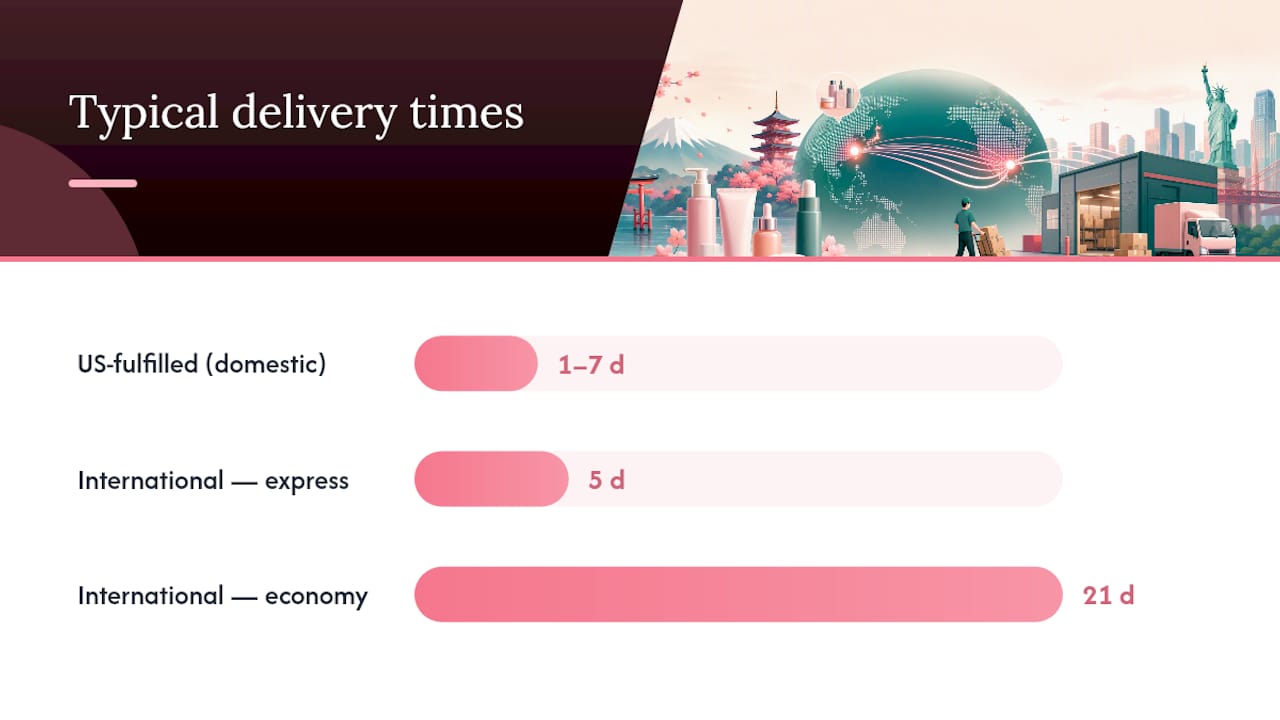
For anything available through a US-fulfilled retailer, domestic shipping wins on nearly every axis. Delivery windows of one to seven business days are standard, returns are simple because you’re mailing back to a US address, and there’s no customs step to go wrong.
When you are shipping internationally, here’s how to keep it under control:
- Choose tracked shipping every time, even if it costs a few dollars more than untracked economy mail. An untracked package that goes missing is not the retailer’s problem to fix.
- Add insurance on orders over roughly $75 to $100. Skincare glass bottles and pressurized packaging (think spray toners or aerosol sunscreens) don’t always survive rough handling.
- Weigh express versus economy honestly. Express international shipping can cut transit time from three weeks to five days, which matters if you’re replacing a product you’re actively out of. If you’re not in a hurry, economy pockets the savings.
- Check your tracking status for customs holds. A package that stalls at a status like “held at customs” or “awaiting duty payment” usually needs action from you: a duty payment, a customs form, or a broker request. Respond promptly. Packages can sit for weeks if nobody replies.
Pro Tip: Set a calendar reminder three days after any international order ships to check tracking. Customs holds often come with a short response window, and missing it can mean the package gets returned to the sender instead of released to you.
How Can You Tell if Japanese Skincare Is Authentic?
Counterfeit and expired skincare are the two risks that actually hurt you, not just your wallet. A fake sunscreen doesn’t protect your skin. An expired serum with degraded actives can irritate skin that a fresh bottle wouldn’t.
Start by checking the listing itself. A “ships from” field showing a US warehouse address, or a storefront explicitly marked as an official brand or authorized retailer, is your strongest signal. On mixed marketplaces, this single check matters more than reviews or star ratings, since third-party sellers can list next to authentic brand storefronts with wildly different sourcing.
- Look for a lot code printed on the box or bottle base. A missing or scratched-off code is a red flag, not a minor detail.
- Compare ingredient labeling. Genuine Japanese-market products usually carry Japanese-language ingredient lists alongside any English sticker; a US “formula” claim on what’s marketed as an imported Japanese product is worth questioning.
- Treat prices well below the typical retail range as a warning sign, not a deal. Authentic Japanese skincare rarely gets discounted 40% to 50% below MSRP outside a documented sale.
- Check how long the seller’s storefront has existed and whether their branding, product photography, and descriptions look consistent across platforms.
If you’re buying direct from a Japan-based seller, ask for photos of the outer packaging and lot code before the item ships. A legitimate seller will do this without hesitation. For a deeper walkthrough of what to check, Spyraverified’s guide to spotting fake skincare covers the specific packaging tells that matter most, and the guide to understanding expiry codes is worth a read before your first order.
| Trust signal | What to check | Red flag |
|---|---|---|
| Seller type | Official brand storefront or verified retailer | Unbranded third-party account, no history |
| Ships from | US warehouse or clearly stated origin | “Ships from” field blank or hidden |
| Pricing | Within normal range of MSRP | 40%+ below typical retail with no sale context |
| Packaging | Visible lot code, matching labeling | No lot code, mismatched fonts or seals |
How Do You Order Japanese Skincare Safely From the US?
Buying safely comes down to five repeatable steps. Run through this checklist and you’ll catch most problems before you pay, not after.
- Search US-fulfilled channels first. Before looking at any Japan-based site, check whether a US retailer or brand storefront already carries the item. This alone eliminates most tariff exposure.
- Calculate total landed cost if you do need to order from Japan. Add the item price, international shipping, and the roughly 15% tariff estimate that current guides use for Japanese beauty imports, then compare that real total against any US price for the same or a similar product.
- Pick your shipping speed deliberately. Tracked shipping is close to mandatory; insurance is worth it above roughly $75; express is worth the premium only if you actually need the product soon.
- Save your receipts and the seller’s contact information, and check tracking every few days if the order is coming internationally. If customs flags the package, you’ll want your order number and any import documentation on hand.
- Inspect the package the day it arrives. Check the lot code, compare it against anything the seller sent you in advance, and confirm the packaging looks consistent with authentic stock. If something’s off, start a return within the seller’s stated policy window immediately. Waiting a week to “see how it feels” can put you outside the return deadline.
Skip step one and you’re often paying more for the same product, waiting longer, and taking on more risk, all at once.
Why Trust This Guide on Shipping Japanese Skincare
This guide draws on how Spyraverified actually operates: sourcing directly from Japanese and Asian manufacturers, verifying products through direct brand partnerships rather than gray-market resale, and fulfilling US orders from domestic inventory instead of shipping every order from overseas. That model exists specifically because the risks covered here (counterfeits, customs surprises, slow transit) are the exact problems US buyers run into with Japanese skincare.
- Spyra Verified partners directly with manufacturers rather than sourcing through unverified resellers.
- Products are verified before listing, reducing the counterfeit and expired-stock risk covered in the authenticity section above.
- US-based distribution means the duty and delivery-speed advantages described throughout this guide apply directly to Spyraverified orders.
For more on how Japanese and Korean formulations differ if you’re still narrowing down what to buy, this comparison is a useful next read before you shop.
Why US Fulfillment Should Be Your Default, Not Your Backup
Most advice on buying Japanese skincare still treats shipping direct from Japan as the “real” way to do it, with US retailers as a consolation prize for people who can’t be bothered. That framing was defensible before August 2025. It isn’t anymore.
The math changed, not the products. A serum shipped from Tokyo isn’t more authentic than the same serum sitting in a US warehouse; it’s just slower and now carries a duty risk it didn’t have before. The buyers who’ll save the most money over the next few years are the ones who flip their default: check US fulfillment first, and treat a Japan-direct order as the exception reserved for things you genuinely can’t get any other way.
Where the conventional advice really falls short is in treating tariffs as a footnote. They’re not. Prioritize availability through US channels first, then worry about the rest.
— Anni
Shop Authentic Japanese Skincare With US Delivery
Spyraverified sources directly from Japanese and Asian manufacturers and fulfills orders from US inventory, which means the tariff exposure and customs uncertainty covered throughout this guide simply don’t apply to your order.
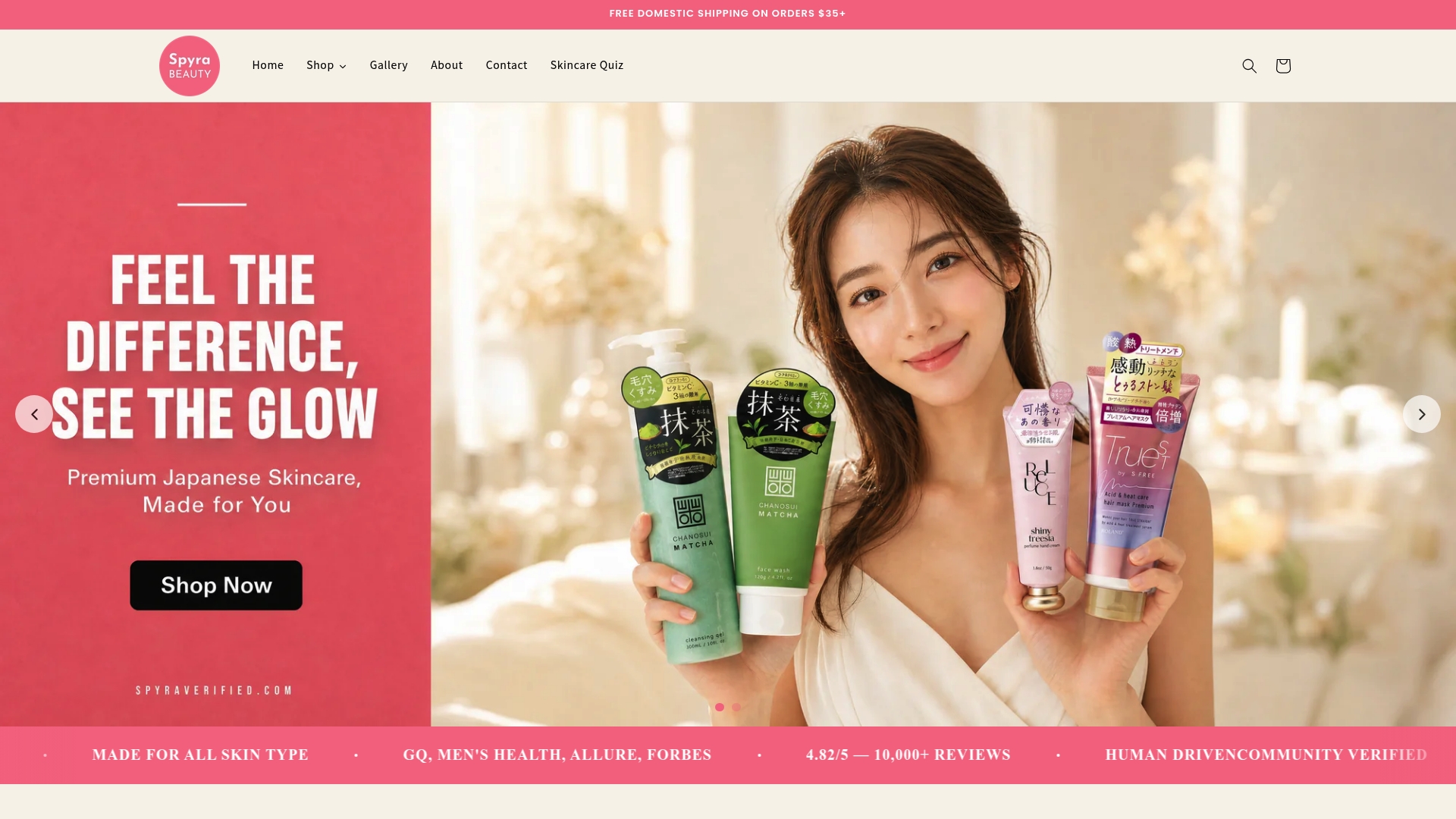
At checkout, you’re looking at domestic shipping speeds, no per-order customs charges tacked on after the fact, and a return process that doesn’t involve mailing anything back to Japan. Every product listed is sourced through direct manufacturer partnerships and verified before it ever reaches inventory, so the authenticity checks covered earlier in this guide are already handled on the retailer’s end. If a product you’re after happens to be a Japan-exclusive not yet in US distribution, that’s the one case worth applying the direct-import math above. For everything else, browse the Spyraverified skincare collection and place your order knowing exactly what you’ll pay before you check out.
Sources
- De‑minimis exemption suspension and its shipping impacts (Easyship)
- Buying Japanese skincare after tariffs: what changed and how to save (Find Japan Beauty)
- Japan beauty and personal care market reporting (Yahoo Finance)
