

Why Fragrance-Free Skincare Benefits Sensitive Skin
Fragrance-free skincare reduces avoidable irritation and helps preserve the skin barrier, which is especially beneficial for sensitive, eczema-prone, rosacea-prone, or acne-prone skin. NHS guidance on contact dermatitis identifies fragrance as one of the most common triggers for skin reactions, and the National Eczema Association specifically flags fragrance and perfume as leading allergens for people with eczema. IFRA (the International Fragrance Association) sets usage limits for fragrance ingredients in cosmetics, but those limits don’t eliminate risk for already-sensitized individuals. For anyone whose skin reacts easily, going fragrance-free isn’t a trend. It’s a practical way to remove a known variable.
The core benefits generally include:
- Reduced irritation and stinging by removing a common chemical trigger
- Fewer allergic flares and decreased redness for reactive or sensitized skin
- Improved barrier healing by reducing ongoing, low-grade inflammatory responses
Key Takeaways
Fragrance-free skincare reduces avoidable irritation, supports barrier repair, and is the evidence-backed choice for sensitive, eczema-prone, rosacea-prone, and acne-prone skin.
| Point | Details |
|---|---|
| “Fragrance-free” vs “unscented” | Only fragrance-free guarantees no added fragrance materials; unscented may contain masking agents. |
| Common culprit chemicals | Limonene, linalool, geraniol, citral, and eugenol are documented sensitizers found in natural and synthetic fragrances. |
| Who benefits most | Eczema, rosacea, acne-prone, infant, elderly, and post-procedure skin all benefit; low-sensitivity individuals may tolerate fragrance but face cumulative risk. |
| Shopping and routine | Read the full ingredient list, look for the National Eczema Association Seal, and patch test every new product for 48 hours. |
| Spyraverified | Curates verified fragrance-free Japanese and Asian skincare with functional ingredients and full ingredient transparency. |
Table of Contents
- Why fragrance-free skincare is beneficial: the label confusion you need to clear up first
- How fragrances trigger irritation and allergic reactions in your skin
- What dermatologists and clinical evidence say about fragrance
- Concrete benefits of switching to fragrance-free skincare
- How to choose genuinely fragrance-free products: a shopping checklist and patch-test steps
- Simple routine swaps for a fragrance-free daily routine
- Common myths about fragrance-free skincare, debunked
- Why fragrance-free curation matters more than you’d think
- Spyraverified’s fragrance-free skincare collection
- Sources
Why fragrance-free skincare is beneficial: the label confusion you need to clear up first
“Fragrance-free” and “unscented” are not the same thing, and that distinction matters more than most people realize.
Fragrance-free means no fragrance materials were added to the formula. The product may still have a faint natural smell from its base ingredients, but nothing was added to create or enhance a scent.
Unscented is trickier. Acibadem Hospitals Group’s clinical review explains that unscented products often contain masking agents — chemicals added specifically to neutralize the smell of other ingredients. Those masking agents are themselves fragrance materials, and they can still irritate sensitive skin.
Naturally scented products use essential oils or botanical extracts for scent. These are still fragrance materials. Limonene from citrus peel, linalool from lavender, and geraniol from rose oil are all naturally derived and all documented skin sensitizers.
What to look for on the ingredient list
| Term on label | What it actually means | Safe for fragrance-sensitive skin? |
|---|---|---|
| Fragrance-free | No added fragrance materials | Yes, if the rest of the formula is clean |
| Unscented | May contain masking agents | Not reliably |
| No added fragrance | Similar to fragrance-free; check full list | Usually, with verification |
| Naturally scented | Essential oils or botanicals used for scent | No — still contains allergens |
| Parfum / Fragrance | Synthetic or blended fragrance compound | No |
Label-reading checklist:
- Scan the ingredient list for “parfum” or “fragrance” — these are catch-all terms that can hide dozens of individual chemicals
- Watch for essential oil names: lavender oil, eucalyptus oil, peppermint oil, citrus peel extract
- Look for specific allergen names: limonene, linalool, geraniol, citral, eugenol
- Prefer products with short, functional ingredient lists where every item has a clear purpose
How fragrances trigger irritation and allergic reactions in your skin
Two distinct mechanisms are at work when fragrance causes a skin problem, and understanding them helps explain why fragrance-free skincare advantages go beyond just comfort.
Irritant contact dermatitis is a direct chemical injury. Fragrance molecules disrupt the skin’s lipid barrier, allowing irritants to penetrate more easily. The result is redness, stinging, or dryness that appears relatively quickly after exposure. No prior sensitization is needed — it can happen on first contact, especially when the barrier is already compromised.
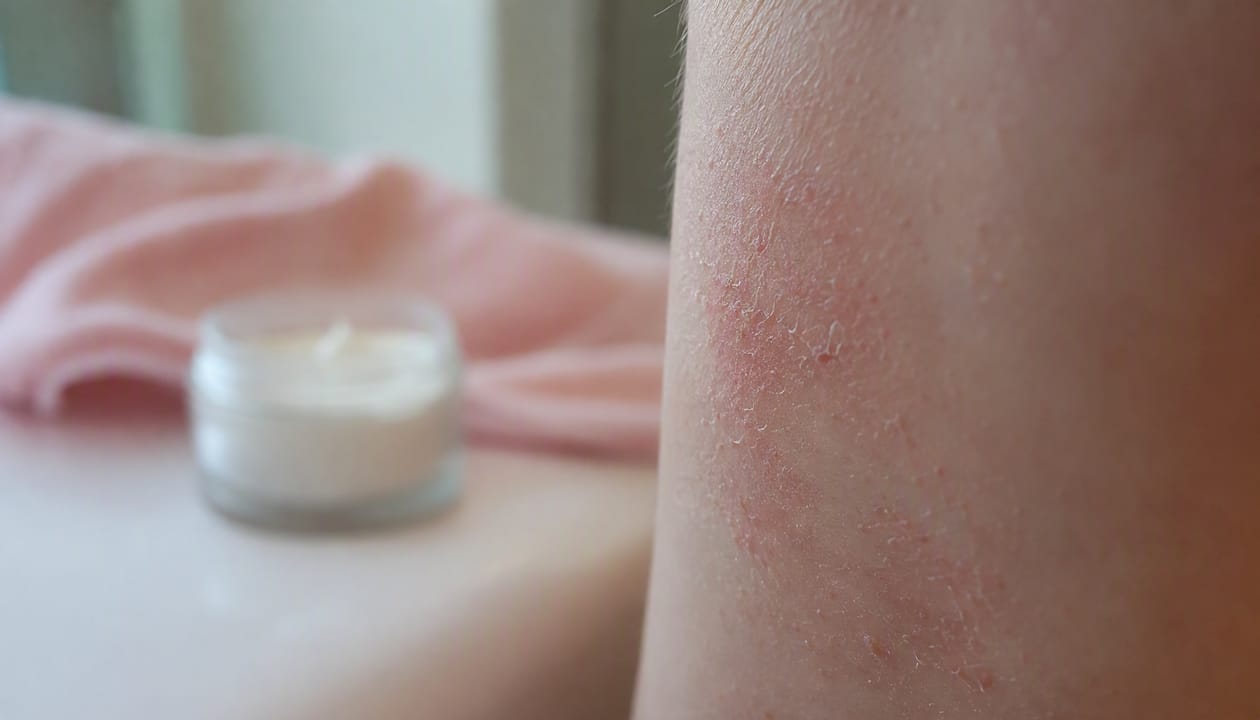
Allergic contact dermatitis is an immune response. The skin becomes sensitized to a specific fragrance molecule over repeated exposures, then mounts a delayed hypersensitivity reaction. Peer-reviewed clinical literature on PMC documents this sensitization mechanism in detail and confirms that fragrance is among the most common causes of cosmetic-related allergic contact dermatitis.
Common culprit chemicals include:
- Limonene (citrus-derived, oxidizes on skin contact to form potent sensitizers)
- Linalool (found in lavender, bergamot, and many “natural” formulas)
- Geraniol (rose and geranium extracts)
- Citral (lemongrass, lemon myrtle)
- Eugenol (clove, cinnamon, many “warming” botanical blends)
These are volatile small molecules, which means they penetrate the skin readily. For more detail on how these fragrance allergy triggers appear on labels and what to watch for, Spyraverified has a dedicated breakdown.
The downstream effects matter too. Chronic low-grade inflammation from fragrance exposure delays blemish healing, worsens post-inflammatory hyperpigmentation, particularly relevant for deeper skin tones, and keeps acne inflammation active longer. For anyone already managing a reactive skin condition, that’s a compounding problem.
What dermatologists and clinical evidence say about fragrance
The guidance from major dermatology bodies is consistent. The American Academy of Dermatology recommends fragrance-free formulations for people with known sensitivities and points to functional alternatives — ceramides, glycerin, niacinamide — as the ingredients that actually support skin health in those formulas. The logic is straightforward: fragrance adds sensory appeal but no therapeutic benefit, so removing it reduces risk without sacrificing efficacy.
NHS contact dermatitis guidance advises avoiding known irritants and allergens, with fragrance explicitly named, and recommends medical assessment for persistent or severe reactions. That’s worth noting: if a rash doesn’t clear after removing fragrance products, a dermatologist patch test can identify the specific allergen.
IFRA regulates fragrance usage in cosmetics by setting concentration limits for individual ingredients. Those limits reduce risk for the general population, but they don’t protect everyone. A person who has already developed sensitization to linalool or limonene will react at concentrations well below IFRA’s thresholds. Regulation sets a floor; it doesn’t set a ceiling for individual sensitivity.
Key clinical takeaways:
- Fragrance-free is the standard recommendation for eczema, rosacea, and contact dermatitis management
- Sensitization is cumulative and can develop after years of uneventful use
- Patch testing by a dermatologist (not just at-home testing) is the gold standard for identifying specific fragrance allergens
- “Hypoallergenic” on a label has no regulated definition in the United States; it does not mean fragrance-free
Concrete benefits of switching to fragrance-free skincare
The National Eczema Association notes that for eczema-prone skin, fragrance is a leading trigger for flares, and removing it is one of the most direct ways to reduce barrier disruption. That same principle applies across several reactive skin types.
Reduced stinging and burning. Products without fragrance are less likely to cause the immediate discomfort that many people with sensitive skin accept as normal. That stinging isn’t a sign the product is “working” — it’s a sign of irritation.
Fewer allergic flares. Removing fragrance eliminates one of the most common triggers for delayed hypersensitivity reactions. For rosacea-prone skin, this also means less flushing and fewer visible capillary responses.
Improved barrier function. Fragrance-free formulas tend to focus on barrier-supporting ingredients. Less ongoing irritation means the barrier gets a chance to repair itself, reducing transepidermal water loss (TEWL) over time.
Better tolerance of active ingredients. Retinoids, AHAs, and BHAs are already challenging for reactive skin. Pairing them with a fragrance-containing base product compounds the irritation load. Fragrance-free formulas let you use actives without stacking triggers.
Faster blemish healing. Fragrance-driven inflammation keeps skin reactive longer, which slows the resolution of acne lesions and extends the window for post-inflammatory hyperpigmentation to develop.
Who benefits most: people with eczema, rosacea, acne-prone skin, infants, older adults with thinning skin, and anyone recovering from a procedure (chemical peel, laser, microneedling). For people with no history of sensitivity, low-level fragrance in a well-formulated product often causes no reaction — but cumulative exposure over years can shift that.
Pro Tip: When introducing a new active ingredient like a retinoid or acid, switch your entire routine to fragrance-free first. That way, if irritation occurs, you know the active is the variable, not a hidden fragrance in your cleanser or moisturizer.
How to choose genuinely fragrance-free products: a shopping checklist and patch-test steps
Front-label claims are marketing. The ingredient list is the truth. Here’s a practical framework for skincare for acne-prone skin and other reactive types that actually holds up.
Shopping checklist:
- Read the full ingredient list — not just the front label. Look for “parfum,” “fragrance,” essential oil names, and the specific allergens listed above.
- Look for certification seals. The National Eczema Association Seal of Acceptance generally indicates a product has been reviewed and likely contains no fragrance materials. The EPA Safer Choice Fragrance-Free designation is another reliable signal.
- Prefer short, functional lists. Ceramides, glycerin, niacinamide, hyaluronic acid, and mild syndet cleansers are the workhorses of fragrance-free formulas. If an ingredient’s only job is to smell good, it shouldn’t be there.
- Avoid “no added fragrance” without verification. This phrase isn’t regulated the same way “fragrance-free” is in the US. Check the list anyway.
- Be skeptical of “natural” or “botanical” formulas. Essential oils are fragrance materials. A product marketed as “clean” or “natural” can still contain multiple sensitizing fragrance compounds.
Functional ingredients to look for:
- Ceramides (NP, AP, EOP) for barrier repair
- Glycerin for humectant hydration
- Niacinamide for anti-inflammatory support and barrier strengthening
- Hyaluronic acid for surface hydration
- Mild syndet (synthetic detergent) cleansers that don’t strip the barrier
Patch-test protocol
Patch testing is the single most reliable way to check a new product before committing to full-face use.
- Apply a small amount of the product to the inside of your forearm or behind your ear.
- Leave it on for 24 hours without washing.
- Check at 24 hours and again at 48 hours for redness, itching, swelling, or bumps.
- If no reaction appears after 48 hours, the product is likely safe for your skin type.
- Stop immediately if any reaction develops, and note the product’s ingredient list to identify the likely trigger.
Pro Tip: Test one new product at a time, with at least a week between introductions. If you add three products simultaneously and react, you won’t know which one caused it.
Simple routine swaps for a fragrance-free daily routine
Building a fragrance-free routine doesn’t mean giving up performance. It means choosing product types where the active work is done by functional ingredients, not fragrance.
Core product swaps:
- Cleanser: swap a foaming, fragranced face wash for a mild syndet bar or a low-pH gel cleanser with no added fragrance. Syndet cleansers maintain a skin-compatible pH and don’t strip the barrier.
- Moisturizer: swap a scented lotion for a ceramide-rich cream or gel. Apply immediately after cleansing while skin is still slightly damp to lock in moisture.
- Sunscreen: swap a fragranced SPF for a fragrance-free broad-spectrum mineral or chemical SPF 30+. Many mineral sunscreens (zinc oxide, titanium dioxide) are naturally fragrance-free and well-tolerated by reactive skin.
- Serums: swap multi-ingredient “glow” serums (which often contain botanical extracts for scent) for single-active formulations: pure niacinamide, hyaluronic acid, or azelaic acid.
- Essences: lightweight fragrance-free essences can deliver hydration and functional actives without the sensitizing risk of scented toners.
Example AM routine:
- Rinse with cool water or use a mild syndet cleanser
- Apply fragrance-free hyaluronic acid serum to damp skin
- Follow with a ceramide moisturizer
- Finish with fragrance-free broad-spectrum SPF 30+
Example PM routine:
- Double cleanse: oil-based cleanser (fragrance-free) to remove SPF, then mild syndet cleanser
- Apply any active (retinoid or acid) — fragrance-free formula only
- Follow with ceramide moisturizer; apply while skin is still slightly damp
Special cases: For baby skin, fragrance-free is the baseline, not the exception. Infant skin has a thinner barrier and higher surface-area-to-body-weight ratio, making it more vulnerable to absorption of fragrance chemicals. For post-procedure skin (after a peel or laser), fragrance-free products are non-negotiable during recovery. Older adults with thinning skin benefit from the same approach.
Pro Tip: If you’re managing eczema-prone skin, moisturizing immediately after cleansing — within two to three minutes — is one of the most evidence-backed steps for reducing TEWL and supporting barrier repair.
Common myths about fragrance-free skincare, debunked
Myth: Fragrance improves a product’s performance. Fragrance is added for sensory appeal, not efficacy. No fragrance ingredient repairs the barrier, reduces inflammation, or delivers hydration. Removing it doesn’t weaken a formula. If anything, it frees up the formula to focus on functional ingredients.
Myth: Natural scents are always safer than synthetic ones. Limonene, linalool, and geraniol are all naturally derived and all documented allergens. Healthline’s overview of fragrance notes that fragrance-containing products — natural or synthetic — can cause irritation, headaches, and respiratory symptoms in some people. “Natural” describes origin, not safety profile.
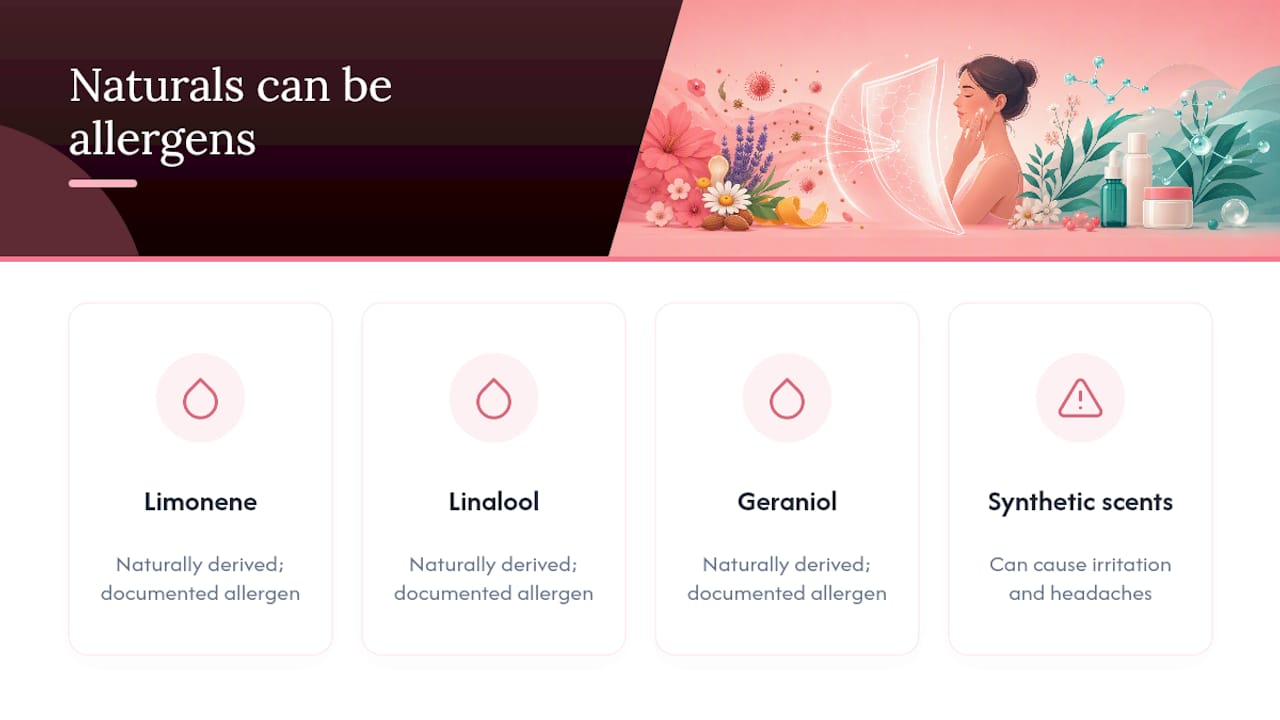
Myth: Unscented means fragrance-free. Unscented products often contain masking agents to neutralize odor. Those agents are fragrance materials. Always read the ingredient list rather than relying on the front label.
Myth: If you’ve used a product for years without a reaction, you’re safe. Sensitization is cumulative. A fragrance ingredient tolerated for years can eventually trigger an allergic response once the immune threshold is crossed. This is why dermatologists recommend fragrance-free as a long-term strategy, not just a short-term fix.
Myth: Fragrance-free products are less pleasant to use. This is the one with the most personal variation. Many people find that once they stop using fragranced products, the absence of scent becomes the norm, and they stop missing it. The skin often improves noticeably within a few weeks, which tends to be its own motivation.
Why fragrance-free curation matters more than you’d think
Most skincare advice treats fragrance-free as a simple binary: either a product has fragrance or it doesn’t. The reality is messier. A product can be labeled fragrance-free and still contain botanical extracts that function as fragrance materials. A product can carry a “clean beauty” badge and list linalool and limonene in the ingredient panel. The label is not the formula.
What actually matters is whether the people sourcing and curating products have read the ingredient lists carefully, understand the difference between masking agents and true fragrance-free formulations, and have filtered for the functional ingredients that support barrier health. That’s a sourcing and curation problem as much as a chemistry problem.
For people with reactive skin, the cumulative fragrance load across a full routine adds up fast: a fragranced cleanser, a scented toner, a moisturizer with “natural botanical extracts,” and a perfumed SPF can mean four separate fragrance exposures before 9 AM. Switching one product to fragrance-free helps; switching the whole routine is where the real difference shows.
Spyraverified’s fragrance-free skincare collection
Spyraverified curates Japanese and Asian skincare products sourced directly from verified manufacturers, with ingredient transparency as a core part of the selection process. The fragrance-free picks in the skincare collection are chosen specifically for short, functional ingredient lists — ceramides, niacinamide, glycerin, and hyaluronic acid as the active workhorses, with no added parfum or masking agents.
Every product ships with full ingredient documentation so you can verify the formula before it arrives. Authenticity is sourced directly from brand partners, which means fewer ingredient surprises than you’d get from a third-party reseller. If you’re building a fragrance-free routine from scratch, the skincare collection is a practical starting point. Browse the collection, patch test each new addition, and consult a dermatologist if you’re managing a persistent skin condition.
Sources
The following sources were used to support the clinical and practical claims in this article. For persistent or severe skin reactions, consult a board-certified dermatologist.
- American Academy of Dermatology (AAD)
- Contact dermatitis - NHS
- PMC article on fragrance-related contact dermatitis
- Unscented Soap explained by medical evidence - Acibadem Hospitals Group
- What Actually Is Fragrance? And Why You Might Want to Avoid It | Healthline
This article is general information, not a substitute for advice from a qualified doctor. Consult a qualified healthcare professional about your own circumstances before acting on anything here.
