

Why Are Japanese Beauty Products So Popular?
Japanese beauty products are defined by their focus on long-term skin health rather than short-term cosmetic fixes. This philosophy, known in the industry as J-Beauty, drives global demand for Japanese skincare and cosmetics. The skincare segment alone commands 46.6% of a total market valued at more than $35 billion. That scale reflects something real: consumers worldwide trust Japanese formulations to deliver consistent, science-backed results. Understanding why Japanese beauty products are popular means looking at three converging forces: advanced research and development, a prevention-first skincare philosophy, and a deep commitment to ingredient quality.
Why are Japanese beauty products popular with global consumers?
Japan leads skincare science in ways that most markets cannot replicate. Japanese R&D centers set the global standard for texture, efficacy, and how a product feels on the skin. That leadership is so recognized that luxury brands like Chanel and Dior have established dedicated research centers in Tokyo to adapt their formulas to Japanese skin attributes and sensory expectations. This is not a marketing move. It reflects the fact that Japanese sensory testing is the benchmark for what a premium skincare product should feel like.

Japanese R&D also addresses the specific biology of Asian skin. Asian skin typically has higher melanocyte density and greater sebum production than European skin types. Those differences require specialized ingredient approaches for pigmentation control and oil balance. Japanese scientists have spent decades developing actives that address these needs without disrupting the skin barrier. The result is a body of formulation knowledge that no other country has matched at scale.
One regulatory factor amplifies this trust further. Japan classifies certain cosmetics as “quasi-drugs,” a category that requires stricter efficacy and ingredient verification than standard cosmetics. About 50% of makeup shipment value in Japan consists of these medicated beauty products. That means half the market is held to a standard closer to pharmaceuticals than to typical cosmetics. Consumers who buy quasi-drug products know the efficacy claims have been tested and verified.
“Global luxury brands recognize Japanese sensory research as the standard for texture and feel, often requiring Japanese testing to meet local consumer expectations.”
Pro Tip: When shopping for Japanese skincare, look for the quasi-drug designation on the packaging. It signals that the product has passed a higher level of efficacy review than a standard cosmetic.
How does the J-Beauty philosophy differ from other skincare traditions?
J-Beauty is built on a single principle: protect the skin barrier first, correct problems second. This stands in direct contrast to skincare traditions that lead with aggressive exfoliation, high-concentration actives, or rapid visible results. The J-Beauty approach prioritizes gentle cleansing, consistent hydration, and daily high-performance sun protection rated PA++++. Prevention is the goal, not correction.
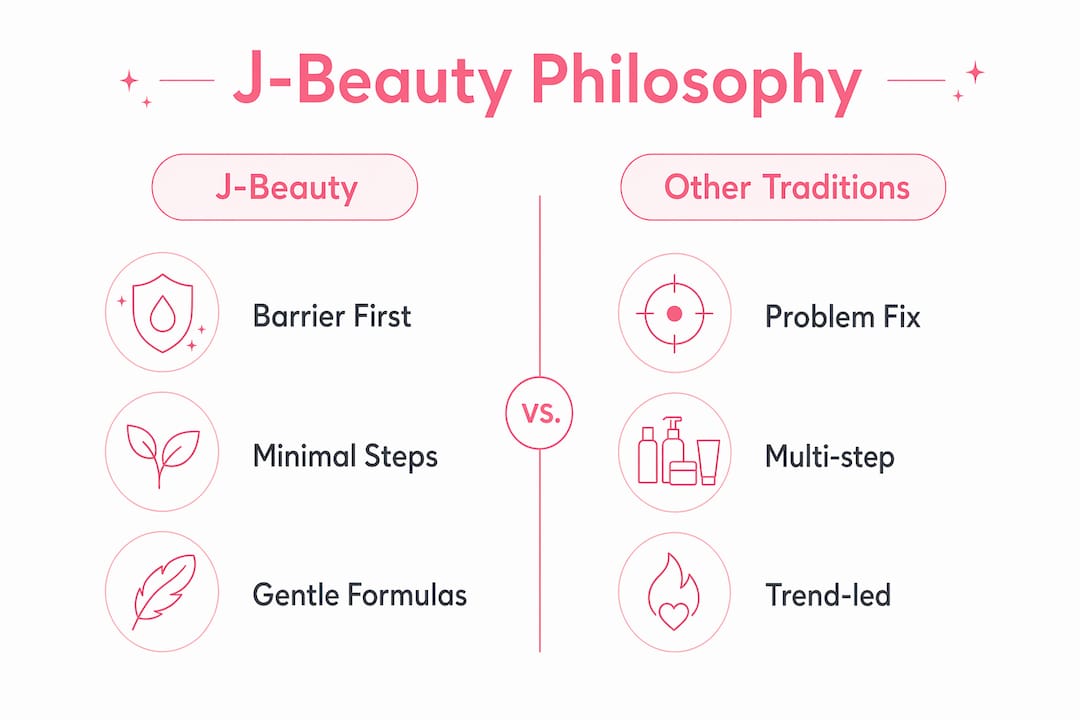
The comparison with K-Beauty is worth making clearly. K-Beauty routines are often trend-led and multi-step, with new product categories appearing each season. J-Beauty routines are minimal and consistent. The focus is on doing a few things exceptionally well every day rather than layering on new products in response to trends. For consumers who want results without complexity, J-Beauty offers a more sustainable path.
The layering technique is central to how J-Beauty delivers hydration. Products are applied from thinnest to thickest texture, starting with a lightweight essence and finishing with a cream or oil. This sequencing allows each layer to absorb fully before the next is applied, which hydrates deeply without clogging pores or leaving a heavy residue. Western moisturizers often rely on occlusive ingredients that sit on top of the skin. Japanese layering works differently by drawing moisture into the skin at multiple levels.
Key elements of a standard J-Beauty routine include:
- Double cleansing: An oil cleanser removes sunscreen and makeup, followed by a gentle foam cleanser for the skin itself.
- Hydrating essence: A lightweight, water-based layer applied immediately after cleansing to prep the skin for absorption.
- Targeted serum: A concentrated treatment for specific concerns like pigmentation or fine lines, used sparingly.
- Moisturizer: A cream or emulsion to seal in hydration without heaviness.
- PA++++ sunscreen: Applied every morning as the final and most non-negotiable step.
Pro Tip: Japanese sunscreens are among the best-formulated globally for daily wear. They absorb without residue and layer cleanly under makeup, which removes the most common excuse for skipping SPF.
What ingredients make Japanese skincare products stand out?
Ingredient quality is the foundation of Japanese beauty’s global reputation. Approximately 40% of Japanese beauty consumers prioritize natural ingredients, while 18% actively seek sustainable options. Those preferences have shaped how Japanese brands formulate their products, pushing them toward botanicals and actives that are both effective and gentle.
The most recognized ingredients in Japanese skincare include:
- Ceramides: Lipid molecules that reinforce the skin barrier. Japanese ceramide research spans more than 25 years, and proprietary ceramide formulations have earned strong trust from both consumers and dermatologists for their safety and effectiveness, particularly for sensitive skin.
- Rice extracts: Rich in antioxidants and amino acids, rice bran and fermented rice water have been used in Japanese beauty for centuries. Modern formulations concentrate these benefits into targeted actives.
- Fermented ingredients: Fermentation increases the bioavailability of actives, allowing them to penetrate the skin more effectively. Japanese brands have refined fermentation science to a degree that few other markets have matched.
- Vitamin C derivatives: Japanese chemists developed stabilized vitamin C derivatives that deliver brightening benefits without the irritation associated with pure ascorbic acid. These are now used globally.
| Ingredient | Primary benefit | Skin type suitability |
|---|---|---|
| Ceramides | Barrier repair and moisture retention | All types, especially sensitive |
| Rice extract | Brightening and antioxidant protection | All types |
| Fermented actives | Deep hydration and improved absorption | Dry, dull, or aging skin |
| Vitamin C derivatives | Pigmentation control and radiance | All types, including reactive skin |
For consumers exploring Japanese anti-aging ingredients, the science behind these actives is well documented and clinically supported. This is not trend-driven formulation. It is decades of targeted research applied to real skin concerns.
How does Japanese beauty maintain its global appeal as markets evolve?
The Japanese cosmetic market is valued at $3.79 billion in 2025 and is projected to reach $4.75 billion by 2031, growing at a compound annual rate of 3.85%. That growth is not driven by novelty. It is driven by consumer trust in efficacy, safety, and consistency.
Several forces are accelerating international interest in Japanese beauty:
- Premiumization: Consumers globally are trading up to products with verified efficacy claims. Japanese quasi-drug products and high-end skincare lines meet that demand directly.
- E-commerce access: Digital retail has removed the geographic barrier that once limited Japanese beauty to specialty stores or travel purchases. Platforms like Spyraverified now bring authenticated Japanese brands to consumers who could not previously access them.
- Travel retail: Japanese airports and department stores introduced millions of international travelers to J-Beauty. Many of those consumers became repeat buyers after returning home.
- Dermatologist endorsement: The clinical backing behind Japanese ceramide technology and barrier-first formulations has earned J-Beauty credibility in medical and professional skincare communities.
The shift toward premium, efficacy-driven products is a global trend, and Japanese beauty is positioned at the center of it. The market’s growth reflects a broader consumer shift away from cosmetic-only products toward formulations that genuinely improve skin health over time.
Key Takeaways
Japanese beauty products earn global trust because they combine verified scientific rigor, a prevention-first philosophy, and ingredient quality that most markets have not matched.
| Point | Details |
|---|---|
| Science sets the standard | Japanese R&D centers define global benchmarks for texture, efficacy, and sensory performance. |
| Quasi-drug classification matters | About 50% of Japanese makeup shipments are medicated products held to pharmaceutical-level efficacy standards. |
| Layering drives results | Applying products from thinnest to thickest texture hydrates deeply without pore congestion. |
| Ingredients are research-backed | Ceramides, fermented actives, and stabilized vitamin C derivatives are supported by decades of clinical research. |
| Market growth signals trust | The Japanese cosmetics market is projected to grow from $3.79 billion in 2025 to $4.75 billion by 2031. |
What I’ve learned from years of watching J-Beauty go global
The most common mistake I see consumers make is treating J-Beauty as a trend. It is not. It is a methodology. When you understand that the goal is barrier health maintained over years, not a visible fix in two weeks, the entire product lineup makes sense. The essences, the layering, the obsessive focus on sunscreen — none of it is arbitrary. It is all in service of one outcome: skin that ages well because it was protected consistently.
What strikes me most about Japanese beauty is how little it relies on marketing language. The products do not promise miracles. They promise consistency. That restraint is itself a signal of quality. Brands that know their formulations work do not need to oversell them.
The ceramide story is a good example. Ceramide research spanning 25 years produced formulations that dermatologists now recommend for compromised skin barriers. That kind of credibility is not built through advertising. It is built through results that hold up under clinical scrutiny. If you are thinking about transitioning to Japanese skincare, start with the barrier basics: a gentle cleanser, a hydrating essence, and a PA++++ sunscreen. Build from there. The philosophy rewards patience, and your skin will show it.
— Anni
Japanese beauty, curated for where you are
Spyraverified brings authenticated Japanese and Asian beauty brands to consumers who want the real thing without the guesswork of sourcing from overseas. The Spyraverified skincare collection is built around the same principles that make J-Beauty trusted worldwide: gentle formulations, barrier-supporting ingredients, and products designed for consistent daily use.
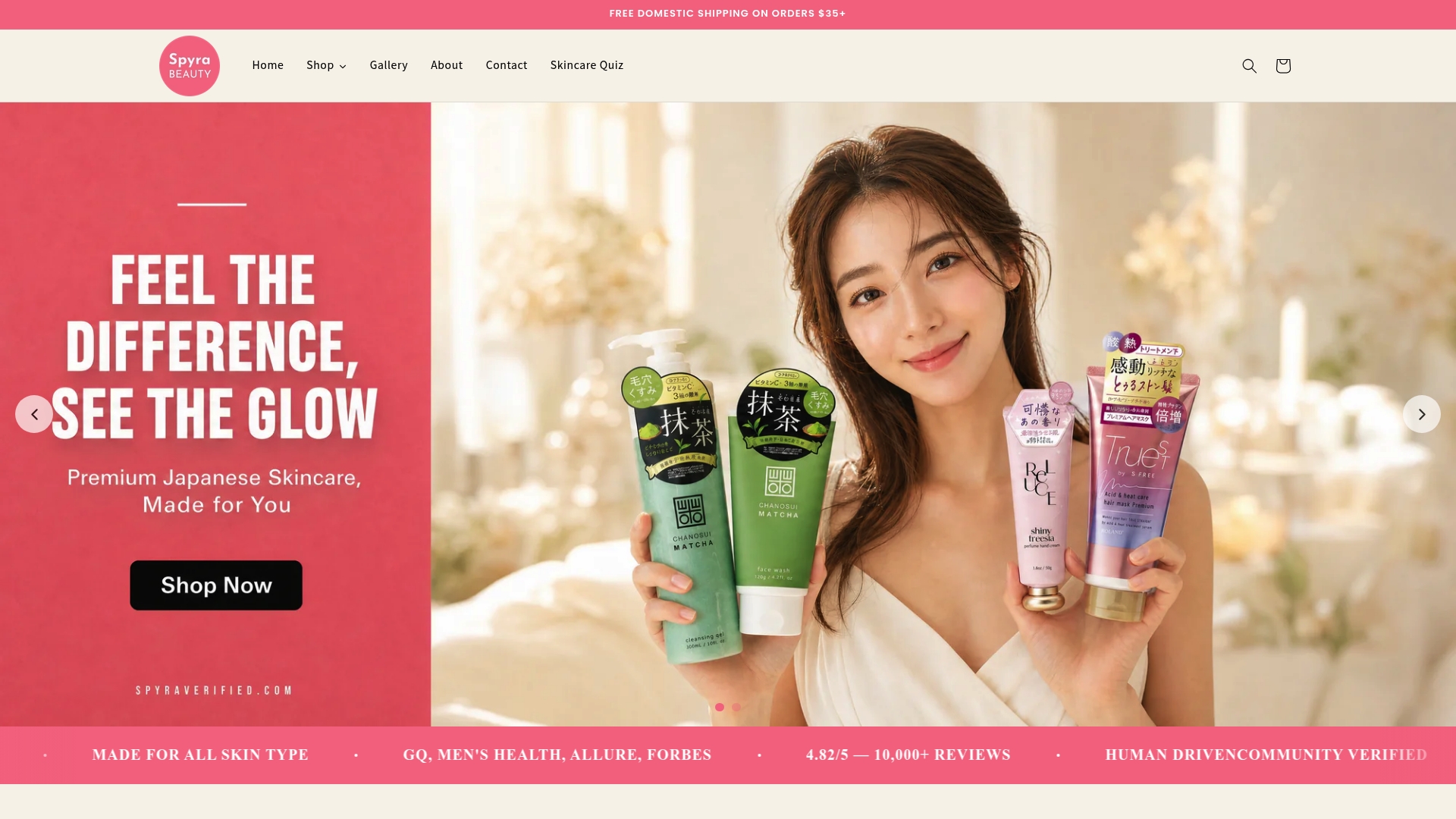
One standout is the Goshinboku Aroma Mist, a product that brings traditional Japanese hinoki cypress into a modern skincare format. It reflects the J-Beauty commitment to natural, high-value botanicals with a clear functional purpose. Every product in the Spyraverified range is selected for ingredient integrity and alignment with Japanese skincare philosophy. Browse the collection and find what your skin actually needs.
FAQ
What makes Japanese beauty products different from Western skincare?
Japanese skincare prioritizes long-term barrier health through gentle, layered formulations and daily sun protection, while many Western products focus on faster-acting corrective treatments. The quasi-drug regulatory category also holds Japanese products to stricter efficacy standards than typical cosmetics.
Is J-Beauty or K-Beauty better for sensitive skin?
J-Beauty is generally better suited to sensitive skin because it emphasizes minimal steps, gentle cleansing, and barrier-supporting ingredients like ceramides. K-Beauty routines can include more active ingredients and trend-driven steps that may cause irritation for reactive skin types.
Why do Japanese sunscreens have a better reputation than Western ones?
Japanese sunscreens are formulated with feather-light textures that absorb without residue or chalkiness, and they carry the PA++++ rating for superior UVA protection. This combination of performance and wearability makes them the preferred daily SPF for consumers worldwide.
What are the most important ingredients in Japanese skincare?
Ceramides, fermented rice extracts, stabilized vitamin C derivatives, and fermented actives are the core ingredients in Japanese skincare. Each is supported by clinical research and chosen for efficacy without irritation.
How large is the Japanese beauty market?
The Japanese cosmetics market is valued at $3.79 billion in 2025 and is projected to reach $4.75 billion by 2031, growing at a 3.85% compound annual rate. That growth reflects sustained global consumer demand for efficacy-driven, premium skincare products.
