


What Witch Hazel Does for Skin: Benefits and How to Use It
Witch hazel is a plant-derived astringent with mild anti-inflammatory effects. Applied topically, it can temporarily tighten the look of pores, cut surface oil, and calm minor irritation. The primary supporting benefits:
- Reduces redness from sun exposure, bug bites, or razor burn
- Tightens pores and depuffs under-eye skin
- Controls shine on oily and acne-prone skin
- Calms scalp itching in some shampoo formulations
The FDA classifies witch hazel as GRASE (generally recognized as safe and effective) for over-the-counter skin-protectant use. Before you reach for a bottle, patch-test it, skip alcohol-heavy versions if your skin runs dry or sensitive, and never apply it to open wounds.
Key Takeaways
Witch hazel works as a topical astringent and mild anti-inflammatory, and alcohol-free formulations deliver those benefits with far less risk of drying out skin.
| Point | Details |
|---|---|
| Core effect | Tannins and gallic acid tighten pores, reduce oil, and calm minor redness. |
| Best evidence | FDA lists it GRASE for OTC astringent use; small trials show reduced UV redness and scalp irritation. |
| Acne role | Helps oil control and mild blemishes but doesn’t replace salicylic acid or prescription treatment. |
| Safety rule | Patch-test first, avoid open wounds, and stop use if burning or flaking appears. |
| Product choice | Spyraverified’s skincare collection lets you compare alcohol-free, water-based witch hazel toners before buying. |
Table of Contents
- What Does Witch Hazel Do for Skin Inflammation and Redness?
- Can Witch Hazel Help With Acne and Oily Skin?
- Does Witch Hazel Soothe an Itchy or Sensitive Scalp?
- Other Common Uses You’ll See Recommended Online
- How Witch Hazel Works on Skin, Explained Simply
- What Do Dermatologists and Clinical Studies Say?
- How to Add Witch Hazel to Your Skin Care Routine Safely
- How to Choose a Witch Hazel Product for Your Skin Type
- Why We Recommend Alcohol-Free Witch Hazel First
- Where to Find Gentle, Verified Witch Hazel Formulas
- Frequently Asked Questions
- Sources
What Does Witch Hazel Do for Skin Inflammation and Redness?
Witch hazel calms redness because its tannins and gallic acid interrupt the inflammatory signals that make skin flush and swell. A trial cited by MedicineNet found a 10% distilled witch hazel lotion reduced UV-induced redness in 40 participants, and a separate 48-person study showed a low-dose witch hazel cream outperformed chamomile for erythema, though it fell short of 1% hydrocortisone.
That puts witch hazel in a useful middle tier: not a steroid, but more than a placebo. It handles everyday flare-ups well.
- Sunburn or wind-chapped cheeks after a day outside
- Puffy under-eyes during allergy season
- Razor burn right after shaving
- Mosquito or gnat bites that itch and swell
Can Witch Hazel Help With Acne and Oily Skin?
Witch hazel helps with oil control and some noninflammatory blemishes, but it will not replace salicylic acid, benzoyl peroxide, or a prescription retinoid for real acne. Its astringent action tightens tissue and mildly reduces surface bacteria, which explains why it shows up in so many oil-control toners, according to dermatology-focused skincare guidance.
If you’re adding it to an acne routine, keep these in mind:
- Choose alcohol-free formulas; alcohol strips oil short-term but often triggers rebound breakouts
- Don’t layer it directly under a strong retinoid without testing tolerance first
- Use it as a spot treatment or light toner, not a leave-on acne medication
- Watch for tightness or flaking, both signs you’re overdoing it
Witch hazel’s astringent and mild antibacterial properties support short-term shine control, but the evidence backs surface-level benefit, not treatment of diagnosed acne.
Does Witch Hazel Soothe an Itchy or Sensitive Scalp?
Witch hazel-containing shampoos can reduce scalp itching and surface redness for some people. In a large shampoo study covering 1,373 people, witch hazel extract improved scalp irritation noticeably enough to be worth noting in the trial results.
To use it on your scalp:
- Apply a witch hazel-infused pre-shampoo treatment or diluted rinse before washing
- Follow the product’s stated contact time rather than guessing
- Stick to leave-on scalp serums only if the label says they’re formulated for that use
Skip it on broken, weepy, or actively inflamed scalp skin, and stop immediately if tingling turns into burning.
Other Common Uses You’ll See Recommended Online
Search around and you’ll find witch hazel recommended for hemorrhoid pads, minor razor bumps, bug bites, and under-eye puffiness. Each has a caveat: hemorrhoid relief is a recognized OTC use, razor bumps and bites respond to its anti-inflammatory action, and depuffing works mainly because tannins temporarily contract skin tissue.
Evidence varies by use case. Witch hazel soothes surface symptoms; it is not a cure for any diagnosed medical condition.
How Witch Hazel Works on Skin, Explained Simply
Witch hazel’s tannins and gallic acid bind proteins in the outer skin layer, causing mild tissue contraction. That’s the astringent effect people feel as “tightening,” and it’s also why pores look smaller right after application, per Healthline’s breakdown of the compound. Traditional distillations include alcohol, which speeds up oil removal but pulls moisture along with it.
- Tannins contract tissue, producing the tightening sensation
- Gallic acid contributes to the anti-inflammatory effect
- Alcohol content boosts short-term oil removal but increases dryness risk
- Water- or aloe-based extracts preserve soothing benefits with less irritation
Pro Tip: Reach for an alcohol-free, aloe- or water-based witch hazel formula for daily use. Save alcohol-based versions for occasional, targeted spot treatment only.
What Do Dermatologists and Clinical Studies Say?
The FDA’s GRASE designation covers witch hazel for OTC astringent and skin-protectant uses, and several small trials back that up: reduced UV-related redness, improved scalp irritation in more than 1,300 participants, and modest improvement in a 72-person eczema trial. That said, low-dose hydrocortisone outperformed witch hazel in both the eczema and erythema comparisons, according to the same MedicineNet clinical summary.
Small trials show a real but limited signal. Witch hazel is not uniformly superior to low-dose hydrocortisone for inflammatory skin conditions.
Dermatologists generally frame it this way; for a gentle approach to redness-prone skin, see our guide to rosacea natural skincare routines.
- Good fit for oily or acne-prone skin, provided the formula is alcohol-free
- Skip it if you have rosacea, eczema flare-ups, or very dry, reactive skin
- Always patch-test on your inner arm 24 hours before applying to your face
- Discontinue if you notice burning, stinging, or new flaking
How to Add Witch Hazel to Your Skin Care Routine Safely
Here’s the step-by-step way to try it without guessing your way into irritation:
- Patch-test a small amount on your inner forearm and wait 24 hours.
- Cleanse your face as usual, then apply witch hazel with a cotton pad once daily.
- Let it dry fully before layering on moisturizer to lock in hydration.
- Apply SPF every morning, since freshly astringed skin can feel more reactive to sun.
- Reassess after one week. If skin feels tight, flaky, or irritated, cut back to every other day or stop.
Combining witch hazel with retinoids or strong acids raises irritation risk. Introduce one active ingredient at a time and space out application if needed.
Avoid applying it over open wounds, active breakouts with broken skin, or freshly shaved areas that are still raw. If you’re layering multiple products, check that you’re not stacking two irritants back to back.
Pro Tip: Read the ingredient list, not just the front label. “Witch hazel water” and products marketing themselves as toners can still list SD alcohol high up, which tells you more than the word “natural” on the front of the bottle.
How to Choose a Witch Hazel Product for Your Skin Type
Look for alcohol-free on the label first. That single word separates a soothing daily toner from a drying one. After that, check for supporting ingredients like aloe vera, rose water, or glycerin, which cushion the astringent effect. Fragrance-free versions are the safer call if your skin reacts easily.
- Alcohol-free or “SD alcohol-free” stated clearly on the label
- Supporting humectants like aloe or rose water listed near the top of ingredients
- Fragrance-free formulation for sensitive or reactive skin
- Vague “natural” claims without an ingredient breakdown are a red flag
Alcohol-based witch hazel solutions can worsen dryness and irritation for sensitive or barrier-compromised skin, according to Healthline’s ingredient guidance.
Compare gentle, water-based toner options side by side before committing to one, especially if you’re new to astringents.
Why We Recommend Alcohol-Free Witch Hazel First
The clinical picture is consistent: witch hazel works, but the extraction method decides whether it helps or hurts your skin barrier. Alcohol-free versions capture the soothing tannins without the trade-off. Spyraverified curates gentle, well-formulated skincare, so if you want to check exact ingredient lists before buying, that’s worth doing on any product page rather than trusting front-label marketing.
Where to Find Gentle, Verified Witch Hazel Formulas
Sorting through ingredient labels for alcohol-free, barrier-friendly formulas takes real effort, and most drugstore shelves mix reliable options with drying ones under the same “witch hazel toner” label. Spyraverified solves that upfront: every product listed on the platform comes from partnered manufacturers with verified sourcing, so you’re not gambling on an unfamiliar brand’s ingredient claims.

If you’re building out a routine around a gentle astringent, browse the skincare collection for alcohol-free toners and soothing formulas, or check the hair care collection if scalp irritation is your main concern. Start by comparing two or three toners with different supporting ingredients (aloe versus rose water) to see which calms your skin best, then add it to your routine one product at a time.
Frequently Asked Questions
What does witch hazel do for skin exactly? It acts as an astringent, tightening the look of pores and reducing surface oil, while its tannins and gallic acid calm minor redness and irritation.
Can I apply witch hazel directly to my skin? Yes, most people can apply it directly after patch-testing, though alcohol-free versions are gentler for daily use than traditional distilled extracts.
Is witch hazel safe for private or sensitive areas? It’s commonly used on hemorrhoids as an OTC astringent, but always choose a fragrance-free, alcohol-free formula for sensitive areas and stop if irritation occurs.
Does witch hazel help acne? It helps control oil and calm some noninflammatory blemishes, but dermatologist guidance notes it isn’t a substitute for proven acne treatments like salicylic acid or benzoyl peroxide.
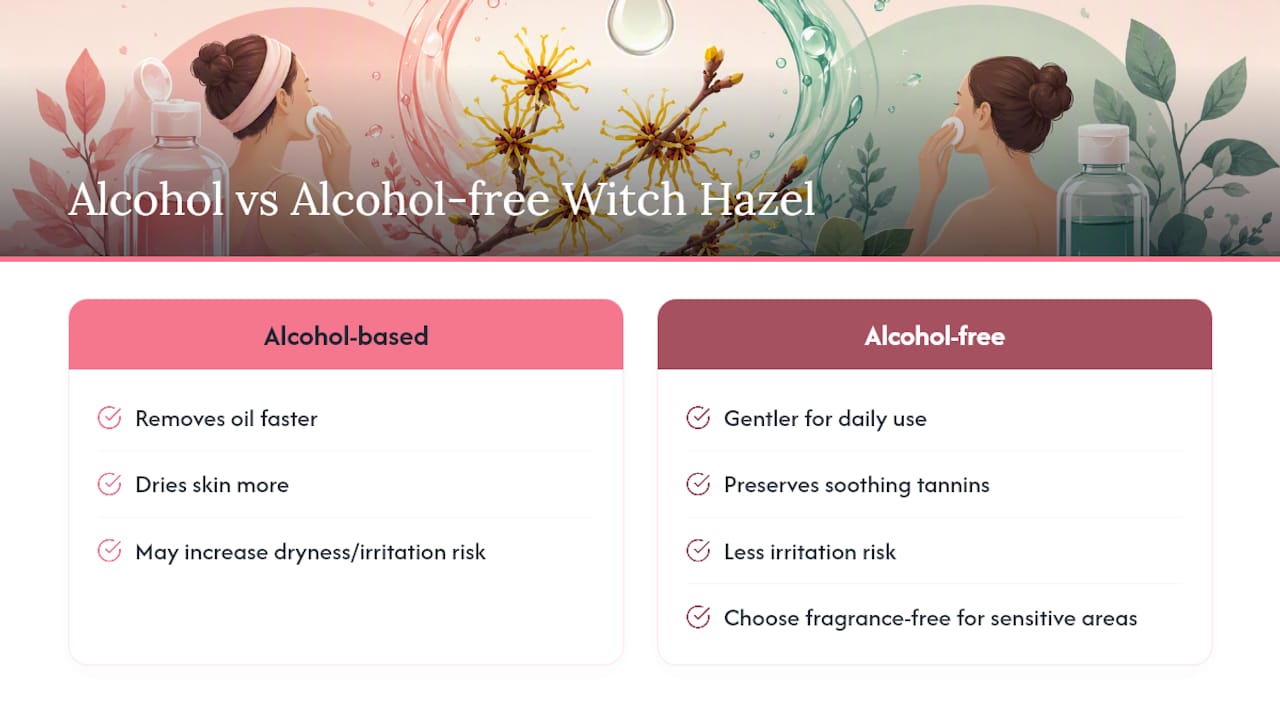
What’s the difference between alcohol-based and alcohol-free witch hazel? Alcohol-based versions remove oil faster but dry out skin more; alcohol-free versions preserve the soothing tannins with less irritation risk, according to dermatologist recommendations.
When should I avoid witch hazel? Skip it on open wounds, active eczema or rosacea flare-ups, and very dry or reactive skin, and discontinue immediately if you notice burning or increased flaking.
This article is general information, not a substitute for advice from a qualified doctor. Consult a qualified healthcare professional about your own circumstances before acting on anything here.
Sources
- What Is Witch Hazel Used for and When Should You Not Use It?
- 4 Benefits and Uses of Witch Hazel
- How to Use Witch Hazel on Your Face, According to Dermatologists | Glamour
- Witch Hazel for Skin: Pores, Acne, and Inflammation
For persistent redness, rosacea, or diagnosed skin conditions, talk to a dermatologist before relying on witch hazel alone.
