


Skin Type Assessment Explained: Your Complete Guide
Skin type assessment is the systematic process of evaluating your skin’s characteristics to classify it accurately and build a skincare routine that actually works. The two most widely used classification systems are the Fitzpatrick Scale and the Baumann Skin Type system. Understanding both, plus the critical difference between skin type and skin condition, is the foundation of every effective skincare decision you will ever make. Getting this wrong means buying products that irritate, dry out, or worsen your skin. Getting it right changes everything.
What is skin type assessment explained, and why does it matter?
Skin type assessment is defined as a structured evaluation of your skin’s sebum production, hydration levels, sensitivity, pigmentation, and texture. The goal is to classify your skin into a recognized category so you can choose products and treatments that match your biology, not just your budget. Proper skin type assessment guides product selection, reducing the risk of irritation and supporting long-term skin health. That single fact explains why dermatologists treat assessment as step one, not an optional extra.
The five classic skin types are normal, oily, dry, combination, and sensitive. These categories describe how much oil your skin produces and how it reacts to environmental stress. Skin type is relatively stable across your lifetime, though it shifts gradually with age, hormonal changes, and climate. Knowing yours gives you a fixed reference point for every product decision you make.

The term “skin type assessment” is the everyday phrase most people search for. The clinical equivalent used by dermatologists is skin phenotype classification. Both refer to the same process. This article uses both terms so you recognize them in professional and consumer contexts.
Key skin type classification systems and what they measure
The Fitzpatrick Skin Type Scale classifies skin into six types based on UV sensitivity and pigmentation response. Type I always burns and never tans. Type VI never burns and carries deep pigmentation. The scale was originally developed for phototherapy dosing, but it now guides sunscreen selection, laser treatment planning, and post-procedure care across dermatology.
The Baumann Skin Type system goes further. It classifies skin into 16 types using four pairs of parameters: oily or dry, sensitive or resistant, pigmented or nonpigmented, and wrinkled or tight. A 64-item questionnaire generates a clinically specific profile. That depth makes it far more useful for product formulation and personalized skincare than a simple five-category model. The Wendy Roberts and Glogau scales address pigmentation disorders and photoaging severity, respectively, and are used primarily in clinical dermatology rather than consumer skincare.
| Classification system | Primary focus | Best used for |
|---|---|---|
| Fitzpatrick Scale | UV response and pigmentation | Sun protection, laser, phototherapy |
| Baumann Skin Type | Oiliness, sensitivity, pigmentation, aging | Personalized product selection |
| Glogau Scale | Photoaging severity | Anti-aging treatment planning |
| Wendy Roberts Scale | Pigmentation disorders | Hyperpigmentation treatment |
Pro Tip: Use the Fitzpatrick Scale to choose your SPF level and the Baumann system to select your daily moisturizer. They answer different questions and work best together.
How do you determine your skin type at home?
The two most reliable at-home methods are the wash test and the day test. The wash test and day test observe oiliness and dryness after cleansing at set intervals. These tests offer a general indication but lack the precision of professional methods. They are a starting point, not a diagnosis.
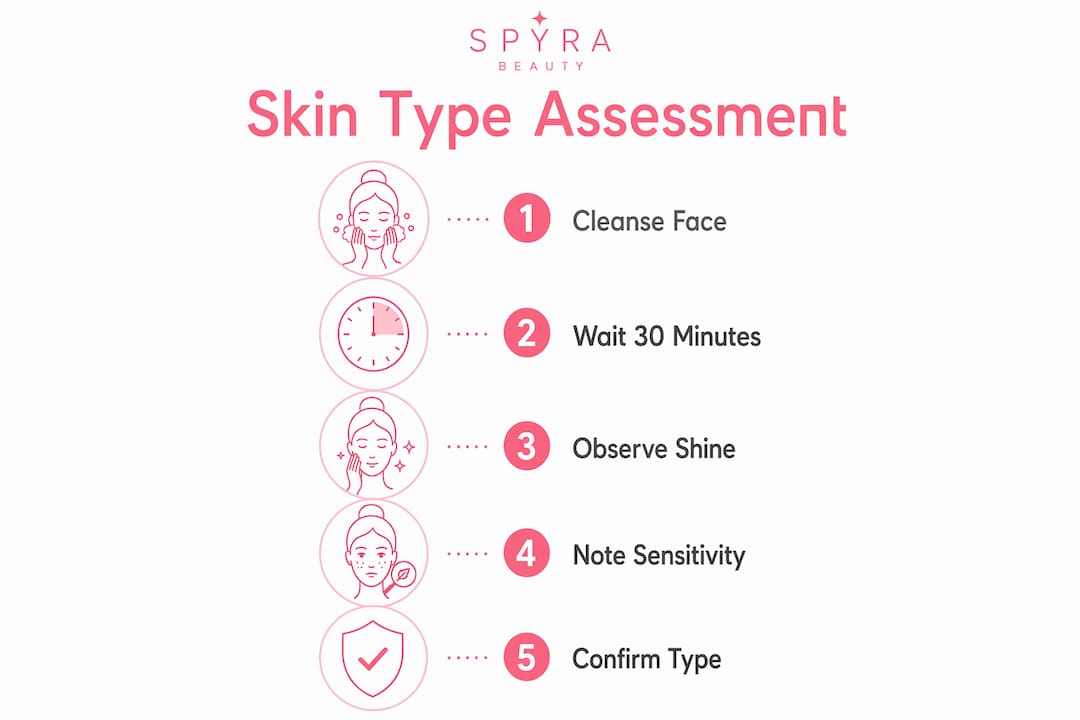
For the wash test, cleanse your face with a gentle, fragrance-free cleanser and apply no products afterward. Wait 30 minutes, then press a clean tissue to your forehead, nose, cheeks, and chin. Oil on the tissue across all zones points to oily skin. Oil only on the T-zone with dry cheeks signals combination skin. No oil and a feeling of tightness suggests dry skin.
The day test works differently. Cleanse in the morning, apply no products, and observe your skin throughout the day. By midday, oily skin looks shiny across the face. Dry skin feels tight and may show flaking. Combination skin shows shine only in the T-zone. Normal skin stays balanced with minimal shine or tightness.
Common mistakes in self-assessment include testing right after a workout, in extreme weather, or after using a new product. All three skew results. Hormonal fluctuations during your menstrual cycle also temporarily shift sebum production, which can make oily skin appear normal or normal skin appear oily.
Pro Tip: Always perform at-home skin tests on a day when you have not exercised, traveled, or changed your diet. Environmental variables are the biggest source of inaccurate self-assessments.
What does professional skin analysis involve?
Clinical skin analysis involves an eight-stage evaluation including consultation, visual and tactile assessment, and technological measurements such as high-frequency ultrasound. Professional assessments measure hydration, elasticity, and pigmentation at a microscopic level, often taking 30–60 minutes. That level of detail is simply not possible at home.
A professional skin analysis typically includes:
- Consultation: Health history, current products, lifestyle factors, and skin concerns
- Visual inspection: Assessing color, texture, pore size, and visible lesions under natural and UV light
- Tactile assessment: Feeling skin firmness, elasticity, and surface texture by touch
- Wood’s lamp examination: Detecting pigmentation irregularities and bacterial presence invisible to the naked eye
- Skin scanner imaging: Capturing subsurface texture, pigmentation depth, and vascular patterns
- Hydration measurement: Using a corneometer to quantify moisture levels in the stratum corneum
- Sebum measurement: Using a sebumeter to quantify oil production by facial zone
- Final classification and recommendations: Combining all data into a skin profile and product plan
Specialized equipment such as Wood’s lamp and skin scanners enhance detection of pigmentation and texture issues that visual inspection alone misses. Seek professional evaluation if your skin reacts unpredictably to products, if you are managing a condition like rosacea or melasma, or if you are planning a chemical peel or laser treatment.
Skin type versus skin condition: why the difference matters
Skin type is defined by stable characteristics rooted in genetics, primarily sebum production and baseline hydration. Skin condition is temporary. Skin type remains relatively stable while skin condition fluctuates with diet, hormones, weather, and product use. Treating a temporary condition as a permanent skin type leads to the wrong products and, often, worse skin.
A common example: your skin breaks out in winter and feels tight and flaky. You conclude you have dry skin and switch to heavy creams. But your actual type is combination. The dryness was a seasonal condition caused by indoor heating stripping moisture from the air. The heavy cream then clogs your T-zone and triggers more breakouts. The misdiagnosis created the problem it was meant to solve.
Sensitivity is not a separate skin type but a trait that can coexist with any skin type, influencing ingredient tolerance and product safety. Identifying sensitivity is critical to avoid fragrances and strong actives that may damage the skin barrier. You can have oily, sensitive skin or dry, resistant skin. These are not contradictions.
Signs that sensitivity is a factor in your skin profile:
- Redness or stinging after applying products with alcohol, fragrance, or essential oils
- Visible flushing triggered by heat, spicy food, or emotional stress
- Prolonged irritation after exfoliation or active ingredients like retinol or AHAs
- A history of eczema, rosacea, or contact dermatitis
If you recognize three or more of these signs, check the Japanese retinol alternatives guide for gentler active ingredient options that preserve barrier integrity.
How to apply your skin type findings to your skincare routine
Skin type is often not uniform across the face, which means a single product applied everywhere rarely performs well everywhere. Multi-masking addresses this directly by applying different products to different facial zones. The standard approach uses oil-controlling products on the T-zone and hydrating products on the cheeks. This is not a trend. It is a practical response to biological variation within a single face.
| Skin type | Key concern | Ingredients to seek | Ingredients to avoid |
|---|---|---|---|
| Oily | Excess sebum, enlarged pores | Niacinamide, salicylic acid, zinc | Heavy mineral oils, petrolatum |
| Dry | Moisture loss, flaking | Hyaluronic acid, ceramides, squalane | Alcohol denat., strong AHAs |
| Combination | T-zone oil, dry cheeks | Lightweight gel moisturizers, niacinamide | Thick occlusive creams applied all over |
| Sensitive | Barrier disruption, redness | Centella asiatica, panthenol, oat extract | Fragrance, essential oils, high-dose retinol |
| Normal | Maintenance and prevention | Antioxidants, SPF, gentle exfoliants | Overuse of actives without rotation |
Skin changes over time. Oily teenage skin often shifts toward combination or normal in your 30s. Dry skin becomes more common after menopause due to declining estrogen. Reassess your skin type every one to two years, or whenever your skin starts behaving differently despite no product changes. Avoiding common skincare layering mistakes also prevents you from accidentally counteracting the right products with the wrong application order.
For readers curious about how Asian skincare philosophy approaches skin evaluation differently from Western dermatology, the Asian skin identification methods guide covers those distinctions in detail.
Key Takeaways
Accurate skin type assessment is the single most effective step you can take to stop wasting money on products that do not work for your skin.
| Point | Details |
|---|---|
| Assessment defines your baseline | Skin type classification using systems like Fitzpatrick or Baumann gives you a fixed reference for all product decisions. |
| Home tests have real limits | The wash test and day test provide a starting point, but professional analysis measures hydration and sebum with clinical precision. |
| Skin type and skin condition differ | Skin type is stable; skin condition is temporary. Confusing the two leads to the wrong products and worsened skin. |
| Sensitivity crosses all skin types | Any skin type can be sensitive. Identifying this trait prevents barrier damage from actives and fragrances. |
| Reassess as your skin changes | Skin shifts with age, hormones, and climate. Update your routine every one to two years to stay aligned with your current profile. |
What I have learned from years of watching people get this wrong
The most common mistake I see is people treating a bad skin week as a permanent diagnosis. Someone breaks out after a stressful month at work, decides they have oily skin, and switches to a mattifying routine that strips their barrier. Three months later their skin is red, reactive, and more broken out than before. The original problem was a stress-triggered condition, not a skin type shift.
The second mistake is trusting a single at-home test done under poor conditions. I have seen people assess their skin in the middle of summer after a flight and conclude they have oily skin, when their actual type is normal. Travel dehydrates you. Heat increases sebum production. Neither condition reflects your baseline.
My honest recommendation: do the wash test twice, one week apart, under consistent conditions. If the results differ, your skin condition is masking your skin type. That is the moment to book a professional analysis. A 30–60 minute clinical assessment with a corneometer and sebumeter will tell you more in one session than months of self-observation.
Patch testing before adding any new active is non-negotiable if sensitivity is even a possibility. Apply the product to your inner arm for three days before putting it on your face. It takes three minutes and saves weeks of recovery from a barrier reaction. Personalized skincare built on accurate assessment consistently outperforms generic routines, and the assessment itself costs far less than the wrong products.
— Anni
Skincare products matched to your skin type, from Spyraverified
Knowing your skin type is only half the work. The other half is finding products formulated specifically for it.

Spyraverified curates skincare from Japanese and Asian brands that are built around skin type specificity, not one-size-fits-all formulas. Many of these brands use ingredient concentrations and delivery systems that are not widely available in Western markets. Whether your skin is oily, dry, combination, or sensitive, the Spyraverified skincare collection organizes products by skin concern so you can match what you buy to what your assessment actually found. Browsing by skin type takes the guesswork out of selection and puts the science of your assessment to immediate use.
FAQ
What is skin type assessment?
Skin type assessment is the structured process of evaluating your skin’s sebum production, hydration, sensitivity, and pigmentation to classify it into a recognized category. It combines visual inspection, tactile evaluation, and in clinical settings, technological measurements like high-frequency ultrasound.
How do I determine my skin type at home?
Use the wash test: cleanse your face, apply no products, and press a tissue to your skin after 30 minutes. Oil across all zones indicates oily skin; oil only on the T-zone indicates combination skin; no oil with tightness indicates dry skin.
What is the difference between skin type and skin condition?
Skin type is a stable genetic trait based on sebum and hydration levels. Skin condition is a temporary state caused by diet, hormones, weather, or product use. Treating a condition as a permanent type leads to the wrong skincare choices.
Can sensitive skin occur with any skin type?
Yes. Sensitivity is not a standalone skin type. It is a trait that can coexist with oily, dry, combination, or normal skin, and it significantly affects which ingredients are safe to use.
When should I get a professional skin analysis?
Seek professional analysis if your skin reacts unpredictably to products, if you are managing rosacea or melasma, or if you are planning a clinical treatment like a chemical peel or laser procedure. Professional assessments take 30–60 minutes and provide data that home tests cannot replicate.
