


Sake Lees Skincare: Choose Dealcoholized Japanese Extracts
Sake lees, the fermented rice paste left over from brewing sake, is rich in amino acids and fermentation-derived compounds that can hydrate, gently brighten, and support your skin barrier. It works as a supporting ingredient, not a replacement for retinoids or vitamin C, and most of the evidence behind it still comes from lab and animal research rather than large human trials.
TL;DR:
- Sake lees contains amino acids, kojic acid, and ferulic acid, which support skin hydration, brightening, and antioxidant activity, but most evidence is from laboratory and animal studies.
- A 2025 study shows that concentrated sake lees extract can activate antioxidant pathways in worms, but results may not directly translate to human skin improvements.
- Sake lees is best used as a supportive ingredient in formulations, applied after cleansing or as a weekly mask, rather than a standalone treatment.
- Choose products with specific ingredient labels like sake kasu extract or sake filtrate and avoid vague or unverified fermentation claims for better efficacy.
- Patch-test fermented rice ingredients if you have sensitive or reactive skin, and consult a dermatologist if pregnant or managing a skin condition before use.
Table of Contents
- What Is Sake Lees (Sake Kasu) and Why Does It Matter for Skincare?
- What Does the Science Say About Sake Lees for Skin?
- How Do You Use Sake Lees in a Skincare Routine?
- What Should You Look for When Choosing a Sake-Lees Product?
- Who Should Be Careful With Sake-Lees Skincare?
- Why Spyra Verified Pays Close Attention to Sake-Lees Sourcing
- How Do You Make a Sake-Lees Face Mask or Toner at Home?
- What Does Current Research Actually Prove About Sake Lees and Skin?
- Is Sake Lees Skincare Worth the Hype?
- Where to Find Authenticated Sake-Lees Skincare
- Primary Studies and Resources
- Sources
What Is Sake Lees (Sake Kasu) and Why Does It Matter for Skincare?
Sake kasu is the solid residue strained out after rice, koji mold, and water ferment into sake. Brewers have known for centuries that the workers who handled it, especially the women who pressed the mash by hand, often had noticeably soft, even-toned skin. That folklore is the reason sake lees shows up in J-Beauty formulas today, though the mechanism is fermentation chemistry, not magic.
You’ll see it on labels in a few different forms: raw paste, liquid extract, filtrate (the water-soluble portion pressed out during brewing), and dried powder. Each form carries a different concentration of actives, and color matters too. Analysis of sake lees samples shows that lighter, less-ripened lees tend to carry higher levels of GPC and SAM, two compounds tied to cellular repair, while darker, more aged batches shift toward different fatty-acid profiles.
The compounds worth knowing on an ingredient list:
- Amino acids — often the largest share of the extract’s bioactive content
- Kojic acid — a fermentation byproduct associated with gentle brightening
- Ferulic acid — a plant-derived antioxidant that also appears in rice bran
- Peptides — small protein fragments linked to skin repair signaling
- SAM and GPC — compounds more concentrated in lighter-colored lees
What Does the Science Say About Sake Lees for Skin?
The strongest recent data point comes from a 2025 study using continuous phase-transition extraction (CPE), a method that pulled substantially more amino acids out of sake lees than older ultrasound-based techniques. That matters because amino acid density is one of the main levers for the extract’s antioxidant activity.
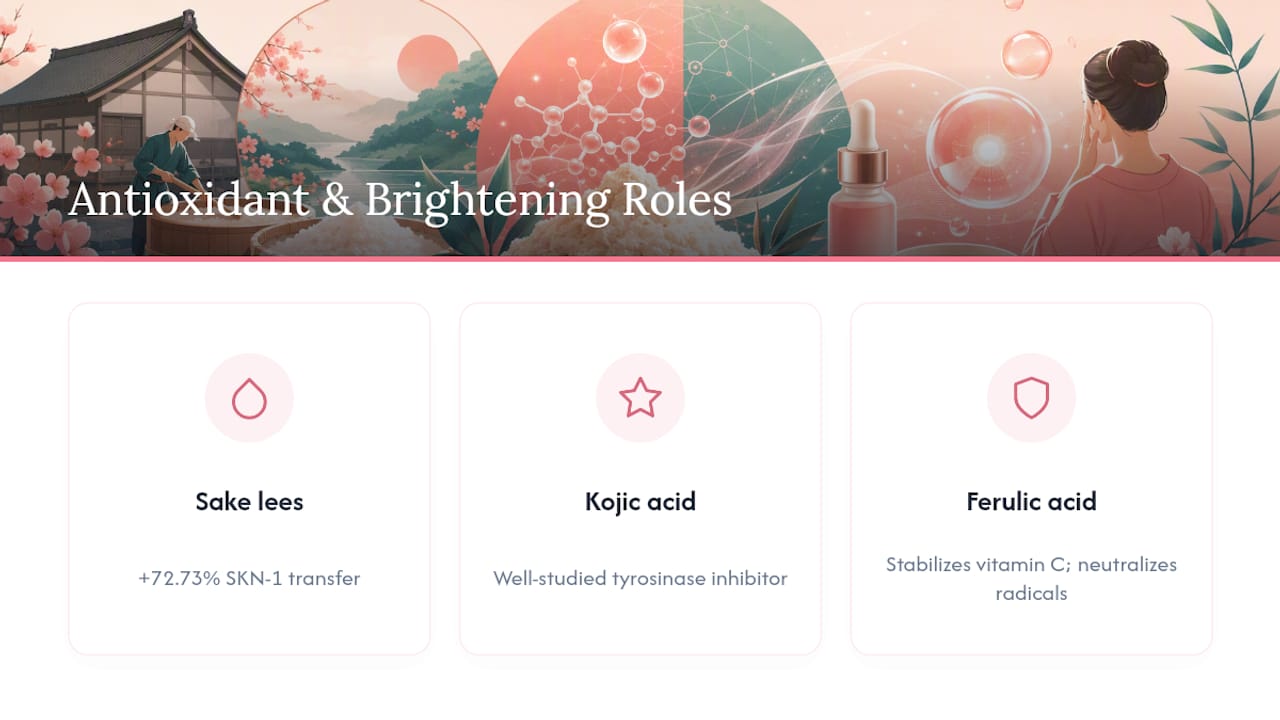
By the numbers: In the CPE study, sake lees extract dosed at 4 mg per milliliter increased C. elegans lifespan by 19.32% and triggered a 72.73% increase in nuclear transfer of SKN-1, the roundworm equivalent of the human Nrf2 antioxidant pathway.
That’s a real signal for antioxidant mechanism, but it comes with real limits. C. elegans is a roundworm, not human skin, and lifespan extension in a lab model doesn’t translate directly into “fewer wrinkles.” The same research is indexed on PubMed for anyone who wants to read the mechanistic detail firsthand.
Kojic acid and ferulic acid round out the brightening and antioxidant story. Kojic acid is well studied as a tyrosinase inhibitor in isolation, which is why it shows up in dedicated brightening serums, while ferulic acid is best known for stabilizing vitamin C and neutralizing free radicals. Neither compound has been tested specifically inside a sake-lees matrix on human skin in a large trial.
What this means practically: expect supportive hydration, a subtle brightening effect over weeks, and antioxidant backup for your existing routine. Don’t expect it to out-perform a dedicated retinoid or a clinical-strength vitamin C serum.
How Do You Use Sake Lees in a Skincare Routine?
Sake-lees products behave differently depending on their form, so where you place them matters.
- Filtrates and essences go right after cleansing and toning, before heavier serums, since they’re thin and mostly water.
- Sheet masks or wash-off masks work best as a weekly treatment rather than a daily step.
- Serums and lotions with sake lees extract layer in as your daily hydration or brightening step, typically before moisturizer.
- Powders meant for DIY masks need to be mixed fresh each time and used immediately, since they don’t carry preservatives once wet.
Patch-test any new sake-lees product on your inner forearm for 24 to 48 hours before applying it to your face. Avoid combining a fresh sake-lees treatment with active exfoliating acids (glycolic, salicylic) in the same session. Fermented ingredients can occasionally increase sensitivity to actives layered on top, and doubling up increases the odds of redness or stinging.
Pro Tip: If you’re new to fermented skincare, start with a rinse-off mask once or twice a week before moving to a leave-on serum. It gives your skin a low-stakes way to see how it reacts before you commit to a daily product.
What Should You Look for When Choosing a Sake-Lees Product?
Ingredient lists in this category range from precise to vague, and the difference matters more than the price tag.
- Look for specific naming: “sake kasu extract,” “sake filtrate,” or “sake lees extract” rather than a generic “rice ferment” or just “ferment,” which tells you almost nothing about the actual compound profile.
- If you have sensitive or reactive skin, favor dealcoholized extracts. Fermented, lactic-acid-processed versions exist specifically to strip out residual alcohol while keeping the functional benefits intact.
- Check whether the formula pairs sake lees with complementary actives like niacinamide or hyaluronic acid, since sake lees alone is rarely the sole active in a well-built formula.
- Watch for an extract percentage on the label. Brands willing to state concentration are usually more transparent about efficacy overall.
- Confirm the product lists a stabilizer or preservative system. Water-soluble sake lees filtrates degrade fast without proper pH control, so a product with no stability information is a yellow flag.
Who Should Be Careful With Sake-Lees Skincare?
Sake lees is a fermentation byproduct of alcohol production, so raw or minimally processed lees can carry residual alcohol content. That’s worth knowing if you have rosacea, eczema, or generally reactive skin, since alcohol-containing formulas can sting or trigger flushing.
- Choose a dealcoholized or fermented FSL-style product if alcohol sensitivity is a known issue for you.
- Patch-test on your inner arm first. Redness, itching, or bumps within 48 hours mean you should skip that formula.
- If you’re pregnant, nursing, or managing a diagnosed skin condition, run any new fermented-rice product past a dermatologist first. This article is general information, not personalized medical advice, and topical reactions vary person to person.
Why Spyra Verified Pays Close Attention to Sake-Lees Sourcing
Fermented rice ingredients are one of the categories where sourcing quality varies wildly, since “sake lees” on a label can mean anything from a trace additive to a genuinely concentrated extract. Anni, who covers Japanese fermented skincare for Spyra Verified, has spent considerable time tracking how extraction method and concentration change what a product actually delivers, not just what it claims.
Spyra Verified works directly with manufacturers rather than through resellers, which means every sake-lees product in the catalog gets checked against its labeled ingredient claims before it goes live. That direct-partnership model is also how the platform catches vague “ferment” labeling before it reaches a shopper’s cart.
How Do You Make a Sake-Lees Face Mask or Toner at Home?
If you want to try sake lees before committing to a finished product, a basic DIY mask is the lowest-risk entry point, provided you follow a few safety rules.
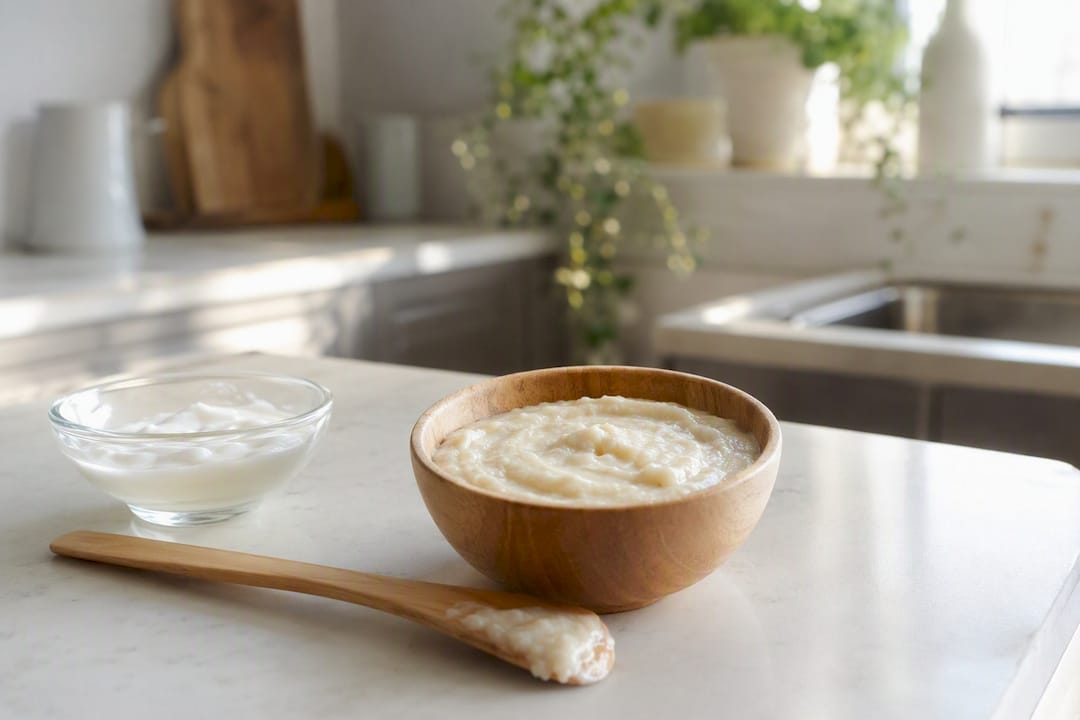
Simple sake lees face mask: Mix one tablespoon of unseasoned sake kasu (available at Japanese grocers or online, sold as a food ingredient) with one to two teaspoons of plain, unsweetened yogurt or filtered water until it forms a spreadable paste. Apply a thin layer to clean, dry skin, avoiding the eye area, and leave it on for 10 to 15 minutes before rinsing with lukewarm water.
Sake lees toner (short shelf life): Dissolve a small amount of food-grade sake kasu in filtered water, strain through a fine cloth to remove solids, and use the resulting liquid within 24 to 48 hours since it has no preservative system.
A few non-negotiable rules for DIY versions: always source food-grade sake kasu meant for consumption, never use brewing byproducts intended for industrial use, and make small batches since none of this has a shelf life beyond a couple of days in the refrigerator. Patch-test every batch, since homemade extracts have no standardized concentration and potency can vary from batch to batch. And never treat sake lees as an ingestible skincare treatment based on internet claims. Food-grade consumption of sake kasu is a separate culinary tradition, not a dermatological therapy.
What Does Current Research Actually Prove About Sake Lees and Skin?
Strip away the marketing language and the evidence base for sake lees looks like this: strong compositional data, promising mechanistic signals in lab models, and a near-total absence of large human clinical trials on finished skincare products.
The 2025 CPE extraction study is the most rigorous recent work, and it’s genuinely useful for understanding why sake lees behaves the way it does chemically. It confirmed that extraction method changes the amino acid yield by a wide margin and that concentrated extract triggers measurable activity in the Nrf2/SKN-1 antioxidant pathway, a pathway also implicated in human skin aging. But the study tested a nematode, not a face.
Supporting evidence for kojic acid and ferulic acid, the two named actives most associated with brightening, comes largely from research on those compounds in isolation, not from trials of sake-lees-specific formulas. Industry overviews of fermented rice ingredients are useful for understanding general mechanisms, but they aren’t a substitute for a randomized, controlled trial on human subjects.
The honest summary: sake lees has a defensible antioxidant and hydration story backed by lab chemistry, plausible mechanisms borrowed from its individual compounds, and centuries of anecdotal use. What it doesn’t have yet is a large, peer-reviewed human trial proving that a finished sake-lees serum measurably reduces wrinkles or hyperpigmentation over a defined period. Treat it as a well-supported complementary ingredient, not a clinical-grade treatment.
Is Sake Lees Skincare Worth the Hype?
The conventional wisdom on fermented skincare treats “fermented” as shorthand for “clinically proven,” and that’s where most coverage of sake lees oversells the ingredient. The 2025 CPE extraction data is genuinely interesting science, but a nematode lifespan study is not a substitute for a dermatology trial, and readers deserve to know that gap exists before they spend money expecting retinoid-level results.
What the research actually supports is narrower and, frankly, more useful: sake lees is a legitimate antioxidant and hydration ingredient with a real compositional basis, best used as a supporting player alongside actives with stronger human data, like amino acid-rich formulas or established brightening agents.
The bigger mistake I see readers make isn’t trying sake lees. It’s buying whatever has “ferment” printed on the front label without checking whether the ingredient list names sake kasu specifically or just vaguely gestures at fermentation. Extraction method and concentration are what separate a functional product from a marketing exercise, and that’s the detail worth checking before checkout, not after.
— Anni
Where to Find Authenticated Sake-Lees Skincare
Sourcing genuine sake-lees products gets complicated once you’re shopping outside Japan, since import listings rarely disclose extraction method or alcohol content. Spyra Verified works directly with the manufacturers behind these formulas, so every listing carries clear ingredient labeling, including whether an extract is dealcoholized for sensitive skin.
The skincare collection includes fermented rice masks, essences, and serums vetted for authenticity before they’re listed, not after complaints roll in. If you’re building out a full fermented-skincare routine, the Japanese skincare routine guide is a useful companion for figuring out where each product fits.
Patch-test anything new, sake lees included, and check each product page for full ingredient percentages before you buy. Browse the collection when you’re ready to add a verified, clearly labeled sake-lees product to your shelf.
Primary Studies and Resources
- Sake lees extract CPE study — Food & Function, RSC Publishing
- PubMed index for SLE/CPE extraction research
- Japan Sake and Shochu Makers Association on sake health benefits
- Spyra Verified: what is fermented skincare
Sources
- Sake lees extract obtained using a novel continuous phase-transition extraction method: evaluation of its bioactive composition, anti-aging efficacy and mechanism - Food & Function (RSC Publishing)
- PubMed index for SLE/CPE extraction anti-aging research
- Healthy Drinking: The Health Benefits of Sake | Japan Sake and Shochu Makers Association
