

Japanese vs Korean Products: How to Switch and Choose
Choose J-Beauty when you want a streamlined, barrier-first routine built for the long haul. Choose K-Beauty when you want active-driven results, layering flexibility, and the freedom to experiment with new formats every season.
Quick match by goal:
- Sensitivity and barrier repair: J-Beauty. Ceramide-rich formulas and minimal ingredient lists reduce the chance of a reaction.
- Brightening and glow: K-Beauty. Niacinamide, Centella, and vitamin C ampoules are the workhorses here.
- Anti-aging, long-term prevention: J-Beauty. Precision actives, high-quality sunscreens, and decades of R&D behind each formula.
- Budget-minded trial: K-Beauty. Affordable entry points let you test a new active without committing to a $30+ product.
- Trend-led experimentation: K-Beauty. Faster innovation cycles mean new textures, formats, and actives hit shelves seasonally.
Spyraverified curates both approaches, sourcing directly from partnered manufacturers so U.S. shoppers get authentic products without the guesswork. According to wholesale pricing data, Japanese cosmetics are generally 40–100% more expensive per unit than comparable Korean products across most categories, as shown by wholesale pricing data.
Table of Contents
- How culture and beauty philosophy shape product design
- Side-by-side routines: Japanese minimalism vs Korean multi-step
- What ingredients and formulations tell you about each approach
- Price and value when shopping Japanese vs Korean products in the U.S.
- Which skin types and concerns fit each approach best
- How to verify authenticity and buy safely in the U.S.
- Spyraverified’s assortment insight: what wholesale data reveals for shoppers
- Final recommendation: your checklist and starter swaps
- Key Takeaways
- The case for not picking a side
- Authentic Japanese and Korean skincare, curated and verified
- Further reading and sources
How culture and beauty philosophy shape product design
J-Beauty and K-Beauty are not just geographic labels. They reflect genuinely different ideas about what skin needs and how a product should deliver it.
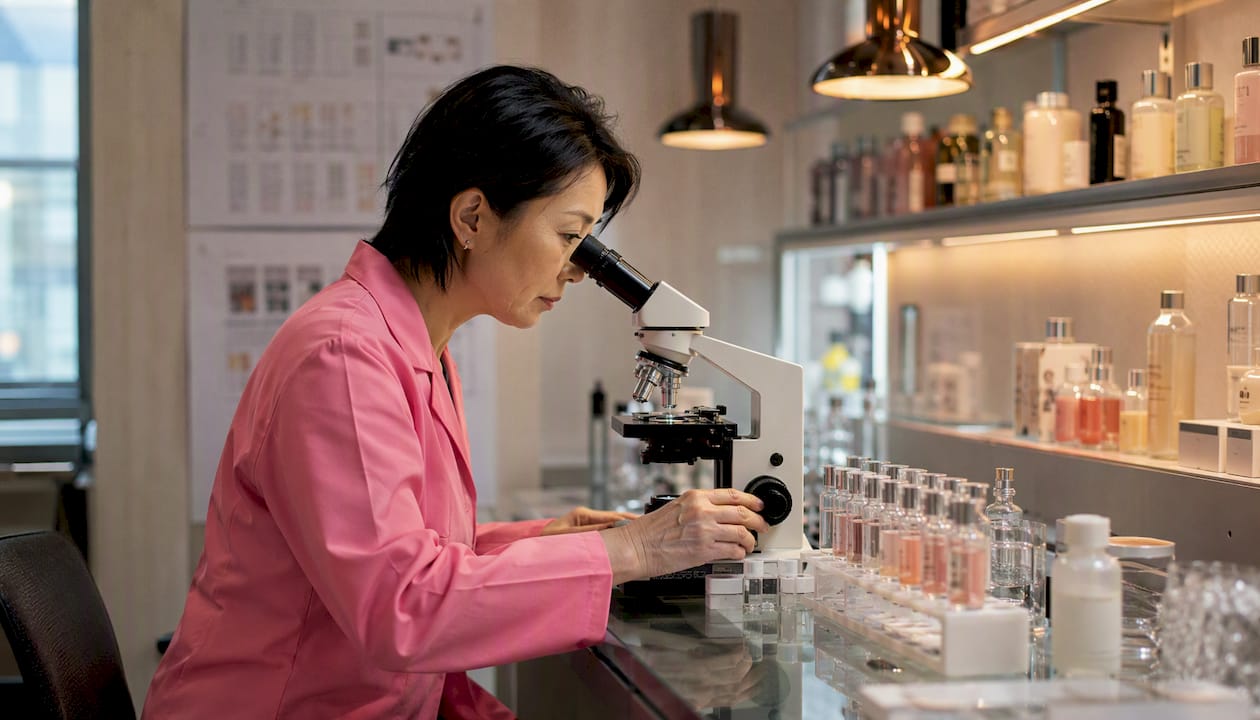
Japan’s approach is rooted in restraint and precision. Brands invest heavily in R&D, often spending years refining a single formula before launch. The result is products with understated claims, minimal ingredient lists, and long product lifecycles. A Japanese moisturizer that has been on shelves for 15 years is not a sign of stagnation; it is a signal that the formula works and the brand stands behind it. That research-driven heritage is a core reason J-Beauty commands premium pricing globally.
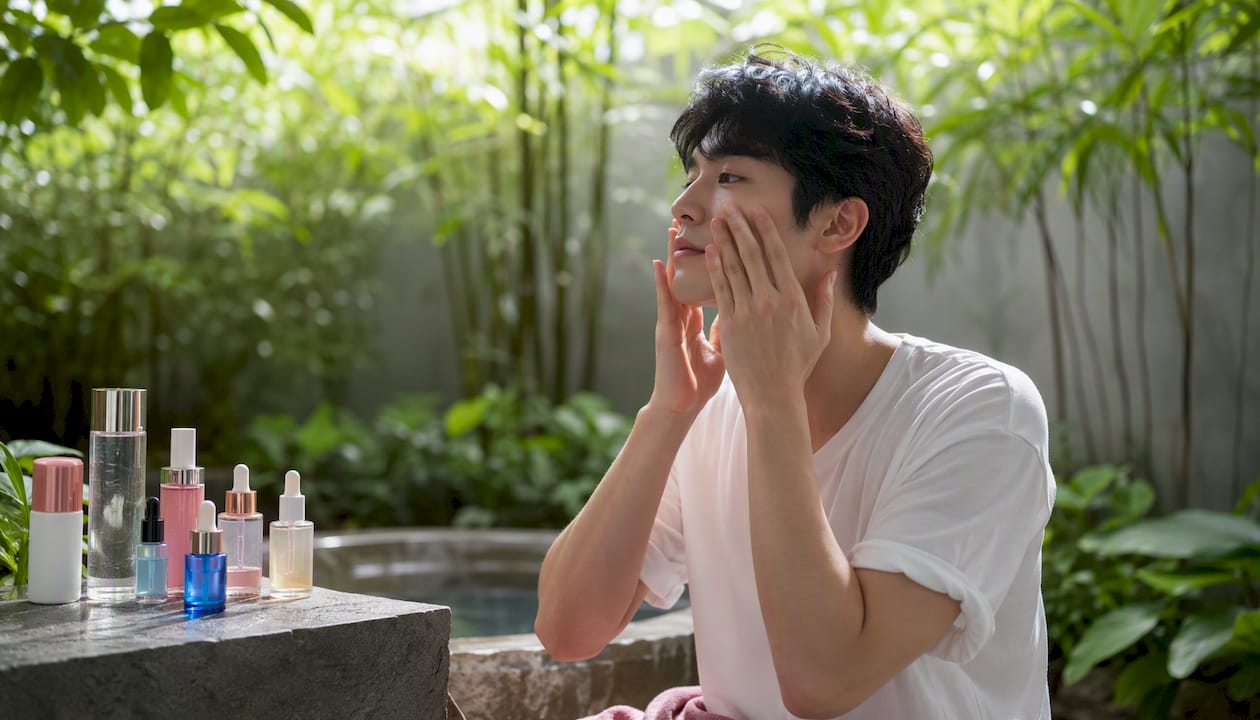
Korea’s philosophy runs in the opposite direction. Speed, transparency, and consumer engagement drive the market. Brands publish full ingredient lists, respond to social media feedback, and reformulate when a better active emerges. The 10-step routine was not invented as a marketing gimmick; it grew from a genuine cultural belief that layering lightweight products delivers better hydration than one heavy cream. That same openness to experimentation is why K-Beauty leads in formats like sheet masks, essences, and ampoules.
Three practical implications for shoppers:
- Packaging signals intent. Japanese products tend toward minimal, pharmacy-style packaging. Korean products often use bold graphics, transparent bottles, and ingredient callouts on the front label.
- Claims language differs. J-Beauty claims are typically conservative (“moisturizes,” “smooths”). K-Beauty claims are often specific and active-forward (“20% niacinamide,” “CICA-repair formula”).
- Trend speed varies. A trending Korean active can go from lab to shelf in under a year. Japanese brands typically take longer, which means fewer trend misses but also fewer trend firsts.
The community consensus captures it simply: K-Beauty for active-led glow and layering; J-Beauty for prevention, minimal fuss, and long-term skin health. Both framings are accurate, and neither is complete without the other.
Side-by-side routines: Japanese minimalism vs Korean multi-step
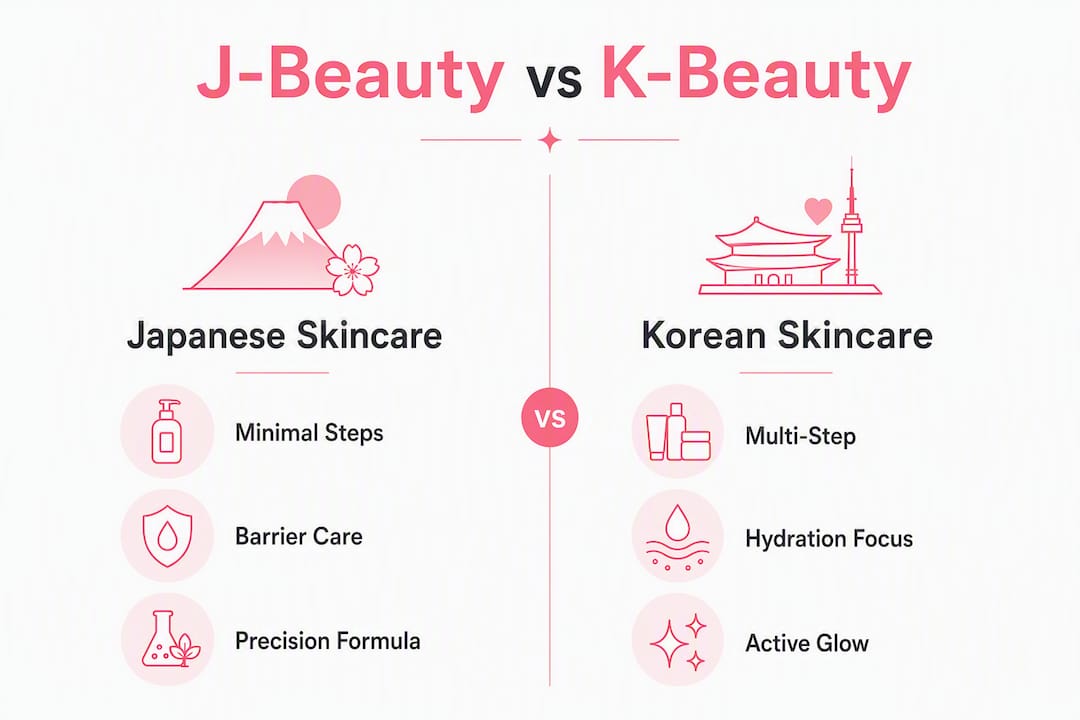
J-Beauty routines prioritize barrier integrity with fewer steps; K-Beauty routines prioritize hydration depth and targeted treatment through layering. The full comparison on Spyraverified’s blog breaks down both approaches in detail.
| Dimension | J-Beauty | K-Beauty |
|---|---|---|
| Philosophy / goal | Barrier health, prevention, long-term skin function | Hydration layering, active treatment, glow |
| Typical step count | 3–5 steps | 5–10 steps |
| Signature textures | Milky lotions, cleansing oils, light emulsions | Essences, ampoules, gel creams, sheet masks |
| Routine pace | Quick, consistent, daily | Flexible, customizable, trend-responsive |
J-Beauty AM routine:
- Gentle foaming or oil cleanser (removes overnight buildup without stripping)
- Hydrating lotion/toner (Japanese “lotion” = a thin, skin-prep layer, not a Western astringent)
- Lightweight emulsion or moisturizer (seals in hydration)
- SPF 50+ sunscreen (Japan produces some of the world’s most elegant UV formulas)
J-Beauty PM routine:
- Cleansing oil (dissolves SPF and makeup thoroughly)
- Gentle second cleanser (optional, for thorough cleanse)
- Hydrating lotion
- Richer emulsion or night cream
K-Beauty AM routine:
- Low-pH gel or foam cleanser
- Hydrating toner (first essence or prep layer)
- Essence (concentrated hydration, often fermented)
- Serum or ampoule (targeted active: niacinamide, vitamin C, or Centella)
- Moisturizer (gel cream or emulsion)
- SPF (separate step, not mixed into moisturizer)
K-Beauty PM routine:
- Cleansing balm or oil
- Second cleanser
- Toner
- Treatment essence or ampoule
- Sheet mask (2–3 times per week)
- Sleeping mask or night cream
Starter swaps for blending both approaches:
- Replace your K-Beauty gel moisturizer with a Japanese emulsion on days your skin feels reactive.
- Add a Korean essence between your Japanese lotion and emulsion for an extra hydration layer.
- Swap your current SPF for a Japanese sunscreen; the texture and UV coverage are often noticeably better.
- Use a Korean sheet mask 2–3 times weekly within a J-Beauty routine for a hydration boost.
- Try a Japanese cleansing oil as the first step in a K-Beauty double-cleanse.
What ingredients and formulations tell you about each approach
Japan leans on precision-proven actives with long safety records; Korea leans on trend-driven actives and multi-ingredient layering that targets specific concerns fast.
Common Japanese staples:
- Rice bran (sake kasu, rice water): Brightens and softens; used in Japanese skincare for centuries and backed by modern studies on kojic acid derivatives.
- Ceramides: Restore the skin barrier; Japanese formulas often use ceramide complexes at clinically relevant concentrations.
- Collagen technologies: Japanese collagen products position around formulation depth and long-term skin density rather than raw concentration claims.
- High-quality UV filters: Japan’s sunscreen technology leads globally. Filters like Tinosorb S and Uvinul A Plus appear in Japanese formulas years before FDA approval in the U.S., which is why imported Japanese SPF often feels lighter than domestic options.
- Hyaluronic acid: A staple in both markets, but Japanese formulas often use multiple molecular weights for layered penetration.
Common Korean staples:
- Niacinamide: Brightens, minimizes pores, and reduces inflammation; K-Beauty brands often list the exact percentage on the label.
- Snail mucin (snail secretion filtrate): Repairs and hydrates; a K-Beauty signature ingredient that gained global traction through social media.
- Centella asiatica (CICA): Calms redness and supports barrier repair; now one of the most-used actives in Korean formulas.
- Marine collagen peptides: Korean collagen supplements and topicals often source marine peptides and market high-concentration claims, a different positioning than Japanese collagen products.
- High-percentage acids (AHA/BHA): K-Beauty brands publish exact percentages and pH levels, making it easier to build an evidence-based routine.
Texture and formulation differences: Korean essences are thinner than serums and designed to be applied immediately after toning; they prime the skin for everything that follows. Japanese milky lotions serve a similar prep function but feel slightly richer. Korean ampoules deliver a concentrated active hit in a small volume; Japanese serums tend to be lighter and less concentrated per drop. In humid climates, Korean gel creams and essences layer without heaviness. In dry or cold climates, Japanese emulsions and richer lotions hold moisture more effectively.
Pro Tip: When switching between styles, introduce one new active at a time and patch-test on your inner arm for 24 hours before applying to your face. This is especially important when moving from a minimal J-Beauty routine to a K-Beauty stack with multiple actives.
Price and value when shopping Japanese vs Korean products in the U.S.
Japanese products cost more per unit at wholesale, and that gap carries through to retail. Wholesale data shows the spread across categories:
| Category | Japanese wholesale range | Korean wholesale range |
|---|---|---|
| Cleanser | $4–8 | $2–5 |
| Toner | $5–10 | $3–6 |
| Serum | $8–20 | $4–10 |
| Sheet mask | $1–3 | $0.30–1.50 |
| Moisturizer | comparable to serum range | comparable to serum range |
At retail, expect Japanese serums and moisturizers to land in the $25–60 range for mid-tier brands; Korean equivalents often sit at $15–35. Sheet masks are where the price gap is sharpest: a Japanese sheet mask can cost 2–6 times more than a Korean one at the same retail tier.
Value-per-use tips for U.S. shoppers:
- Check concentration, not just price. A Korean ampoule at $20 with 10% niacinamide may outperform a $40 product with an unlisted percentage.
- Compare ml/oz pricing. Japanese toners often come in 150–200ml bottles; Korean toners can range from 100ml to 300ml. Price per ml tells the real story.
- Factor in application frequency. A Japanese cleansing oil used nightly lasts longer per bottle than a sheet mask used three times a week.
- Use K-Beauty for high-turnover steps. Rotate serums and ampoules seasonally without guilt; the lower price point makes experimentation practical.
- Invest in J-Beauty for anchor products. A Japanese SPF or cleansing oil that you use daily justifies a higher per-unit cost through consistent, long-term use.
Which skin types and concerns fit each approach best
J-Beauty tends to suit barrier repair and sensitivity; K-Beauty tends to suit brightening, acne management, and active-driven results. Most people benefit from elements of both.
- Sensitive or reactive skin: Start with J-Beauty. Minimal ingredient lists, ceramide-forward formulas, and conservative fragrance use reduce the chance of a flare. Avoid Korean products with high-percentage acids or essential oils until your barrier is stable.
- Acne-prone skin: K-Beauty has the edge. BHA-based toners, niacinamide ampoules, and CICA creams target breakouts and post-acne marks with precision. Choosing the right K-Beauty formula for your acne type matters more than the step count.
- Hyperpigmentation: K-Beauty leads here too. Vitamin C serums, niacinamide, and arbutin are widely available at labeled concentrations, making it easier to build a targeted brightening stack.
- Dehydrated skin (any type): Layer both. A Japanese hydrating lotion followed by a Korean essence delivers more hydration than either approach alone.
- Aging and prevention: J-Beauty. Long-lifecycle formulas with ceramides, collagen technologies, and best-in-class UV protection address the root causes of photoaging before they compound.
- Oily skin in humid climates: Korean gel textures and lightweight essences sit better under makeup and don’t add heaviness. Japanese milky lotions can feel too rich in high humidity.
- Dry skin in cold climates: Japanese emulsions and richer lotions hold moisture through temperature extremes better than most Korean gel creams.
Sensitivity triggers to watch: Fragrance (parfum) appears in both markets but is more common in mid-range Korean products. High-percentage AHAs (above 8%) and BHAs (above 1%) in K-Beauty can cause purging or irritation if introduced too fast. Japanese products occasionally use botanical extracts that cause reactions in people sensitive to plants in the Asteraceae family (chamomile, arnica).
How to verify authenticity and buy safely in the U.S.
Safe buying in the U.S. comes down to one principle: buy from a retailer who can trace the product back to the manufacturer.
Practical checks before you order:
- Ingredient list in English. The FDA requires imported cosmetics sold in the U.S. to carry an English-language ingredient list. If the listing shows only Korean or Japanese characters, the product is not legally labeled for U.S. retail.
- SPF labeling compliance. In the U.S., SPF products are regulated as OTC drugs by the FDA. An imported Japanese sunscreen sold as a cosmetic (not an OTC drug) is technically in a regulatory gray area. Know what you are buying and why.
- Batch codes. Every authentic product carries a batch code, usually on the bottom or back of the packaging. Use sites like CheckFresh or CheckCosmetic to verify production dates.
- Authorized retailer or distributor. Ask whether the seller sources directly from the brand or through a gray-market channel. Direct sourcing means the product has not been stored in unknown conditions or repackaged.
- Return policy. A seller who offers no returns on sealed products is a yellow flag. Legitimate retailers stand behind authenticity.
- Certifications and labeling. The 2026 Asian skincare certifications guide explains which labels matter for U.S. shoppers and what they actually verify.
Pro Tip: Look for localized product versions when available. Some Japanese and Korean brands release U.S.-market versions with FDA-compliant labeling and adjusted formulas. These are not inferior; they are often reformulated specifically to meet U.S. regulatory standards, which can make SPF claims more straightforward to interpret.
For a step-by-step ordering checklist, Spyraverified’s guide to ordering authentic Korean skincare covers the red flags and verification steps in detail.
Spyraverified’s assortment insight: what wholesale data reveals for shoppers
Spyraverified’s category-level data points to a consistent pattern: Korean products drive volume and trial; Japanese products anchor quality perception and repeat loyalty.
Retailers building an Asian beauty assortment typically weight Korean products more heavily in high-turnover categories (sheet masks, toners, serums) and use Japanese products as premium anchors in cleansers, moisturizers, and SPF. That split reflects both price sensitivity and purchase frequency. Korean sheet masks at $0.30–1.50 wholesale move fast and encourage repeat visits; a Japanese cleanser at $4–8 wholesale holds its place in a routine for months.
For individual shoppers, this logic translates directly. If you are building a routine from scratch, Korean products give you affordable entry points to test actives and formats. Once you know what your skin responds to, a Japanese cleanser or SPF becomes a worthwhile long-term investment. The wholesale price gap of 40–100% across categories reflects genuine differences in R&D investment, ingredient sourcing, and production standards.
One practical implication: a premium Japanese cleanser used daily for three months often costs less per use than rotating through three Korean cleansers in the same period. The math favors J-Beauty for anchor steps and K-Beauty for treatment steps where you want to experiment.
Spyraverified sources both categories directly from partnered manufacturers, which means the wholesale pricing advantage is passed through to shoppers rather than absorbed by middlemen. The exclusive Japanese beauty brands available through the platform illustrate how heritage positioning and long product lifecycles translate to real value for buyers who want a product they can rely on year after year.
Final recommendation: your checklist and starter swaps
Pick J-Beauty as your foundation if barrier health, sensitivity, or long-term prevention is your priority. Add K-Beauty treatment steps once your skin is stable.
Six-point checklist before you switch or blend:
- Skin goal: Barrier repair and prevention point to J-Beauty; brightening and active treatment point to K-Beauty.
- Budget: K-Beauty gives you more room to experiment at lower cost; J-Beauty rewards commitment to a few hero products.
- Time: A 3-step J-Beauty routine fits a busy morning; a 7-step K-Beauty routine suits evenings when you have more time.
- Tolerance for actives: If your skin reacts easily, start with J-Beauty and introduce K-Beauty actives one at a time.
- Climate: Humid climates favor Korean gel textures; dry or cold climates favor Japanese emulsions and richer lotions.
- Willingness to experiment: K-Beauty rewards curiosity; J-Beauty rewards consistency.
Six starter swaps to try this week:
- Replace a heavy Western cream with a Japanese emulsion for a lighter, more breathable finish.
- Swap your current SPF for a Japanese sunscreen; the texture difference alone is worth it.
- Add a Korean hydrating toner between your cleanser and moisturizer as a first hydration layer.
- Replace a single-purpose serum with a Korean ampoule that lists the active percentage on the label.
- Try a Korean sheet mask two nights a week inside your existing J-Beauty routine for a hydration reset.
- Swap your foam cleanser for a Japanese cleansing oil as your first step; it removes SPF and makeup more thoroughly without stripping.
Key Takeaways
Japanese products suit long-term barrier care and prevention; Korean products suit active-driven treatment and glow, and the strongest routines often combine both approaches.
| Point | Details |
|---|---|
| Core verdict | J-Beauty for barrier and prevention; K-Beauty for brightening and active treatment. |
| Ingredient tip | Patch-test one new active at a time when switching styles; introduce K-Beauty acids gradually into a J-Beauty routine. |
| Price expectation | Japanese wholesale pricing is typically 40–100% higher than Korean equivalents; invest in J-Beauty anchors, rotate K-Beauty treatment steps. |
| Shopping safety | Buy from retailers who source directly from manufacturers and provide English ingredient lists and batch codes. |
| Spyraverified option | Spyraverified curates both J-Beauty and K-Beauty with direct sourcing, authenticity checks, and U.S.-ready product information. |
The case for not picking a side
The framing of J-Beauty versus K-Beauty as a binary choice misses the most useful insight: the two approaches were designed for different parts of a routine, not different types of people.
Most of the debate online centers on which philosophy is “better,” but that question only makes sense if you are building a one-product routine. For anyone using more than three products, the real question is which approach to use at which step. A Japanese cleansing oil and SPF at the anchor positions. A Korean essence and ampoule in the treatment layer. A Japanese emulsion to seal. That is not fence-sitting; it is how the most effective routines actually work.
What gets underestimated is how much the wholesale pricing structure reinforces this. The 40–100% price gap between Japanese and Korean products at wholesale reflects where to invest and where to try new products. It is a signal about where to invest and where to rotate. Premium Japanese products earn their price at steps you repeat daily for years. Affordable Korean actives earn their place at steps where you want to experiment seasonally. Treating the price gap as a quality signal alone leads to either overspending on a full J-Beauty routine or underinvesting in the anchor products that actually protect your skin long-term.
The other thing worth saying plainly: trend cycles in K-Beauty move fast enough that a product you love today may be reformulated or discontinued within two years. That is not a flaw; it is a feature for shoppers who like to experiment. But it means your J-Beauty anchor products, the ones with 10-year track records, carry a different kind of value. Reliability is its own form of efficacy.
Authentic Japanese and Korean skincare, curated and verified
Spyraverified is the direct-sourcing alternative to hunting across marketplaces for products you cannot verify. Every item in the collection is sourced from partnered manufacturers, checked for authenticity, and supported with U.S.-ready product information so you are not decoding a foreign-language label at checkout.
- Direct sourcing: Products come from brand partners, not gray-market distributors, which means genuine batch codes, accurate ingredient lists, and no counterfeit risk.
- Curated for hybrid routines: The assortment covers both J-Beauty anchor products and K-Beauty treatment steps, so you can build the blended routine this article describes without shopping across five different sites.
- Localized support: U.S. shoppers get English-language product information, SPF context, and guidance on what each product actually does.
Browse the curated skincare collection to find verified Japanese and Korean products matched to your routine goals. Global shipping is available, and the team can help you identify the right starting point whether you are switching styles or building a hybrid routine for the first time.
Further reading and sources
- Korean vs Japanese Skincare: What Fits You? — Spyraverified: Routine and ingredient philosophy comparison with shopping guidance for U.S. buyers.
- How to Order Authentic Korean Skincare Abroad — Spyraverified: Step-by-step authenticity checks and red flags for international buyers.
- Types of Asian Skincare Certifications: 2026 Guide — Spyraverified: What certification labels mean and which ones matter for U.S. shoppers.
- Why Are Japanese Beauty Products So Popular? — Spyraverified: The R&D heritage and premium positioning behind J-Beauty’s global reputation.
