

The Role of Prebiotics in Skincare: 2026 Guide
Prebiotics in skincare are defined as non-living substrates, primarily oligosaccharides, that selectively feed beneficial bacteria already living on your skin. The role of prebiotics in skincare is fundamentally different from probiotics: they do not introduce live microbes but instead nourish the ones already present. Oligosaccharides like FOS and GOS are the most studied prebiotic compounds in topical formulations, with clinical evidence linking them to improved hydration, stronger barrier function, and reduced inflammation. The field is formally called skin microbiome modulation, and prebiotics are one of its most practical tools.
What is the role of prebiotics in skincare?
Prebiotics work by selectively stimulating beneficial bacteria on the skin surface, which shifts the microbial ecosystem toward a healthier, more protective state. This selectivity is what separates prebiotics from broad antimicrobial ingredients, which kill both harmful and helpful microbes indiscriminately. By feeding the right bacteria, prebiotics help restore the balance that harsh cleansers, pollution, and stress routinely disrupt.

The downstream effects are measurable. A randomized, double-blind trial with 60 women aged 40–60 found that an 8-week GOS serum improved skin hydration, reduced transepidermal water loss (TEWL), and lowered erythema scores, while also increasing microbial diversity and reducing Staphylococcus aureus abundance. No adverse effects were observed. That combination of outcomes, covering barrier physiology, inflammatory markers, and microbiome sequencing, represents the gold standard for evaluating any prebiotic skincare claim.
TEWL is the rate at which water evaporates through the skin. When TEWL decreases, the skin barrier is functioning better and retaining more moisture. Erythema reduction signals less surface inflammation. Both are proxy measures you can track at home with a skin analyzer or by monitoring visible redness and dryness over time.
| Skin health marker | Direction after prebiotic treatment |
|---|---|
| Hydration level | Increased |
| Transepidermal water loss (TEWL) | Decreased |
| Erythema (redness) | Decreased |
| Microbial diversity | Increased |
| S. aureus abundance | Decreased |
Pro Tip: Look for clinical studies that report all three outcomes together: TEWL, erythema, and microbiome diversity. A product backed by only one of these markers offers weaker evidence than one with all three.
How do prebiotics, probiotics, and postbiotics differ?
The three terms are frequently used interchangeably in marketing, but they describe distinct categories with different formulation realities. Probiotics are live microorganisms. Prebiotics are the substrates that feed those organisms. Postbiotics are the bioactive compounds produced when microbes metabolize prebiotics or other nutrients.
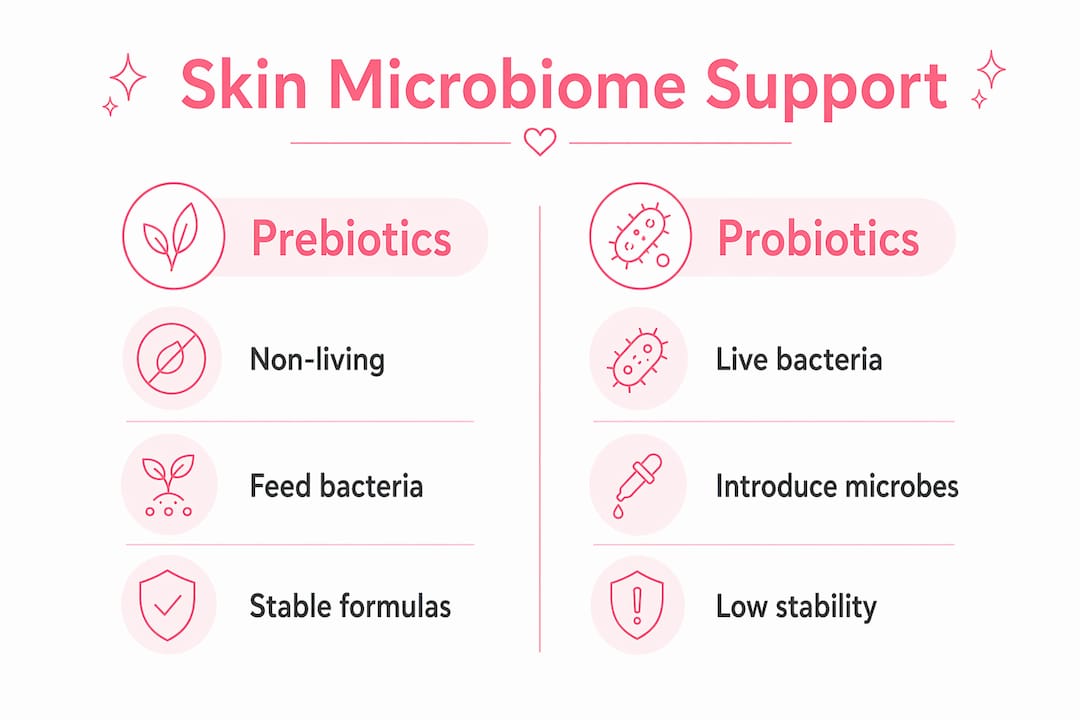
Formulation stability strongly favors prebiotics over live probiotics. Keeping live bacteria viable in a cream or serum requires refrigeration, precise pH control, and short shelf lives. Prebiotics, as non-living oligosaccharides, are far more stable and easier to incorporate into standard cosmetic formulations. That stability is a practical reason why prebiotic products are more widely available than true probiotic skincare.
Postbiotics complement both. They deliver the end products of microbial activity, such as short-chain fatty acids and peptides, without requiring live organisms or a functioning microbiome to produce them. For people with severely disrupted skin microbiomes, postbiotics can provide immediate bioactive benefits while prebiotics work to rebuild the ecosystem over time.
Here is a direct comparison of each category:
- Prebiotics: Non-living oligosaccharides (FOS, GOS, botanical extracts). Stable in formulations. Feed existing beneficial bacteria. Results build over 6–10 weeks.
- Probiotics: Live microorganisms. Require careful preservation. Introduce beneficial bacteria directly. Formulation challenges limit availability.
- Postbiotics: Bioactive metabolites from microbial activity. Stable. Deliver immediate bioactive effects. Do not require a functioning microbiome to work.
The most forward-thinking formulations combine all three. A prebiotic feeds the microbiome, a postbiotic delivers immediate bioactive support, and a probiotic (where formulation allows) reinforces microbial populations. For most people, a prebiotic plus postbiotic combination is the most practical starting point.
Which prebiotic ingredients are used in skincare?
Prebiotic skincare ingredients are mostly oligosaccharides, with fructooligosaccharides (FOS) and galactooligosaccharides (GOS) carrying the strongest clinical evidence. Both are derived from plant sources. FOS comes from chicory root, agave, and certain grains. GOS is derived from lactose through enzymatic processing. Both have been shown to selectively nourish beneficial skin bacteria in controlled trials.
Beyond FOS and GOS, botanical extracts with prebiotic properties are gaining traction. Inulin, a polysaccharide found in Jerusalem artichoke and chicory, functions similarly to FOS. Beta-glucan, derived from oats or yeast, supports both the microbiome and the skin barrier directly. These ingredients appear on labels under their common names, so they are easier to identify than synthetic oligosaccharides.
One critical point: two products labeled “prebiotic” can have entirely different biological effects depending on which substrate they use. FOS and GOS have distinct microbial selectivity profiles. A product using a vague “prebiotic complex” without specifying the substrate type offers no guarantee of the outcomes seen in GOS or FOS trials. Reading ingredient lists for specific oligosaccharide names is the only reliable way to assess a product’s evidence base.
- Fructooligosaccharides (FOS): Plant-derived, well-studied, supports Lactobacillus and Bifidobacterium growth on skin.
- Galactooligosaccharides (GOS): Lactose-derived, backed by the strongest clinical trial data for hydration and barrier improvement.
- Inulin: Polysaccharide from chicory or artichoke, functions similarly to FOS, widely used in gentle formulations.
- Beta-glucan: Oat or yeast-derived, supports both microbiome balance and direct barrier reinforcement.
- Botanical extracts: Certain plant polysaccharides act as prebiotics, though evidence varies by extract and concentration.
For a deeper look at how specific substrates interact with skin biology, the amino acid skin guide at Spyraverified covers related ingredient mechanisms. Japanese formulations in particular have long used plant-derived oligosaccharides, as covered in Spyraverified’s Japanese anti-aging ingredients guide.
How should you add prebiotics to your skincare routine?
Start with product selection. A credible prebiotic product names its specific substrate on the ingredient list. FOS, GOS, inulin, or beta-glucan should appear, not just a generic “prebiotic blend.” Products that cite clinical trial data, even in summary form, are more trustworthy than those relying entirely on marketing language about the gut-skin axis.
Set realistic expectations. Clinical trials show that measurable microbiome modulation and barrier improvements take approximately 6–10 weeks. Any product claiming visible results in 48 hours is not describing prebiotic action. Microbiome shifts are gradual. Barrier improvements follow as the microbial ecosystem stabilizes.
Layer prebiotics thoughtfully. Prebiotics pair well with ceramides, niacinamide, and hyaluronic acid, all of which support barrier function through complementary mechanisms. Avoid combining prebiotic products with high-concentration acids or strong antimicrobial actives in the same routine step. Those ingredients can disrupt the very microbial environment the prebiotic is trying to support. For guidance on sequencing, Spyraverified’s article on skincare layering mistakes is a practical reference.
- Check the ingredient list. Confirm a named oligosaccharide (FOS, GOS, inulin) appears, not just “prebiotic extract.”
- Introduce gradually. Add one prebiotic product at a time to isolate its effect on your skin.
- Track proxy metrics. Monitor redness, dryness, and skin texture weekly. These are the visible signs of TEWL and erythema changes.
- Allow 6–10 weeks. Commit to a full trial period before evaluating results.
- Avoid conflicting actives. Do not use strong antimicrobials or high-acid exfoliants in the same routine step as your prebiotic product.
Pro Tip: Take a close-up photo of your skin under consistent lighting every two weeks. Comparing photos at weeks 2, 4, 6, and 8 gives you a clearer picture of barrier and redness changes than relying on memory alone.
Key Takeaways
Prebiotics strengthen the skin barrier by selectively feeding beneficial bacteria, with clinical evidence showing measurable improvements in hydration, TEWL, and erythema after 6–10 weeks of consistent use.
| Point | Details |
|---|---|
| Prebiotics defined | Non-living oligosaccharides (FOS, GOS) that feed beneficial skin bacteria without introducing live microbes. |
| Clinical evidence | An 8-week GOS trial showed improved hydration, reduced TEWL and erythema, and lower S. aureus levels. |
| Stability advantage | Prebiotics outperform live probiotics in formulation stability, making them more practical for daily skincare. |
| Ingredient specificity | Two “prebiotic” products can have different effects; always check for named substrates like FOS or GOS. |
| Realistic timeline | Expect 6–10 weeks for measurable microbiome and barrier improvements, not overnight results. |
Why I think the prebiotic conversation in skincare needs more precision
The skincare industry has a habit of adopting scientific terms before the science is fully translated. “Microbiome” and “prebiotic” are now on packaging everywhere, but most products do not specify which substrate they use or cite any trial data. That gap between the label and the evidence is where people waste money and lose trust in the category.
What I have found genuinely useful is focusing on the three-marker standard: TEWL, erythema, and microbiome diversity. If a brand cannot point to improvements in at least two of these, the prebiotic claim is mostly marketing. The evidence for GOS specifically is strong enough to treat it as a benchmark. Any product claiming comparable results should be held to a comparable standard of proof.
The other thing worth saying plainly: individual microbiome variability means no prebiotic will work identically for everyone. Your baseline microbial composition determines how much a given substrate can shift your ecosystem. That is not a flaw in the science. It is a reason to track your own results rather than relying on average trial outcomes. The 6–10 week window is an average. Some people see changes at week 4. Others need the full 10 weeks.
The future of this category is in specificity: named substrates, published trial data, and formulations that combine prebiotics with postbiotics for layered microbiome support. That is the standard worth holding brands to now, before the market gets more crowded.
— Anni
Spyraverified’s microbiome-friendly skincare picks
Spyraverified curates skincare products from Japanese and Asian brands that prioritize gentle, barrier-supportive formulations. Many of these products are built around ingredients that work with the skin’s natural ecosystem rather than against it.

The Spyraverified skincare collection includes options formulated with microbiome-conscious principles, from lightweight serums to barrier-repair creams. Each product page lists full ingredient details so you can verify specific substrates before purchasing. For body care that aligns with the same gentle philosophy, the Japanese Peppermint Cool Body Soap offers a soothing, microbiome-friendly cleanse without disrupting the skin’s natural bacterial balance.
FAQ
What are prebiotics in skincare?
Prebiotics in skincare are non-living substrates, typically oligosaccharides like FOS and GOS, that selectively feed beneficial bacteria on the skin surface. They differ from probiotics, which introduce live microorganisms.
How long do prebiotic skincare products take to work?
Clinical trials show that measurable improvements in skin barrier function and microbiome balance take approximately 6–10 weeks. Products claiming faster results are not describing prebiotic action.
What is the difference between prebiotics and probiotics in skincare?
Prebiotics are stable substrates that feed existing skin bacteria. Probiotics are live microorganisms that introduce new bacteria and require careful formulation to stay viable in cosmetic products.
Which prebiotic ingredients should I look for on a label?
Look for fructooligosaccharides (FOS), galactooligosaccharides (GOS), inulin, or beta-glucan. Generic terms like “prebiotic complex” without a named substrate offer no guarantee of clinical efficacy.
Can prebiotics help with sensitive or inflamed skin?
Yes. The 8-week GOS trial showed reduced erythema and lower S. aureus levels, both relevant to sensitive and inflammation-prone skin. Results depend on the specific substrate and individual microbiome baseline.
