

Water-Based vs. Oil-Based Skincare: Which One Is Right for You?
Water-based skincare delivers lightweight hydration using water as its primary carrier, while oil-based skincare uses oils, butters, and occlusives to seal in moisture and repair the skin barrier. The short version: if your skin runs oily, combination, or acne-prone, start with water-based products. If it runs dry, mature, or barrier-compromised, oil-based formulas will do more for you. Most people end up using both, and the one rule that makes that work is simple: apply water-based products first, oil-based products last.
Water-based suits you if:
- Your skin feels greasy by midday
- You break out easily or have enlarged pores
- You want lightweight serums and gel moisturizers that absorb fast
- You’re layering multiple actives (vitamin C, niacinamide, AHAs)
Oil-based suits you if:
- Your skin feels tight, flaky, or rough after cleansing
- You’re dealing with mature skin or a compromised barrier
- You need lasting moisture overnight without reapplying
- You want to remove sunscreen and makeup thoroughly
The layering rule: thinnest to thickest, water before oil. Applying an oil first creates an occlusive film that blocks water-based actives from penetrating the skin.
Key Takeaways
Water-based products hydrate with humectants like hyaluronic acid and suit oily or acne-prone skin, while oil-based products reduce TEWL with occlusives and suit dry or mature skin. Apply water-based layers first, oil-based last.
| Point | Details |
|---|---|
| Base determines function | Water-based products hydrate; oil-based products occlude and repair the barrier. |
| Skin type drives the choice | Oily and acne-prone skin benefits from water-based formulas; dry and mature skin needs oil-based products. |
| Layer thinnest to thickest | Always apply water-based serums and toners before oils or rich creams to avoid blocking absorption. |
| Fatty-acid composition matters | For acne-prone skin, choose linoleic-rich oils like rosehip or squalane over oleic-heavy oils like coconut. |
| Spyraverified curates both bases | The skincare collection includes vetted water- and oil-based Japanese and Asian products; patch-test before full use. |
Table of Contents
- What are water-based skincare products, and how do they work?
- What are oil-based skincare products, and why do they feel richer?
- How can you tell if a product is water-based or oil-based?
- Which base is best for your skin type?
- Are oils bad for acne-prone skin? The comedogenicity question
- How to layer water-based and oil-based products correctly
- Which product category should you reach for?
- Evidence, safety notes, and what the research actually says
- A curator’s perspective on shopping both bases
- Curated water- and oil-based skincare from Spyraverified
- Sources
What are water-based skincare products, and how do they work?
Water (listed as “aqua” on ingredient labels) is the primary carrier in water-based formulas. That single fact explains most of what makes them feel the way they do: light, fast-absorbing, and non-greasy. They’re built to deliver water-soluble actives directly into the skin rather than sit on top of it.
The most common formats are toners, hydrating mists, gel moisturizers, and lightweight serums. Their textures range from thin and watery to gel-like, but they share the same basic behavior: they sink in quickly and leave little to no residue. Hydrating mists like those in Japanese skincare routines often use botanical hydrosols or mineral water as their base, which is part of why they feel so refreshing without any heaviness.
The workhorse ingredients in water-based products are humectants: hyaluronic acid, glycerin, and panthenol. These molecules attract water from the environment and from deeper skin layers, pulling it toward the surface. Harvard Health notes that humectants provide rapid hydration by drawing water in, while occlusives (found in oil-based products) work by reducing transepidermal water loss (TEWL). These are complementary mechanisms, not competing ones. Water-soluble vitamins like vitamin C (as ascorbic acid or sodium ascorbyl phosphate) and niacinamide also dissolve cleanly in water-based formulas, which is why most brightening and pore-refining serums are water-based.
Water-based products are the natural fit for oily, combination, and acne-prone skin because they hydrate without adding lipids that could tip sebum production or clog pores. They’re also the right choice when you’re layering multiple actives, since each layer absorbs cleanly before the next goes on. You can read more about how water functions in skincare formulations and why it matters beyond just being a filler ingredient.

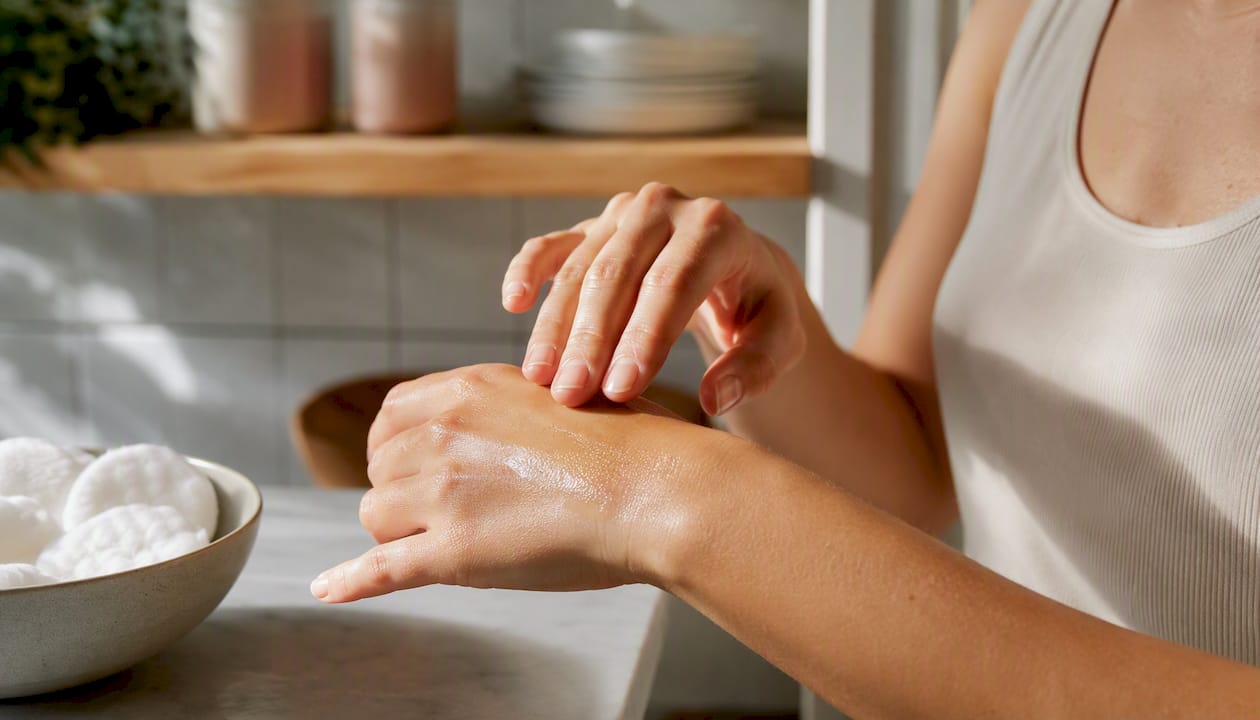
Pro Tip: Dab a small amount of a product on the back of your hand and wait 30 seconds. If it absorbs without a trace, it’s water-based. If it leaves a slight sheen or slick residue, there’s oil in the formula.
What are oil-based skincare products, and why do they feel richer?
Oil-based products use oils, butters, or waxes as their primary carrier instead of water. That structural difference is why they feel heavier on the skin and why they behave so differently once applied. Rather than sinking in like a serum, they form a film on the surface that slows water from evaporating out of the skin. This is occlusion, and it’s the mechanism behind their ability to keep dry skin soft for hours.
Common formats include facial oils, cleansing oils and balms, rich night creams, and body butters. Water-in-oil (W/O) emulsions, where water droplets are suspended in an oil phase, also fall into this category — they feel richer than oil-in-water (O/W) creams and leave a more noticeable finish.
The oils you’ll see most often in skincare:
- Jojoba oil: technically a liquid wax, closely mimics the skin’s natural sebum, absorbs relatively well
- Squalane: a lightweight, stable hydrocarbon derived from sugarcane or olives; absorbs quickly for an oil and suits most skin types
- Argan oil: rich in vitamin E and oleic acid; nourishing but heavier
- Coconut oil: high in lauric acid; effective occlusive but high comedogenic potential for some skin types
- Shea butter: a solid fat that melts on contact; deeply emollient, best for very dry skin or body use
Oil-based products are the right call for dry, mature, or barrier-compromised skin. They don’t just add moisture — they lock it in. For someone dealing with eczema flares, a compromised winter barrier, or skin that’s been stripped by over-exfoliation, an occlusive oil or balm applied as the final step can make a visible difference overnight.
Pro Tip: If you have oily or acne-prone skin but still want the benefits of a facial oil, reach for squalane or jojoba first. Both have low comedogenic ratings and absorb without the heavy, pore-clogging feel of coconut oil or cocoa butter.
How can you tell if a product is water-based or oil-based?
The ingredient list tells you almost everything. Cosmetic ingredients are listed in descending order of concentration, so whatever appears first makes up the largest portion of the formula.
Step-by-step label check:
- Find the first ingredient. If it’s “water,” “aqua,” “aloe vera juice,” or a floral hydrosol (rose water, chamomile water), the product is water-based.
- Look for named oils or butters at the top. If jojoba oil, argan oil, coconut oil, or shea butter appears in the first three ingredients, the product is oil-based.
- Check for emulsifiers. Ingredients like cetearyl alcohol, glyceryl stearate, or polysorbate 20 signal an emulsion. Where they appear relative to water and oils tells you whether it’s O/W (lighter) or W/O (richer).
- Do the sensory check. Apply a small amount to clean skin. Water-based formulas vanish in under a minute; oil-based ones leave a residue, a dewy finish, or a slight sheen.
Quick yes/no checklist:
- Does the label list “aqua” or “water” first? → Water-based
- Does it list an oil or butter in the top three? → Oil-based
- Does it absorb in under 30 seconds with no residue? → Water-based
- Does it leave your skin looking dewy or feeling slick? → Oil-based
InStyle’s cosmetic-chemist breakdown confirms this first-ingredient rule as the most reliable quick check. Emulsions are trickier because they contain both phases, but the ingredient order still signals which phase dominates and how the product will behave on skin.
Which base is best for your skin type?
| Feature | Water-Based | Oil-Based |
|---|---|---|
| Texture | Lightweight, gel-like, or watery | Rich, creamy, or balm-like |
| Primary function | Hydration, active delivery | Occlusion, nourishment, barrier repair |
| Best-for skin types | Oily, combination, acne-prone | Dry, mature, barrier-compromised |
| Absorption behavior | Fast, no residue | Slower, leaves a film or sheen |
| Common ingredients | Hyaluronic acid, glycerin, niacinamide | Jojoba, squalane, shea, argan |
| Comedogenic risk | Generally low | Varies widely by oil type |
By skin type, in plain terms:
- Oily skin: Stick to water-based moisturizers and serums. A gel cleanser and a hyaluronic acid serum cover most of your hydration needs without adding lipids.
- Acne-prone skin: Water-based products are safer by default. If you want a facial oil, choose squalane or rosehip (higher in linoleic acid).
- Dry skin: Oil-based products are your best friend, especially as the last step in your routine. A rich cream or a few drops of facial oil seal in everything underneath.
- Combination skin: Use water-based formulas on oily zones (T-zone) and a light oil or richer cream on dry patches. Layering both in the right zones works well.
- Mature skin: The skin barrier thins with age and produces less sebum. Oil-based products help compensate for that loss and reduce the look of fine lines by keeping skin plump.
- Sensitive skin: Either base can work, but check for fragrance and essential oils in oil-based formulas. Squalane and jojoba are among the gentler options.
Pro Tip: Switch your moisturizer base with the seasons, not just your wardrobe. A gel moisturizer that works perfectly in July may leave your skin tight and flaky by January. Keeping a small jar of a richer oil-based cream for fall and winter is one of the simplest upgrades you can make.
Two quick scenarios:
Dehydrated oily skin: This is more common than people expect. The skin produces excess oil partly because it’s dehydrated. A water-based hyaluronic acid serum layered under a lightweight gel moisturizer addresses the dehydration without adding lipids that could worsen breakouts. No facial oil needed.
Dry mature skin in winter: A hydrating toner (water-based), a peptide serum (water-based), and a rich night cream or a few drops of argan oil as the final step. The water-based layers deliver actives; the oil seals everything in overnight.
Are oils bad for acne-prone skin? The comedogenicity question
The short answer: it depends entirely on which oil. Comedogenicity refers to an ingredient’s tendency to clog pores and contribute to breakouts, and the ratings used to measure it (typically a 0–5 scale) were developed from rabbit ear studies that don’t always translate cleanly to human facial skin. Treat comedogenic ratings as directional guidance, not hard rules.
Oils more commonly flagged as higher risk:
- Coconut oil (rating: 4): high in lauric acid, frequently reported to cause breakouts on the face
- Cocoa butter (rating: 4): very heavy, better suited for body use
- Wheat germ oil (rating: 5): among the highest-rated for comedogenicity
- Flaxseed oil: high in oleic acid, which can worsen barrier function in inflamed skin
Oils more commonly tolerated by acne-prone skin:
- Squalane (rating: 0–1): stable, lightweight, rarely causes issues
- Jojoba (rating: 2): mimics sebum, generally well-tolerated
- Rosehip seed oil: higher in linoleic acid, which tends to support rather than disrupt the barrier in inflamed skin
- Hemp seed oil: also linoleic-rich, frequently used in acne-focused formulas
The fatty-acid composition matters more than the comedogenic number alone. A clinical review published in Frontiers in Pharmacology found that oils high in oleic acid can worsen barrier integrity in inflamed or atopic-prone skin, while oils higher in linoleic acid tend to support barrier repair. Acne-prone skin often shows a relative deficiency in linoleic acid, which is part of why linoleic-rich oils like rosehip and hemp seed are better tolerated.
Clinical note: The oleic-to-linoleic acid ratio in a vegetable oil is one of the most useful indicators of how it will behave on inflamed or acne-prone skin. Linoleic-dominant oils generally support barrier repair; oleic-dominant oils can disrupt it.
Patch-test protocol: Apply a small amount of any new oil to the inside of your forearm or behind your ear. Wait 24–48 hours before applying it to your face. If you’re testing for comedogenicity specifically, apply to a small area of your cheek or chin for 7–10 days before committing to full-face use.
Pro Tip: If a product lists “fragrance” or essential oils alongside a botanical oil, those additives are often the real irritant — not the oil itself. Isolate variables by testing fragrance-free versions first.
How to layer water-based and oil-based products correctly
The core rule is non-negotiable: thinnest to thickest, water before oil. Applying an oil first creates an occlusive barrier that prevents water-based actives from reaching the skin. Get that order wrong and your expensive serums are essentially sitting on top of a film, not penetrating.
Morning routine:
- Gel or foam cleanser (water-based)
- Hydrating toner or essence (water-based, thinnest layer)
- Vitamin C serum or other water-based active
- Lightweight gel moisturizer (water-based or O/W emulsion)
- Sunscreen (last step — many chemical sunscreens are oil-based or emulsion-based, which is fine as the final layer)
A light facial oil in the morning is optional. If you use one, add 1–2 drops after your moisturizer and before sunscreen, but only if your sunscreen formula is compatible (test for pilling first).
Evening routine:
- Cleansing oil or balm (first cleanse, removes sunscreen and makeup)
- Gel or foam cleanser (second cleanse, removes remaining residue)
- Hydrating toner or essence
- Water-based treatment serum (retinol in a water-based formula, peptides, etc.)
- Rich moisturizer or facial oil as the final step
The double-cleanse method is worth understanding separately: the oil-based first step dissolves sunscreen and oil-based makeup, which a water-based cleanser alone can’t fully remove. The second, water-based cleanse then removes the emulsified residue. It’s not redundant — each step does a different job. For more on avoiding common errors with oil cleansers, the cleansing oil mistakes guide covers the most frequent missteps.
Pro Tip: Pilling (when products ball up on the skin) almost always comes from applying a new layer before the previous one has absorbed. Wait 30–60 seconds between each step. If pilling persists, check whether your sunscreen and moisturizer are compatible — some silicone-heavy formulas don’t layer well with certain oil-based products.
For a deeper look at common layering mistakes and how to fix them, that guide covers the most frequent ordering errors in detail.
Which product category should you reach for?
Knowing the base helps, but knowing which product format to use for a given goal is just as useful.
- Cleansers: A gel or foam cleanser is water-based and works well for daily morning cleansing on oily or combination skin. A cleansing oil or balm is oil-based and excels at removing sunscreen, heavy makeup, and sebum — best used as the first step in a double cleanse.
- Toners and essences: Almost always water-based. They prep the skin for actives and add a first layer of humectant hydration. Japanese and Korean essences often use fermented water bases that absorb exceptionally well.
- Serums: Water-based serums (hyaluronic acid, niacinamide, vitamin C) deliver targeted actives fast. Oil serums (rosehip, bakuchiol in a jojoba base) deliver lipophilic actives and work best as a final or near-final step.
- Moisturizers: Gel moisturizers are water-based or O/W emulsions — right for oily and combination skin. Rich creams are W/O emulsions or oil-heavy formulas — right for dry and mature skin.
- Facial oils and balms: Pure oil-based. Use as the last step in your evening routine, or as a targeted treatment on dry patches. Balms (thicker, wax-based) are the most occlusive option and work well over cracked or very dry areas.
By goal:
- Antiaging: Layer a water-based retinol or peptide serum under a rich oil-based night cream or squalane.
- Barrier repair: A ceramide-rich water-based moisturizer paired with a linoleic-rich oil (rosehip, hemp seed) as the final step.
- Acne control: Water-based actives (niacinamide, salicylic acid) with a lightweight gel moisturizer. Avoid heavy oils.
- Makeup removal: Start with a cleansing oil or balm — nothing removes oil-based makeup and SPF as effectively.
Evidence, safety notes, and what the research actually says
The Cleveland Clinic’s overview of the epidermis explains the physiological basis for why formulation choice matters: the stratum corneum (the outermost skin layer) regulates both absorption and water loss. When this barrier is intact, it controls what gets in and what stays in. When it’s compromised, TEWL increases and skin becomes more reactive. Occlusive oils reduce TEWL by forming a physical barrier on the surface; humectants in water-based products attract water to compensate for what’s lost.
On the occlusive side, a review published in the International Journal of Cosmetic Science notes that petrolatum is historically considered the gold standard occlusive, often outperforming botanical oils for barrier repair. Botanical oils vary widely in performance and carry more variability in quality and composition. That doesn’t make botanical oils inferior for everyday use — it means petrolatum and mineral oil are more predictable for clinical barrier repair, while plant-based oils offer additional benefits (antioxidants, fatty acids) with more variability.
The clinical evidence on topical oils is genuinely mixed. A ScienceDirect review on topical oils and the skin barrier found that coconut oil showed positive results in multiple studies for hydration and TEWL reduction, but other oils had mixed or negative outcomes depending on the population and usage pattern. Context matters: an oil that works well on healthy adult skin may not be appropriate for infant skin or atopic dermatitis.
Expert note: Cosmetic chemists consistently point out that extraction and processing methods affect oil quality significantly. Cold-pressed, unrefined oils retain more of their active fatty acids and antioxidants, but they also have shorter shelf lives and more variability between batches. An ACS Omega review on plant-based oils in cosmetics confirms that formulation and processing choices directly affect consumer outcomes.
Practical safety notes:
- Infant and child skin is more permeable than adult skin. Use only well-tested, fragrance-free formulas on young children, and consult a pediatric dermatologist before applying botanical oils to infants with eczema.
- Oleic-acid-dominant oils (coconut, olive) can worsen barrier function in inflamed or atopic skin. Choose linoleic-rich alternatives for sensitive or reactive skin.
- Petrolatum and mineral oil, despite their unglamorous reputation, are among the safest and most effective occlusives available. They are non-comedogenic and non-sensitizing for most people.
- Always patch-test new products: apply to the inner forearm or behind the ear, wait 24–48 hours, and check for redness, itching, or breakouts before applying to the face.
A curator’s perspective on shopping both bases
The most common mistake shoppers make is treating “water-based” and “oil-based” as opposing camps when they’re actually a team. The real question is sequencing and purpose.
When I’m reviewing a product page for Spyraverified’s curated collection, the first thing I check is the first three ingredients. If a product claims to be a “lightweight hydrating serum” but lists a heavy butter in position two, that’s a mismatch between marketing and formulation. The label doesn’t lie.
My personal shopping checklist:
- Check the first ingredient (aqua or an oil?)
- Look for fragrance and essential oils — these are the most common irritants in both bases
- For oils, look for squalane or jojoba as the primary oil if you have oily or acne-prone skin
- Buy sample sizes before committing to a full bottle, especially with facial oils
- Patch-test any new oil for at least a week before adding it to your full routine
Seasonal swaps are real and worth planning for. A water-based gel moisturizer that feels perfect in spring and summer will likely leave your skin under-moisturized once the heating comes on in fall. Keeping a richer oil-based option in your cabinet for colder months is practical, not indulgent. Japanese skincare does this particularly well — many brands formulate seasonal variants of the same moisturizer, lighter for summer and richer for winter, which is something worth looking for when browsing curated Asian beauty collections.
Curated water- and oil-based skincare from Spyraverified
Knowing which base your skin needs is half the work. Finding products that are genuinely formulated to match is the other half, and that’s where sourcing matters.
Spyraverified curates authentic Japanese and Asian skincare products directly from partnered manufacturers, which means every item in the skincare collection has been vetted for formulation quality and ingredient transparency. Whether you’re looking for a lightweight hyaluronic acid essence, a linoleic-rich facial oil, or a cleansing balm for double-cleansing, the collection covers both bases with products that are difficult to find outside their home markets. Before purchasing, check the ingredient list for your skin type and patch-test any new oil or active for at least 48 hours.
Sources
- Oil- vs. Water-Based Skin-Care: Everything You Need to Know
- Vegetable butters and oils as therapeutically and cosmetically active ingredients for dermal use: a review of clinical studies
- Moisturizers: Do they work? — Harvard Health Publishing
- Epidermis — Cleveland Clinic
- The benefits and challenges of treating skin with natural oils
- Review: plant-based oils in cosmetics and extraction/processing impacts (ACS Omega)
- Topical oils and the skin barrier: clinical evidence and safety considerations (ScienceDirect review)
