

Fewer Ingredients, Fewer Problems: The Case for Minimalist Skincare
Minimal-ingredient formulas reduce your skin’s exposure to needless additives and make irritation easier to spot. That’s the whole case in one sentence, but it’s worth unpacking because it changes how you shop. Fewer ingredients means fewer chances for a fragrance, preservative, or emulsifier to trigger a flare. It also means that when something does go wrong, you can actually figure out what caused it, instead of staring at a bottle with 30 ingredients wondering which one is the culprit. A dermatologist-recommended baseline routine of cleanse, moisturize, and protect works precisely because each step does one job well. Platforms like Spyra Verified built their entire sourcing model around this idea: short, transparent ingredient lists from Japanese and Asian brands that skip the filler.
- Lower cumulative sensitization risk from unnecessary additives
- Faster troubleshooting when a product causes a reaction
- Higher odds that active ingredients are actually dosed at effective levels
Key Takeaways
Minimal-ingredient formulas reduce cumulative sensitization risk, make troubleshooting reactions faster, and often deliver actives at more meaningful concentrations than long, complex formulas.
| Point | Details |
|---|---|
| Fewer additives, fewer triggers | Short ingredient lists cut exposure to fragrance, preservatives, and emulsifiers that commonly cause reactions. |
| Concentration beats ingredient count | A well-dosed short list often outperforms a long list padded with sub-efficacious actives. |
| Patch test every new product | Test on your forearm for 48 hours and introduce one active at a time over two to four weeks. |
| Check the label before the claims | Look for short INCI lists, fragrance-free labeling, and protective packaging like airless pumps. |
| Shop verified minimal formulas | Spyra Verified curates authentic Japanese and Asian skincare with manufacturer-confirmed ingredient transparency. |
Table of Contents
- Benefits of Minimal Ingredient Formulas You’ll Actually Notice
- The Science: Why Short Ingredient Lists Lower Your Risk
- How to Choose Minimal-Ingredient Formulas: A Shopping Checklist
- Minimalist Asian Routine Examples You Can Copy
- Patch Testing and Introducing New Actives Safely
- Why Trust This Guidance on Minimal Formulas
- Where to Find Minimal-Ingredient Formulas You Can Trust
- Frequently Asked Questions
- Sources
Benefits of Minimal Ingredient Formulas You’ll Actually Notice
The appeal isn’t abstract. It shows up the first week you switch.
Fewer ingredients means fewer fragrances, synthetic preservatives, and emulsifiers competing for space on your skin. Each of those categories carries its own sensitization risk, and stacking several products with overlapping additives compounds that risk fast. A fragrance-free approach removes one of the most common irritant categories entirely, which is a big part of why so many sensitive-skin formulas skip scent altogether.
Simplifying your routine also makes cause-and-effect obvious again. If you’re using a 12-step routine and your skin flares up, good luck isolating which product did it. Drop to four or five products with short ingredient lists, and a reaction points to one or two suspects instead of a dozen.
There’s a formulation upside too. Brands packing a label with 25 or 30 ingredients often can’t dose every “star” active at a level that actually does anything, since long lists frequently contain ingredients at sub-efficacious concentrations just to support a marketing claim. A tighter formula has less room to hide a token amount of niacinamide behind a wall of filler.
Quick math on the tradeoff:
- Long-list formula: more claimed benefits, but individual ingredient concentrations often lower
- Short-list formula: fewer claims, but each ingredient usually earns a bigger share of the bottle
Simpler routines also waste less product and less money, since you’re not buying five overlapping serums that all promise the same glow.
The Science: Why Short Ingredient Lists Lower Your Risk
Water is the reason most formulas balloon past a dozen ingredients. Any water-based product is a breeding ground for bacteria and mold unless you add a preservative system, and most preservative systems aren’t single ingredients. They’re blends, often two or three compounds working together to cover different microbes. That alone can add three or four line items to an otherwise simple formula.
Emulsifiers create a second layer of complexity. Mixing oil and water phases requires a stabilizer, and stabilizers plus pH adjusters create more surface area for a reaction, especially on compromised or reactive skin. None of this is inherently bad. It’s just additive: every extra functional ingredient is one more variable your skin has to tolerate.
The bigger risk shows up in combinations. Stack enough ingredients together and you raise the odds that two of them interact badly, destabilizing an active like Vitamin C or retinol before it ever reaches your skin in a usable form. Formulation analysis on skinimalism points to exactly this: fewer components mean fewer interaction pathways, which makes a formula easier to stabilize and easier to trust.
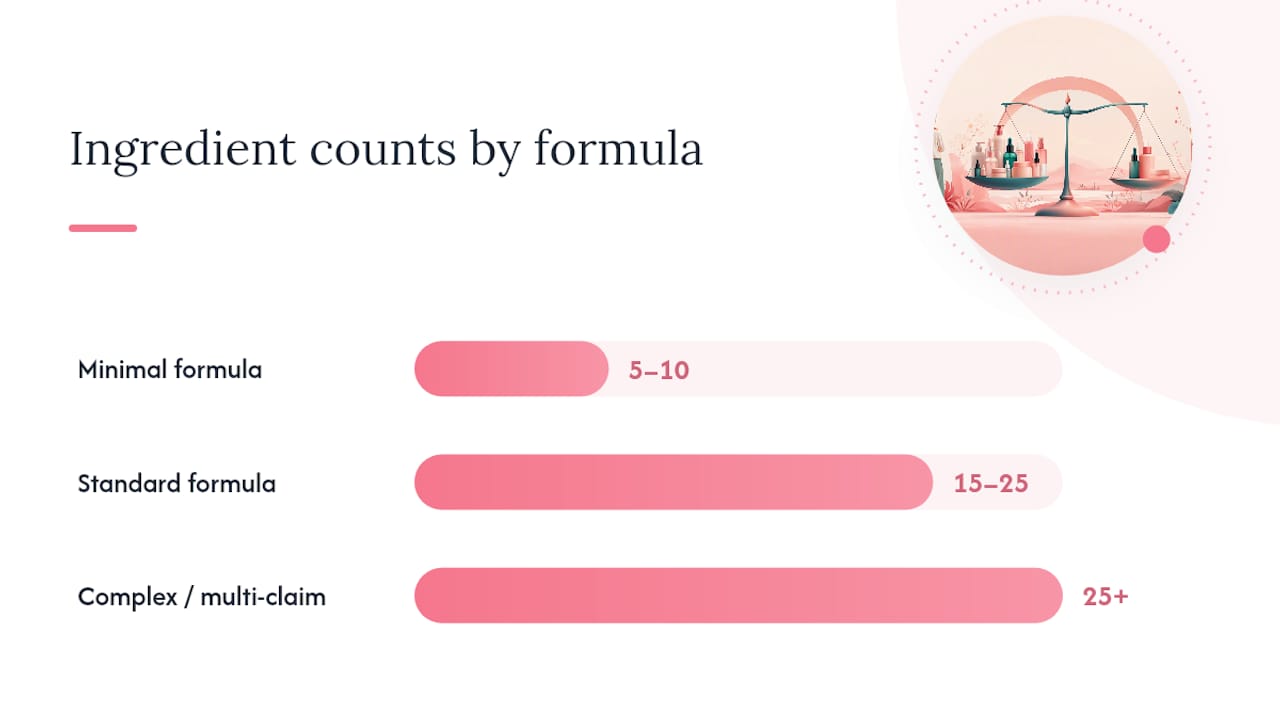
| Formula type | Typical ingredient count | Main risk factor |
|---|---|---|
| Minimal formula | 5 to 10 | Limited but well-dosed actives |
| Standard formula | 15 to 25 | Preservative and emulsifier stacking |
| Complex/multi-claim formula | 25+ | Diluted actives, higher interaction risk |
Pro Tip: If a product claims to fight wrinkles, brighten skin, and calm redness all at once, check where its “hero” ingredient sits on the list. If it’s near the bottom, you’re probably not getting a meaningful dose.
The clinical baseline of cleanse, moisturize, and protect with SPF 30+ still holds up because it isolates function. Each step does one job, and minimalist products fit that model naturally instead of fighting it.
How to Choose Minimal-Ingredient Formulas: A Shopping Checklist
- Read the INCI list first, not the front-of-bottle claims. A short, pronounceable ingredient list with a fragrance-free label is your best early signal.
- Scan for known sensitizers. Fragrance, methylisothiazolinone (MI/MCI), and multiple PEG compounds show up often in reactive-skin complaints, especially when stacked together.
- Check the packaging. Airless pumps and opaque tubes protect actives from air and light exposure, which can reduce how hard a formula has to work to stay stable, and often means fewer preservatives are needed in the first place.
- Be skeptical of multifunctional claims unless dosing is transparent. A serum that claims to replace three steps is only worth it if the label shows real concentrations, not vague “complex” or “blend” naming.
- Watch for layering conflicts. Some common layering mistakes come from stacking actives that shouldn’t touch, not from any single product being flawed.
Pro Tip: Keep a running list of ingredients that have caused you trouble in the past. Cross-reference it every time you shop, because sensitizers tend to repeat under different marketing names.
Minimalist Asian Routine Examples You Can Copy
Skinimalism didn’t come out of nowhere. Japanese skincare has leaned toward “less but better” for years, and that philosophy is now shaping global skincare trends as K-beauty and J-beauty converge on fewer, higher-quality steps.
Morning:
- Gentle cleanse (or just a splash of water if skin isn’t oily overnight)
- Lightweight hydrating essence or toner
- Optional barrier moisturizer if skin runs dry
- Broad-spectrum SPF 30 or higher, non-negotiable
Evening:
- Gentle cleanse to remove sunscreen and daily buildup
- One targeted treatment only if you’re addressing a specific concern
- Barrier-supporting moisturizer to lock things in
A simple sensitive-skin routine template follows this same shape almost exactly. When a Japanese or Korean product claims to be multifunctional, check that it’s replacing a step rather than adding one on top of everything else you already use.
Patch Testing and Introducing New Actives Safely
- Apply a small amount of any new product to your inner forearm and wait 48 hours before using it on your face.
- Introduce one new product or active at a time, then wait two to four weeks before judging whether it’s working or causing trouble.
- If irritation shows up, stop the newest product first and write down every ingredient in it.
- See a dermatologist if redness, swelling, or breakouts persist more than a few days after stopping the suspected product.
Proper patch-testing is the single most reliable way to catch a bad reaction before it spreads to your entire face.
Why Trust This Guidance on Minimal Formulas
Spyra Verified built its catalog around authentic Japanese and Asian beauty brands, working directly with manufacturers to confirm ingredient lists match what’s printed on the label before a product ever reaches a customer. That verification process is the backbone of the platform’s role in this space.
- Author Anni covers ingredient-conscious skincare and ingredient transparency trends
- Every claim in this guide draws on dermatology-aligned sources, not marketing copy
- Spyra Verified partners directly with brand owners to confirm packaging and formulation accuracy before listing a product
A short note on patience and payoff
Fewer products, used consistently, beat a rotating cast of five serums you abandon after two weeks. That consistency is where results actually come from. It’s also just a better use of your money: one well-dosed product outlasts three half-used bottles sitting in a drawer.
Where to Find Minimal-Ingredient Formulas You Can Trust
Spyra Verified exists because sourcing genuine, short-list Japanese and Asian skincare from outside its home market is harder than it should be. Every product in the skincare collection comes from a direct manufacturer partnership, with ingredient transparency checked before it’s ever listed for sale.
If you’re tired of guessing which ingredient in a 20-item list is causing your breakouts, start by browsing formulas built around fewer, better-dosed ingredients instead of more of them. Check the skincare collection for options that fit a minimalist routine, and read the label on anything before it goes on your face. That one habit will do more for your skin than any single product ever could.
Frequently Asked Questions
What are the main benefits of minimal ingredient formulas for sensitive skin? The core benefits are lower irritation risk, faster identification of problem ingredients when a reaction happens, and a better chance that active ingredients are dosed high enough to actually work.
Do minimal-ingredient products work as well as complex formulas? Often better, since concentration and ingredient compatibility matter more than raw count. A short list with well-dosed actives can outperform a long list padded with trace amounts of trendy ingredients.
How many ingredients should a minimal skincare formula have? There’s no strict number, but formulas in the 5 to 10 range tend to keep interaction risk low while still delivering functional results, according to formulation analysis on skinimalism.
How do I patch test a new skincare product? Apply a small amount to your inner forearm and wait 48 hours, watching for redness, itching, or swelling before using it on your face. Full guidance is available in this patch-testing walkthrough.
When should I see a dermatologist about a skincare reaction? If redness, swelling, or breakouts persist for more than a few days after you’ve stopped the suspected product, a dermatologist can help identify the trigger and recommend next steps.
Sources
- Dermatologist-recommended skincare routines (Rao Dermatology)
- Why more ingredients don’t always mean better skincare (Times of India)
- Skinimalism: Less is more (Mount Sinai)
