

Avoid Fakes: Buy Authentic Japanese Skincare Direct From Spyraverified
The most reliable ways to buy authentic Japanese skincare online are official brand stores, direct-from-Japan marketplaces that ship internationally, specialty J‑Beauty importers, and vetted e‑commerce curators like Spyraverified. Each channel earns its place for different reasons: brand stores guarantee correct SKUs, Japan-based marketplaces open the door to domestic-only formulations, and curated importers add English labeling and real customer support. The rest of this guide walks through how to tell them apart and spot a fake before it ships.
TL;DR:
- Buying from official brand stores ensures authenticity, but many products are region-specific and may differ in formulation or packaging outside Japan.
- Japan-based marketplaces like DOKODEMO ship domestic-only SKUs directly internationally, but shipping is slower, and support may be in Japanese.
- Curated Japanese skincare importers provide English labels, customer support, and verified authenticity, making them ideal for first-time or support-focused buyers.
- Always verify SKU, ingredient list, and batch codes before purchasing, and check packaging quality and seals after delivery to prevent counterfeit products.
- Shipping costs, customs duties, and return policies vary significantly by channel and order origin, so understanding these factors helps avoid unexpected expenses.
Table of Contents
- Where to Buy Japanese Skincare From Official Brand Stores
- How Japan-Based Marketplaces and Forwarding Services Work
- Should You Buy From a Curated J‑Beauty Importer?
- How Can You Tell if Japanese Skincare Is Real?
- What Should You Know About Shipping and Returns?
- Why Trust This Guide (and Spyraverified)
- How Do Prices Compare Across Buying Channels?
- What Does Japanese Skincare Really Cost, All In?
- Which Retailers Do Buyers Actually Trust?
- What Should First-Time Buyers Know Before Ordering?
- What Most Buying Guides Get Wrong
- Buy Curated, Verified Japanese Skincare Direct From Spyraverified
- Sources
Where to Buy Japanese Skincare From Official Brand Stores
Official brand stores are the safest starting point when you buy Japanese skincare online because you’re purchasing directly from the manufacturer or a retailer that manufacturer has explicitly authorized. There’s no middleman guessing at inventory, no risk of a reseller padding a listing with stock photos from a different product generation.
The tricky part is that most major J‑Beauty brands, including favorites like Hada Labo, Shiseido, DHC, and Bioré, sell region-specific versions of their products. A Who What Wear roundup of top J‑Beauty brands notes these names come up constantly in editorial coverage precisely because they’re widely available, but “widely available” doesn’t mean every version on shelves outside Japan matches the domestic formula. Export SKUs sometimes carry different preservative systems or packaging to meet the destination country’s regulations.
To confirm you’re on an authorized channel, check for a few specific things:
- An “authorized retailers” or “where to buy” page listed directly on the brand’s official website
- A visible support or contact page with a real phone number or email, not just a contact form
- Consistent product photography that matches current packaging, not older or mismatched box art
- Clear labeling of whether the listing is the Japan-domestic formula or an export version
If a brand’s own site doesn’t list a retailer, treat that retailer’s authenticity claims with caution. Brands that care about their reputation in export markets tend to publish these lists precisely so shoppers can verify before buying.
How Japan-Based Marketplaces and Forwarding Services Work
Japan-based marketplaces solve a real problem: most domestic Japanese skincare never gets an export version at all. Sites like DOKODEMO list these domestic-only SKUs directly, complete with staff recommendations and category browsing, and ship them internationally without requiring a forwarding service.
That’s different from a proxy or freight-forwarding service, which buys on your behalf from a Japanese retailer that doesn’t ship abroad, then reships the package to you. Marketplaces like DOKODEMO and Kokoro Japan cut out that extra step because international shipping is built into checkout.
A few things to expect when ordering this way:
- Packaging and instructions are often in Japanese only, since these are domestic retail items, not export SKUs.
- Delivery windows run longer than domestic e-commerce, typically because items ship in batches from Japan.
- Return policies tend to be stricter, since reverse international shipping is expensive for the seller to absorb.
- Warranty or replacement support (for gadgets like facial devices) may route through Japan rather than a local office.
Pro Tip: Before ordering from a Japan-based marketplace, check its FAQ or help page for shipping and tax policy specifics. Sites like DOKODEMO and Kokoro Japan post these details up front, and reading them saves you a surprise at delivery.
Should You Buy From a Curated J‑Beauty Importer?
Specialty importers sit between brand stores and Japan-based marketplaces. These are retailers based outside Japan that stock J‑Beauty products with English labeling, translated ingredient lists, and customer service in your own time zone. For many first-time buyers, that combination matters more than access to every obscure domestic SKU.
What a solid curated importer typically offers:
- English product descriptions and ingredient breakdowns, so you’re not translating Japanese packaging yourself
- A tighter, edited product selection instead of an overwhelming full catalog
- A published return policy that doesn’t require shipping items back to Japan
- Visible customer reviews or ratings tied to specific products, not just the storefront overall
Editorial coverage of J‑Beauty consistently points to the same handful of trusted brand names, which is a sign that curated retailers and mainstream media are converging on what actually works rather than chasing novelty. When you’re new to Japanese skincare, or you just want a hydration-focused routine without wading through hundreds of listings, a curated importer with strong reviews is usually the faster, lower-risk route. Save the Japan-only marketplaces for later, once you know which brands and textures you actually like.
How Can You Tell if Japanese Skincare Is Real?
Verification splits into two stages: before you click “buy” and after the box arrives. Both matter, and skipping either one is how counterfeit product slips through.
Before purchase, check that the listing includes the exact SKU or product code the brand uses, look for ingredient lists that mirror the brand’s Japanese labeling rather than a vague INCI list pulled from nowhere, and read how transparent the seller is about where the item ships from.
After delivery, Spyraverified’s guide on spotting fake skincare recommends checking packaging print quality, verifying batch or lot numbers, and confirming safety seals are intact and not re-glued. If anything looks off, brands will often confirm authenticity directly if you send them the batch code and photos.
- Compare box printing and font against official product photos
- Check batch codes against the format the brand actually uses
- Contact the brand’s customer service with photos if anything seems inconsistent
- Stop using the product and request a refund if the seller can’t answer basic authenticity questions
Practical checks like comparing photos and validating batch codes work better than vague “buy official” advice because they give you something concrete to actually verify.
What Should You Know About Shipping and Returns?
Delivery timelines vary a lot depending on where your order ships from. Domestic e-commerce stock, including items held by curated importers with US warehouses, usually arrives in familiar timeframes. Orders shipped directly from Japan via marketplaces take longer, since they’re crossing an ocean and clearing customs.
Before you check out anywhere, run through this sequence:
- Check whether the listing ships from domestic stock or directly from Japan. That single detail predicts most of your wait time.
- Look up your country’s duty and tax thresholds using your customs agency’s online calculator before ordering, so a surprise bill doesn’t land at your door.
- Confirm the seller offers tracked shipping with a number you can actually follow, not just “shipped” confirmation.
- Read the return policy specifically for international orders, since many sellers restrict returns once an item leaves the country.
- Pay through a method that offers buyer protection, such as a credit card or a platform with dispute resolution, rather than a direct bank transfer.
Marketplaces that publish clear FAQ and policy pages, the kind DOKODEMO and Kokoro Japan maintain, tend to be more transparent about exactly these details, which is worth checking before you commit to an order.
Why Trust This Guide (and Spyraverified)
This guide draws on Spyraverified’s own published checks for spotting fake skincare, the kind of packaging, batch code, and ingredient verification that actually catches counterfeits before you’ve wasted money. Spyraverified sources its own catalog through direct partnerships with brand owners and manufacturers, which is the same principle recommended throughout this guide: buy as close to the source as possible.
If you’re deciding between J‑Beauty and K‑Beauty formulations, Spyraverified’s breakdown of Japanese versus Korean skincare is worth a read before you build a routine.
How Do Prices Compare Across Buying Channels?
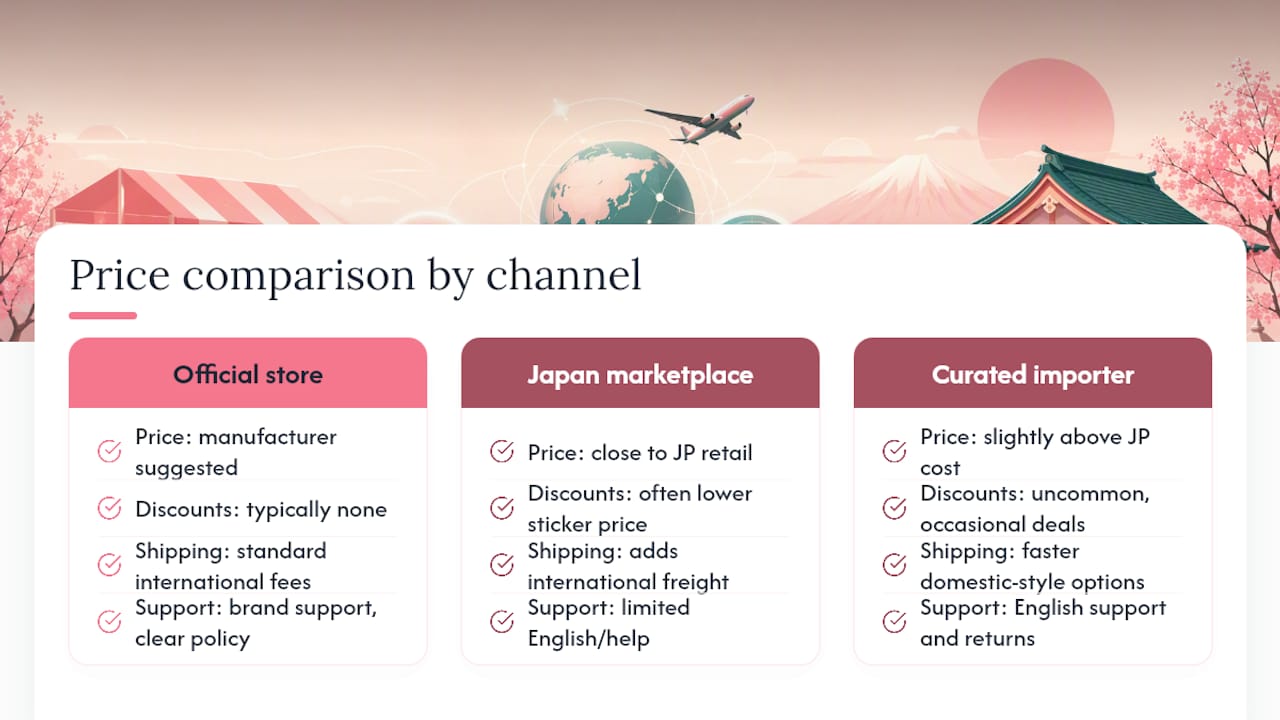
Price differences across channels usually come down to what you’re paying for beyond the product itself. Official brand stores tend to sit at the manufacturer’s suggested price, no discounts, but no guesswork either. Japan-based marketplaces often list items closer to Japanese retail price before shipping, which can make them cheaper on paper until international freight gets added at checkout.
Curated importers and vetted e-commerce retailers usually price slightly above raw Japan-domestic cost, but that premium covers English support, faster domestic-style shipping in some cases, and a return policy you can actually use. Community shopping discussions, including threads on Reddit’s r/AsianBeauty, show buyers repeatedly weighing this exact tradeoff: save a few dollars on the sticker price versus pay a bit more for a smoother, better-supported purchase.
A quick way to compare: pull up the same product on a brand’s official store, a Japan-based marketplace, and a curated importer before buying. If the price gap is small, once you factor in shipping, taxes, and return flexibility, the curated or official option usually wins. If the gap is large, dig into why. Sometimes it’s a domestic-only formula variant; sometimes it’s simply a seller undercutting because they’re moving older stock. Either way, price alone should never be the only signal you check.
What Does Japanese Skincare Really Cost, All In?
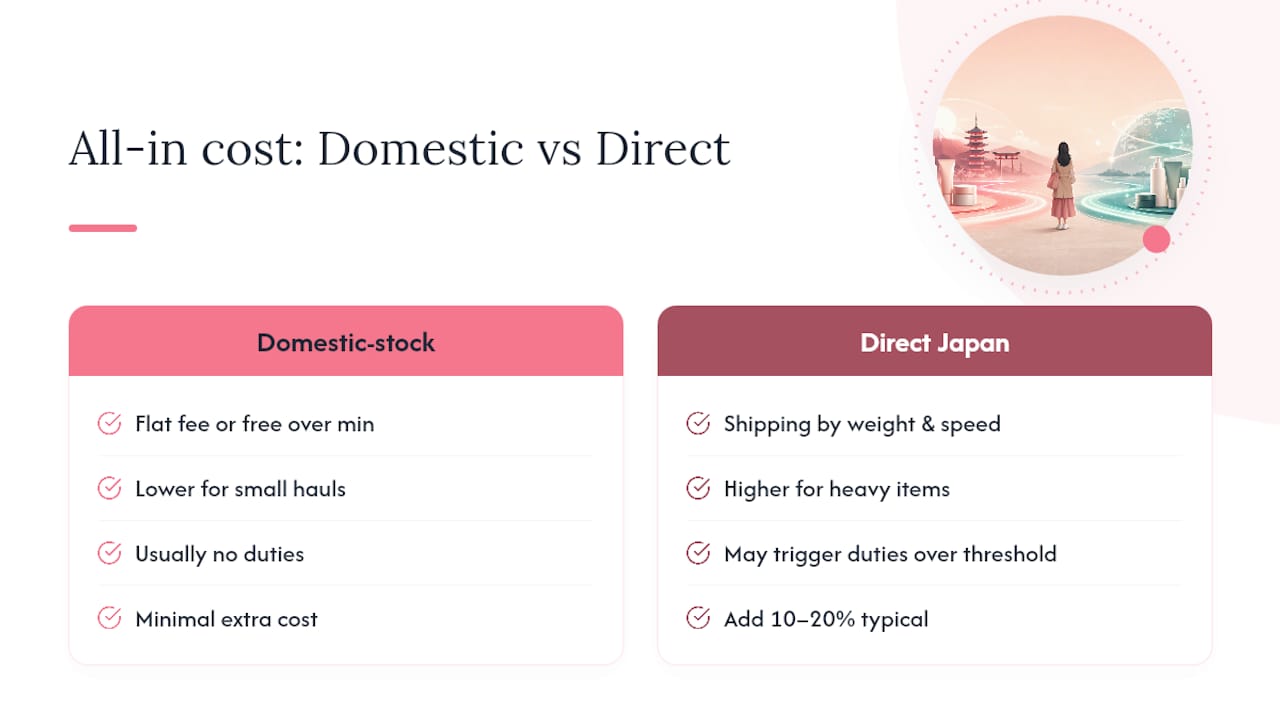
The sticker price on a product page is rarely the full number you’ll actually pay. Budget for three layers: the product price itself, shipping (which varies significantly between domestic-stock retailers and direct-from-Japan marketplaces), and potential customs duties or import taxes depending on your country’s threshold rules.
Domestic-stock purchases from curated importers based in your own country typically avoid customs charges entirely, since the product already cleared import when the retailer stocked it. Orders shipped directly from Japan may trigger duties if your total order value crosses your country’s de minimis threshold, the point above which customs starts charging tax on incoming packages.
Because these thresholds and rates differ by country, check your own customs agency’s calculator before placing a larger order rather than assuming a flat rate. A $30 serum shipped alone rarely triggers anything. A $200 order combining several items from a Japan-based marketplace is far more likely to cross a taxable threshold.
Shipping costs also scale differently. Domestic curated retailers often bundle shipping into a flat fee or offer free shipping past a spending minimum. Direct-from-Japan orders usually price shipping by weight and speed, so a small skincare haul costs less to ship than a box full of heavier items like cleansing oils or large moisturizer jars. Add 10 to 20 percent to whatever the product subtotal shows before you assume that’s your final cost.
Which Retailers Do Buyers Actually Trust?
Trust in this category comes down to a handful of repeat names buyers and editors mention again and again. DOKODEMO shows up often in shopping discussions for its category depth and staff-picked domestic SKUs. Kokoro Japan gets recommended for its curated brand pages and straightforward worldwide shipping.
On the specialty retailer side, shops like Splendora carry J‑Beauty categories alongside other skincare lines, giving US-based shoppers a domestic option with familiar checkout and return norms. Editorial coverage tends to reinforce the same pattern: buyers gravitate toward retailers that clearly label origin, publish real return policies, and carry the brand names that keep coming up in roundups, Hada Labo, Shiseido, DHC, and Bioré among them.
None of these retailer types are mutually exclusive. Plenty of experienced buyers use a Japan-based marketplace for rare domestic finds and a curated importer or specialty shop for the staples they reorder monthly. What matters more than picking one “best” retailer is checking, every time, that the specific seller you’re using that day still has clear policies and current reviews. Retailer reputations shift, staff change, and a shop that was reliable two years ago isn’t guaranteed to still be run the same way.
What Should First-Time Buyers Know Before Ordering?
Start smaller than you think you need to. A first order is a good time to test one retailer’s shipping speed, packaging quality, and customer service responsiveness before committing to a bigger haul.
Stick to well-known brand names for your first few purchases. Hada Labo’s hyaluronic acid lotion and Bioré’s cleansing products are common starting points precisely because they’re easy to verify and widely reviewed, which makes counterfeit detection simpler if something feels off. If you want a longer list of specific products to start with, Spyraverified’s beginner-friendly guide to Japanese skincare walks through a starter routine without overcomplicating it.
Don’t skip the ingredient list, even on your first order. J‑Beauty leans heavily on hydration-focused, minimalist formulas, so an ingredient panel that looks unusually long or packed with unfamiliar filler ingredients is worth a second look before you buy.
Finally, keep your order confirmation and any packaging photos until the product arrives and checks out. If a dispute comes up later, having that paper trail makes resolving it with the seller or your payment provider much faster.
What Most Buying Guides Get Wrong
Most guides to buying Japanese skincare treat every retailer as interchangeable, as if the only question is price. That’s backward. The real question is which channel matches what you’re actually buying: a domestic-only serum you can’t find anywhere else needs a Japan-based marketplace, while a staple like a Hada Labo lotion is available almost everywhere, so pick the retailer with the best support and return policy, not just the lowest number.
Conventional advice also underrates how much authenticity verification depends on the buyer, not just the seller. A retailer can be entirely legitimate and you can still receive a damaged or mismatched item; checking batch codes and packaging yourself isn’t paranoia, it’s just part of buying overseas.
If there’s one thing to prioritize first, it’s this: figure out whether you need a domestic-only formula or a widely exported one before you shop around on price. That single decision determines which retailer type actually makes sense, and it saves you from comparing channels that were never really competing for the same sale.
— Anni
Buy Curated, Verified Japanese Skincare Direct From Spyraverified
Some curated importers source directly from brand partners, which means you skip the guesswork of figuring out whether a listing is domestic, export, or somewhere in between. Some collections come with clear origin information and the kind of authenticity checks this guide just walked through already built into how items are sourced.
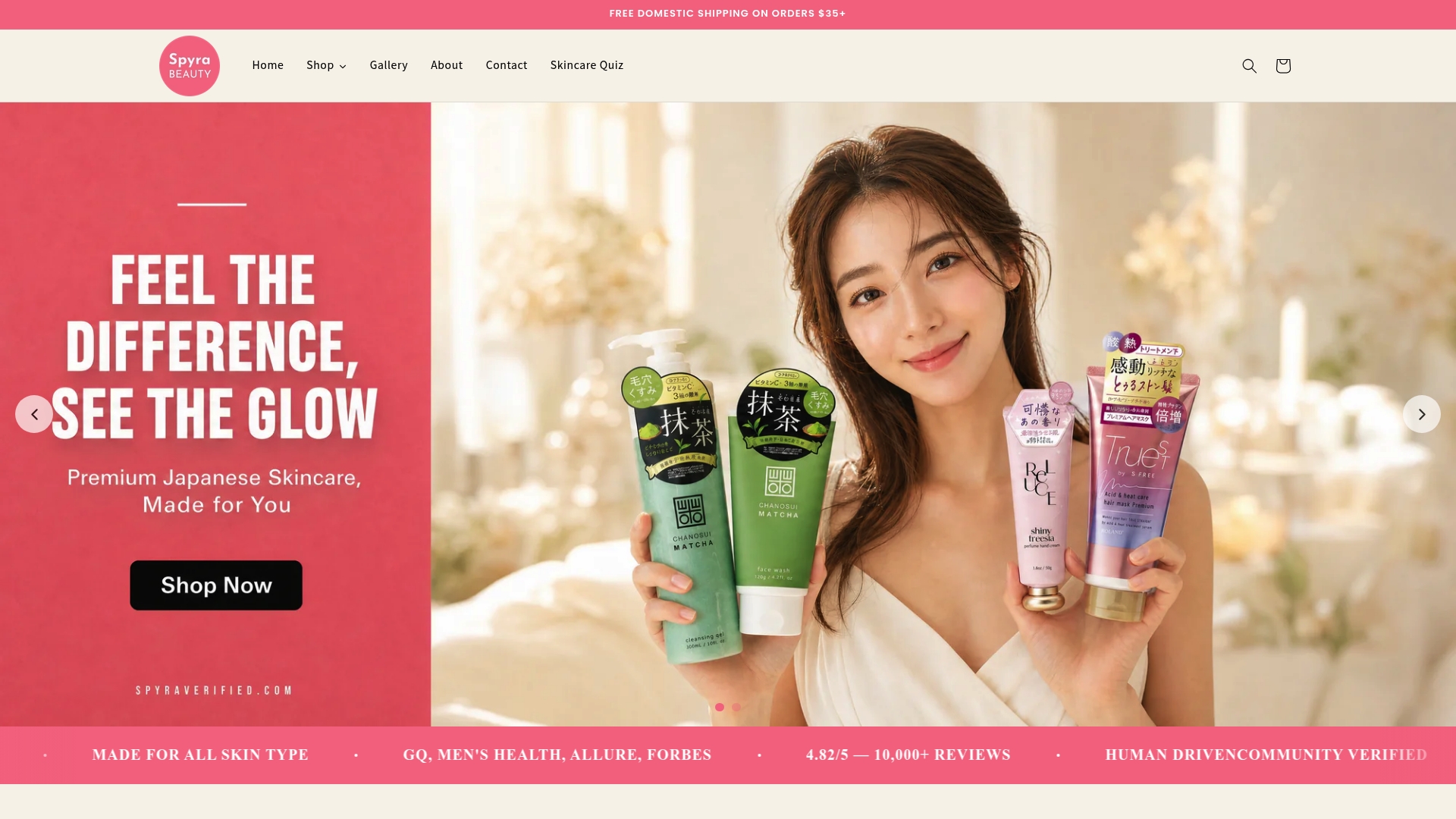
That direct-partnership model matters more than it sounds. Instead of hunting across a Japan-based marketplace, translating packaging yourself, and hoping a batch code checks out, you get a curated catalog with English support and a retailer that’s already done the verification legwork. Browse the Spyraverified skincare collection to see current stock, or check the hair care and body care lines if you’re building out a fuller J‑Beauty routine. Add an item to your cart and see the shipping estimate before you commit. That’s the fastest way to know exactly what you’re paying, all in, before you buy.
Sources
- Buy Japanese Skincare Online | DOKODEMO
- Shop the Best Japanese Skincare Products Online - Free Shipping Worldwide | Kokoro Japan
- 7 Best Japanese Skincare Brands for Skin Minimalists | Who What Wear
