

Prevent Skincare Freezing: Keep Products 59°F–77°F
Skincare freezing is preventable in most cases: keep water-based products between 59°F and 77°F, and avoid the freeze-thaw swings that happen in cars, entryways, and mailboxes. A single accidental freeze rarely ruins a product, but repeated cycles between cold and warm break down emulsions and weaken active ingredients for good. The fix is simple. Stop the swing, not just the cold.
TL;DR:
- Repeated freeze-thaw cycles damage water-based skincare products more severely than a single freeze, causing separation, graininess, and color changes.
- High-risk products for freezing include serums and creams with high water content, especially those in glass or droplet packaging, while oils and balms are more resilient.
- Store skincare between 59°F and 77°F in a stable environment, avoiding cars, unheated garages, or windowsills that experience large temperature swings.
- Use insulated packaging and expedite shipping during winter to minimize the risk of freezing damage during transit, and always check product labels for storage guidance.
- When a product freezes, thaw it slowly at room temperature, inspect for changes, and patch test before full use, discarding formulas with persistent separation or unusual odors.
Table of Contents
- How Freezing Damages Skincare: Water Expansion and Emulsion Failure
- Which Skincare Products Actually Survive the Cold
- How to Store Skincare So It Never Gets the Chance to Freeze
- How to Keep Deliveries Safe from Freezing During Winter Shipping
- What to Do When Your Skincare Freezes: Thaw, Inspect, Test
- Adjusting Your Cold-Weather Routine Without Risking Your Products
- What Spyra Verified Wants You to Know About Winter Skincare Delivery
- Find Winter-Ready Skincare That’s Built to Travel Well
- Sources
How Freezing Damages Skincare: Water Expansion and Emulsion Failure
Water expands when it turns to ice, and that expansion is the root of almost every skincare freezing problem. Most creams, lotions, and serums are emulsions, meaning they suspend oil droplets in water (or the reverse) using an emulsifier to keep the two from separating. When the water portion freezes, ice crystals form and grow, physically shoving those oil droplets apart. The emulsifier holding everything together simply can’t compete with expanding ice.
That’s why a frozen moisturizer often comes back looking curdled, watery, or gritty instead of smooth. The physical shearing action of ice crystals can permanently separate oil and water phases, and no amount of shaking fixes that once it’s set in.
One freeze isn’t always fatal to a formula. The bigger threat is repeated cycling: freeze, thaw, freeze again. Each cycle regrows ice crystals in a slightly different pattern, and that repeated freeze-thaw cycling does more damage than a single cold exposure, according to cosmetic chemistry research. A serum left in a mailbox overnight during one cold snap has a decent shot at surviving. That same serum frozen and thawed five separate times over a winter is a different story.
Watch for these signs that a formula has taken real damage:
- Separation: visible layers of oil floating on watery liquid that won’t reincorporate.
- Graininess: a texture that feels sandy or lumpy instead of smooth on the skin.
- Cloudiness: a formula that used to be clear now looks hazy or milky.
- Off-odors: any smell that wasn’t there before, especially sour or rancid notes.
- Color changes: browning or yellowing, which often signals oxidation of active ingredients.
Water content also matters for a subtler reason. Ice crystals don’t just break emulsions apart. They create condensation as they melt, and that extra moisture inside a sealed container can encourage bacterial growth over time, tied to how water density and phase changes work. A product that looks fine after thawing might still carry a shorter safe-use window than it did before it froze.
Which Skincare Products Actually Survive the Cold
Not every bottle in your medicine cabinet faces the same risk. Formula type determines almost everything about how a product handles a freeze.
High-risk products are the ones with the most water and the most delicate structure. Water-based serums, emulsified creams, and many chemical sunscreens sit at the top of the danger list because they rely on stable emulsions and often contain actives that degrade with any structural disruption. Sheet masks are especially vulnerable since they’re essentially soaked in serum and have almost no packaging protection. Products stored in glass droppers face a double risk: the liquid can freeze and expand while the glass itself can crack under that pressure.
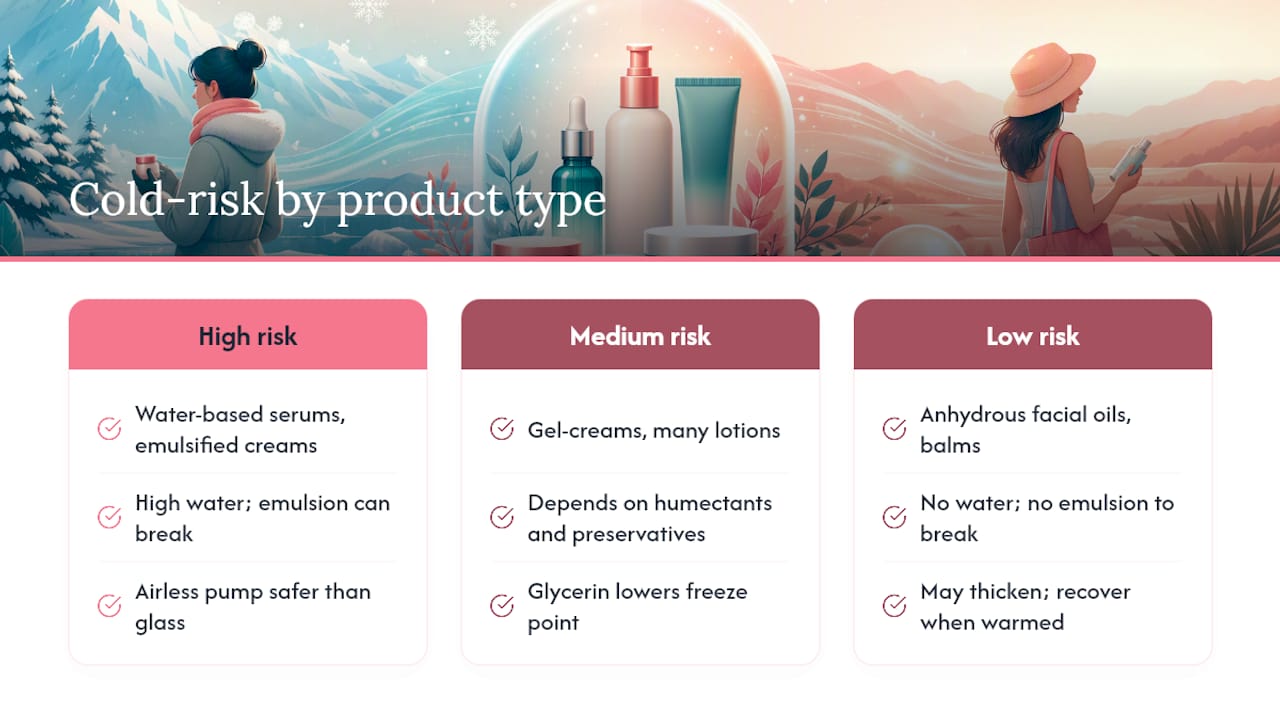
Medium-risk products include gel-creams and many lotions, though their fate depends heavily on their specific humectants and preservative systems. A gel-cream loaded with glycerin, for instance, tends to resist freezing better than one built mostly around water, since glycerin lowers the freezing point of the mixture.
Low-risk products are the anhydrous ones, meaning they contain no water at all. Pure facial oils and balms may thicken, cloud, or solidify in the cold, but they usually return to normal once warmed back to room temperature. There’s no water to expand, so there’s no emulsion to shear apart.
Packaging plays a bigger role in this than most people assume. Airless pump packaging and opaque bottles improve formula stability partly because they limit air and light exposure, which reduces oxidation, a problem that gets worse after a freeze-thaw event has already stressed a formula. If you’re choosing between two versions of a product, the one in an airless pump is the safer bet for winter travel. You can read more on why airless packaging is better for skincare if you want the full breakdown.
How to Store Skincare So It Never Gets the Chance to Freeze
Storage location decides more of this outcome than any product choice you make. Water freezes at 32°F, but most skincare formulas start showing stress before they hit that exact number, so give yourself a real buffer.
-
Aim for 59°F to 77°F for everyday storage. This is the stable room-temperature range recommended for cosmetics, and it applies to nearly everything in your routine, from cleansers to moisturizers.
-
If you’re refrigerating anything, target a cool temperature ideal for skincare products with unstable actives, but it should be monitored to avoid freezing, since fridge temperatures can vary between compartments.
-
Pick the right room in your home. An interior closet or a bedroom cabinet away from exterior walls holds a steadier temperature than almost anywhere else in a house.
-
Avoid the classic freeze zones. Cars are the worst offender, since interior temperatures can swing more than outside air within minutes. Windowsills catch drafts and direct cold from glass. Unheated garages and mudrooms often sit close to outdoor temperature. Bathrooms, despite feeling warm during a shower, tend toward humidity swings that aren’t great for packaging integrity either.
-
If you use a dedicated skincare fridge, verify what it actually is. Some inexpensive models are thermoelectric coolers that only drop temperature by 20 to 30 degrees below ambient room temperature rather than true compressor fridges, so they may not get cold enough to matter, or in rare setups, cold spots can dip lower than the display suggests.
-
Use an independent thermometer. Don’t trust a built-in digital display alone. A small stick-on or probe thermometer costs very little and tells you the real temperature near where products actually sit, which matters because skincare mini-fridges need monitoring to avoid freezing zones near the back panel.
-
Limit door openings if refrigerating. Every open door lets warm air in and forces the compressor to overcorrect, which can create brief cold spikes near the back wall.
-
When traveling, keep products close to your body. An insulated pouch inside a carry-on bag holds heat far better than checked luggage in a cargo hold, which can sit near freezing at cruising altitude. Layered clothing pockets work in a pinch, since your own body heat acts as a buffer.
Pro Tip: If you’re not sure whether your fridge or car trunk dips below freezing, test it once with a cheap thermometer left inside overnight. You’ll know for certain instead of guessing, and that one data point will change how you pack for the rest of the season.
The single biggest mistake people make with cold-weather storage isn’t picking the wrong spot. It’s assuming a location is safe because it feels warm enough, when the real temperature swing happens overnight while nobody’s checking. Consistency beats intensity here. A spot that stays at a steady 65°F all winter is safer than one that hits 70°F during the day and drops to 28°F at 3 a.m.
How to Keep Deliveries Safe from Freezing During Winter Shipping
Winter shipping introduces a risk you can’t fully control once the box leaves your hands, but you can stack the odds in your favor on both ends.
If you’re ordering, ask about insulated mailers or thermal liners before you check out, especially for orders placed during a cold snap. Choosing expedited shipping cuts the total time a package spends exposed to outdoor temperatures in a truck or on a porch. Daytime delivery windows help too, since packages left overnight on a step face the coldest hours of the whole day.
- Request insulated packaging or thermal liners whenever the option exists at checkout.
- Choose expedited shipping during cold months to shorten transit exposure.
- Ask for a delivery window that avoids overnight porch sitting.
- Bring packages inside as soon as possible rather than letting them wait by the door.
Gel packs deserve a specific callout here, because most people only think of them as cold-preservation tools. In winter shipping, the goal flips: you want thermal buffer material that slows heat loss, not one designed to keep things cold. Phase-change materials tuned for cold weather work by absorbing and releasing heat slowly, which reduces freezing risk in transit for sensitive shipments far more effectively than a generic ice pack repurposed for the wrong season.
If a package does arrive and feels frozen or ice cold, resist the urge to open it right away and check the product. Let the sealed box sit at room temperature for a couple of hours first. Opening a cold box immediately exposes the contents to warm, humid indoor air, which causes condensation to form directly on the product and packaging, exactly the moisture problem that encourages bacterial growth.
For anyone selling skincare online, the checklist is straightforward: label packages clearly as temperature-sensitive, choose insulation appropriate to the season rather than reusing summer packaging, and never stage fragile skincare shipments anywhere near cold storage or loading dock freezer sections during fulfillment.
What to Do When Your Skincare Freezes: Thaw, Inspect, Test
A frozen product isn’t automatically a dead product, but how you handle the next 24 hours determines whether it’s salvageable.
-
Thaw slowly at room temperature. Give it 12 to 24 hours sitting on a counter or shelf, not near a heater or window. Rushing this step is the single most common mistake people make.
-
Never apply direct heat. No microwave, no hot water bath, no setting the bottle on a radiator. Localized hot spots cause uneven chemical breakdown of volatile ingredients and can denature proteins in formulas that contain peptides, which permanently weakens what made the product work in the first place.
-
Inspect once it’s fully thawed. Look for persistent separation that doesn’t reincorporate with gentle shaking, graininess that feels sandy on your fingertips, a foul or sour smell, or browning, which is a particularly strong warning sign in vitamin C formulas since that ingredient oxidizes visibly.
-
Discard anything showing those signs. There’s no fixing separation that’s set in or reversing oxidation that’s already browned a serum.
-
If the formula looks fine, re-emulsify gently. A soft shake or stir, never vigorous shaking that introduces air bubbles, can help redistribute anything that settled without fully separating.
-
Patch test before using it on your face. Apply a small amount to your inner forearm and wait 24 hours before putting it anywhere near your face, even if the product looks completely normal.
-
Be conservative with unstable actives. Products built around pure vitamin C, high-strength retinoids, or certain sunscreen formulations are worth replacing rather than risking irritation from a compromised batch. FDA labeling guidance points to PAO (period-after-opening) symbols as a baseline for freshness, and a freeze event is exactly the kind of stress that should make you lean toward that conservative side of the estimate.
Adjusting Your Cold-Weather Routine Without Risking Your Products
Winter changes what your skin needs, and matching that shift means you’re reaching for the right products less often, which lowers your overall freeze exposure too.
Lean into humectants and heavier moisturizers during cold months. Hyaluronic acid draws water into skin, while a richer, more occlusive moisturizer locks that hydration in against dry winter air. This is also the season to dial back exfoliant frequency, since cold air already strains your skin barrier and extra exfoliation on top of that combination tends to backfire. If your barrier needs support, barrier-repair basics are worth reviewing before you change up your routine.
Sunscreen stays non-negotiable year-round, even in January. Cream-based mineral formulas tend to be less temperature-sensitive than some lighter, water-heavy chemical sunscreens, which makes them a more forgiving choice for a bag or car that might see a few cold hours.
It reduces transepidermal water loss from your skin, and it keeps the air around your open bottles less prone to the dry, cold conditions that stress certain formulas over time.
- Increase humectants and occlusives; ease up on exfoliation frequency.
- Keep sunscreen in daily rotation, favoring cream-based formulas when possible.
- Run a humidifier at 30% to 50% humidity.
- Pack travel-sized backups in insulated pouches instead of exposing full-size bottles to car trunks or cold entryways.
If you’re switching to gentler actives for winter, Japanese retinol alternatives are worth a look, since many lean on more stable, less irritating ingredients that hold up better to seasonal handling.
What Spyra Verified Wants You to Know About Winter Skincare Delivery
Freezing damage is preventable, but it starts before a product ever reaches your door. Some companies source directly from Japanese and Asian manufacturers who build stability testing into their formulas, and that same attention can carry into how orders get packed and shipped during cold months.
Our honest recommendation: choose insulated delivery at checkout whenever it’s offered, and reach out to customer service directly if you’re ordering during an extreme cold stretch in your area. Those two steps cut freezing risk more than almost anything else you can control as a buyer.
This guide gives you the general rules, but it doesn’t replace what’s printed on your product’s label. Manufacturer storage notes are formula-specific for a reason, and following them alongside the practical steps here gives you the best odds of a product that performs the way it’s supposed to, from the day it arrives through the last drop.
— Anni
Find Winter-Ready Skincare That’s Built to Travel Well
Some sources provide authentic Japanese and Asian skincare that is designed with stability in mind, not just marketing claims about it. Formulas sourced directly from manufacturers may go through quality checks similar to those discussed in this guide, and packaging choices like airless pumps and opaque bottles can help a product survive rough winter shipping conditions.
Browse the full skincare collection and look for insulated shipping options at checkout if you’re ordering during a cold stretch. If you’re stocking up on backups for travel, the hair care collection is worth checking too, since many of those formulas face the same cold-weather packaging questions. Place your order, select the delivery option that fits your climate, and you’re covered from the warehouse to your front door.
Sources
The claims in this guide draw on cosmetic chemistry research from Lab Muffin Beauty Science, storage temperature guidance from the Skincare Database, thawing and skin health advice from Cleveland Clinic, labeling standards from the FDA, and mini-fridge setpoint recommendations from Geist for Life.
- Can you freeze your beauty products? — Lab Muffin Beauty Science
- Skincare storage guide — Skincare Database
- Skin care fridge advice — Cleveland Clinic
- Shelf life and expiration dating for cosmetics — FDA
- Skincare mini fridge: what to store — Geist for Life
