

What Is Essence in Skincare? Benefits and How to Use It
Essence in skincare is defined as a lightweight, water-based treatment applied after cleansing and toning, designed to deliver concentrated hydration and active ingredients directly to the skin before serums and moisturizers. The term comes from K-beauty, where it has been a core routine step for decades, but Japanese skincare traditions use a near-identical product called lotion or toner in their multi-step systems. Essences typically contain ferment filtrates, hyaluronic acid, glycerin, and peptides. These ingredients work together to flood the skin with moisture and prime it to absorb everything you apply next.
What is essence in skincare and why does it matter?
Essence is a unique skincare category that sits between toner and serum in both texture and function. It is thinner than a serum but more concentrated than a toner, and its job is to deliver hydration to deeper skin layers rather than simply balance pH or target a specific concern. Think of it as the foundation layer that makes every product you apply afterward work harder.
The skincare essence definition gets blurry because many brands label their products inconsistently. A product called a “toner” by one brand may function exactly like an essence, and vice versa. The clearest way to identify a true essence is by its purpose: it hydrates, it preps, and it stays on your skin. It is never rinsed off.
K-beauty brands like SK-II, Missha, and Cosrx popularized essences globally. SK-II’s Facial Treatment Essence, built around Pitera (a ferment filtrate), is one of the most studied examples of how fermented ingredients can visibly improve skin texture and radiance over time.
What are the main benefits of using a skincare essence?
The benefits of skincare essence go well beyond basic hydration. Regular use boosts ingredient penetration of subsequent products by 30–50%, meaning your serum and moisturizer become significantly more effective when applied over a well-hydrated base. That single fact makes essence one of the highest-return steps in any multi-step routine.
The core benefits break down clearly:
- Deep hydration. Humectants like hyaluronic acid and glycerin pull water into the skin and hold it there, reducing tightness and flakiness.
- Stronger moisture barrier. Consistent essence use reinforces the skin’s natural barrier, making it less reactive to environmental stress.
- Better texture and radiance. A hydrated skin surface reflects light more evenly, which is why the glass skin effect associated with K-beauty relies so heavily on cumulative layered hydration rather than any single ingredient.
- Antioxidant and brightening support. Many essences include niacinamide, vitamin C derivatives, or ferment filtrates that address uneven skin tone alongside hydration.
- Compatibility with all skin types. Oily skin benefits from lightweight, water-based formulas that hydrate without adding oil. Dry skin benefits from richer, gel-like textures that lock in moisture longer.
Pro Tip: If your skin is oily or acne-prone, look for essences with centella asiatica or niacinamide. If your skin is dry or mature, prioritize formulas with ferment filtrates or multiple forms of hyaluronic acid for layered moisture.
Avoiding common skincare layering mistakes is especially important when adding essence to your routine. Applying it over dry skin or skipping it entirely reduces the cascade of benefits it creates for every step that follows.
How does essence differ from toner and serum?
The essence vs serum and essence vs toner comparisons trip up even experienced skincare enthusiasts. Each product has a distinct role, and using them in the wrong order or substituting one for another reduces their effectiveness.
Toners focus on removing residual cleanser, balancing pH, and in some cases exfoliating with AHAs or BHAs. Essences concentrate nutrients for hydration rather than cleansing or pH correction. Serums are thicker, more concentrated, and target specific concerns like hyperpigmentation, acne, or fine lines. Essences are lighter and primarily hydrate and prep.
| Product | Texture | Primary function | When to apply |
|---|---|---|---|
| Toner | Watery | pH balance, light cleansing | After cleanser |
| Essence | Watery to slightly viscous | Deep hydration, skin prep | After toner |
| Serum | Thicker, gel or oil-based | Targeted treatment | After essence |
| Moisturizer | Cream or lotion | Seal in moisture | After serum |
The texture spectrum matters. Toners feel like water. Essences feel like slightly thicker water or a very thin gel. Serums feel noticeably heavier and often leave a slight film. If you pick up a bottle and it pours like water but feels slightly silky, it is almost certainly an essence.
Essences should not be confused with toners because they deliver concentrated nutrients rather than cleansing or pH balancing. The distinction is functional, not cosmetic. Applying them in the correct order, toner then essence then serum, gives each product the surface conditions it needs to work properly.
How to properly use essence for best results
Getting the application right makes a real difference in what you get from an essence. The technique is simple, but most people skip the details that matter.
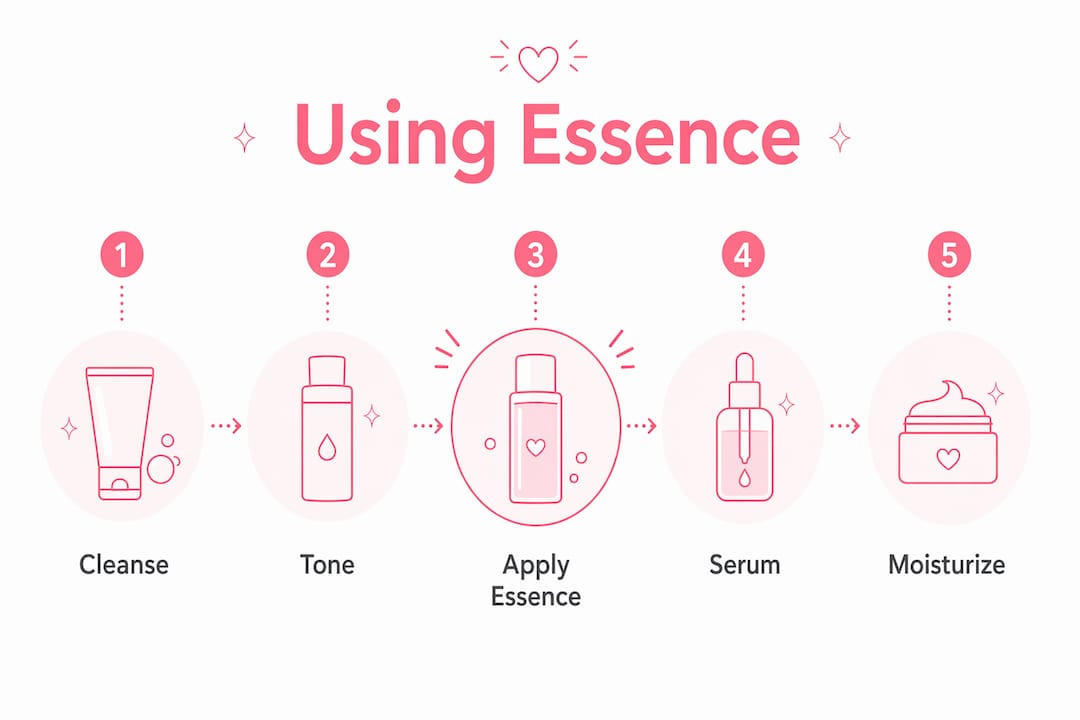
- Cleanse thoroughly first. A clean surface is non-negotiable. A double cleansing method removes both oil-based and water-based residue so the essence can absorb without interference.
- Apply on slightly damp skin. Applying essence immediately after cleansing or toning on skin that is still slightly damp maximizes hydration retention. Dry skin absorbs less.
- Use your palms, not a cotton pad. Patting with palms uses body heat to improve penetration and avoids the waste that happens when a cotton pad soaks up product before it reaches your skin.
- Press gently, do not rub. Press the essence into your cheeks, forehead, chin, and neck using light, repetitive patting motions. Rubbing disrupts the skin surface and reduces absorption.
- Wait 20–30 seconds before the next step. Give the essence time to settle before applying serum. Layering too fast can cause pilling.
- Follow with serum, then moisturizer. The layering order, essence to serum to moisturizer, locks in hydration at every level.
Pro Tip: In humid summer months, a watery essence absorbs fast and feels refreshing without heaviness. In dry winter months or heated indoor environments, switch to a gel-like essence that holds moisture longer. Essence viscosity signals its purpose: thinner for speed, thicker for sustained hydration.
Who benefits most from adding essence to their routine?
Essence is not mandatory for every person, but certain skin conditions and goals make it a clear priority. Dermatologists note that essence value depends on individual skin needs, and that framing is useful. If your skin is already balanced and well-hydrated, you may not notice a dramatic change. If it is not, the difference can be significant.
The people who gain the most from essence include:
- Those with chronic dryness. Essence acts as a hydration buffer that prevents tightness after cleansing, which is the first sign of a compromised moisture barrier.
- Those with dull or uneven skin tone. Brightening essences with niacinamide, vitamin C derivatives, or ferment filtrates address both hydration and radiance at the same time.
- Aging skin. Mature skin produces less natural moisturizing factor (NMF) over time. A gel-like essence with multiple humectants compensates for that loss and visibly plumps fine lines.
- Frequent travelers or people in dry climates. Essences are especially beneficial in low-humidity environments where skin loses moisture faster than it can replace it.
- Skincare enthusiasts building multi-step routines. Anyone layering multiple actives, retinol, vitamin C, AHAs, gets more from those products when the skin underneath is properly hydrated.
The glass skin effect that defines K-beauty at its most aspirational is not achieved by one product. It comes from cumulative hydration and barrier reinforcement built up through consistent layering, and essence is the step that makes that layering possible.
Common misconceptions about skincare essence
The biggest misconception is that essence is just a fancy toner. It is not. Toners and essences have different formulations, different concentrations, and different jobs. Replacing one with the other leaves a gap in your routine.
A few other myths worth clearing up:
- “Essence only hydrates.” Many formulas include antioxidants, peptides, and brightening agents that address aging and pigmentation alongside moisture.
- “You can skip it if you use a good serum.” Skipping essence reduces the absorption benefit that makes your serum more effective. The serum still works, but not as well.
- “Essence is only for dry skin.” Oily and combination skin types benefit from lightweight, water-based essences that hydrate without adding oil or clogging pores.
- “All essences are the same.” Formulation varies widely. A ferment-based essence like SK-II’s Pitera formula behaves very differently from a centella asiatica essence designed for sensitive or acne-prone skin.
Choosing the right essence means matching the formula to your skin concern, not just picking the most popular option. Ingredients like amino acids and Japanese anti-aging actives appear in many high-performing essences and are worth understanding before you buy.
Key takeaways
Essence is the hydration step that makes every other product in your routine work harder, and skipping it costs you absorption efficiency across the board.
| Point | Details |
|---|---|
| Essence definition | A lightweight, water-based treatment applied after toner to deeply hydrate and prep skin. |
| Absorption benefit | Regular use boosts penetration of subsequent products by 30–50%, improving serum and moisturizer results. |
| Essence vs serum | Essences hydrate and prep; serums target specific concerns and have a thicker, more concentrated formula. |
| Best application method | Pat onto slightly damp skin using palms, not cotton pads, to maximize absorption and minimize waste. |
| Who benefits most | Dry, dull, aging, or travel-stressed skin gains the most, but all skin types can benefit from the right formula. |
Why I think essence is the most underrated step in skincare
Most skincare conversations center on serums and moisturizers. Essence gets treated as optional, a nice-to-have for people who enjoy multi-step routines. I disagree with that framing entirely.
Essence is the step that determines how well everything else works. I have seen people spend significant money on a high-quality vitamin C serum and get mediocre results, not because the serum was wrong, but because they applied it to dry, unprepared skin. Adding an essence before the serum changed their results noticeably within a few weeks. The serum did not change. The surface it was applied to did.
The palm-patting technique is also underrated. Most people splash or swipe product on and move to the next step. Taking 20 seconds to press an essence into your skin with warm palms is one of the simplest changes you can make with a real payoff.
My honest recommendation: start with one bottle of a straightforward essence, something with hyaluronic acid and minimal fragrance, and use it consistently for 30 days before judging it. Skin changes slowly. The results from consistent hydration layering are cumulative, not immediate. If you are patient, the difference in texture and radiance is hard to argue with.
— Anni
Spyraverified’s picks for a complete hydration routine
Building a routine around essence works best when the products around it are chosen with the same care. Spyraverified curates Japanese and Asian skincare products specifically selected for hydration, barrier support, and ingredient quality, including serums and mists that layer naturally with essence for a full routine.
The Vitamin C Cream Mist Spray works well as a mid-day refresh that supports the hydration layer your essence builds in the morning. For personalized product recommendations based on your skin type and concerns, the Spyraverified skin quiz matches you with formulas suited to your specific needs. Not sure where to start? Browse the full skincare collection to find essences, serums, and mists that work together.
FAQ
What does essence do for your skin?
Essence delivers concentrated hydration and active ingredients to the skin immediately after cleansing, improving moisture retention and preparing the skin to absorb serums and moisturizers more effectively.
Is essence necessary for a skincare routine?
Essence is not mandatory, but it is recommended for dry, dull, or aging skin. It boosts the performance of every product applied after it, making it a high-value step for anyone running a multi-step routine.
How is essence different from serum?
Essence is lighter and primarily hydrates and preps the skin. Serum is thicker, more concentrated, and targets specific concerns like pigmentation or fine lines. Essence is applied before serum in the routine.
Can oily skin use essence?
Yes. Oily skin benefits from lightweight, water-based essences that hydrate without adding oil. Look for formulas with niacinamide or centella asiatica, which balance hydration while calming excess sebum production.
When should you apply essence in your skincare routine?
Apply essence after your cleanser and toner, while your skin is still slightly damp. Follow it with serum, then moisturizer, to lock in the hydration layers in the correct order.
