

The Role of AI in Beauty Retail: A Practical Guide
AI now turns product discovery, personalization, formulation, and fulfillment into measurable, scalable systems that raise conversion, average order value, and retention. That’s the role of AI in beauty retail in one sentence: it compresses the distance between “I don’t know what I need” and “I just bought it,” while giving brands data to build better products and hold less dead stock. The technology stack behind this shift includes generative models, computer vision, and recommendation engines, and it’s already reshaping how brands like Sephora and L’Oréal operate.
The measurable gains show up across the business:
- Conversion lifts from AI-guided product discovery and chat-based recommendations
- Higher average order value when routines are bundled instead of sold as single SKUs
- Fewer returns thanks to better shade and formula matching before purchase
- Faster time-to-market for new formulations through AI-assisted screening
- Better discoverability as products get indexed for AI-driven shopping assistants, not just search engines
The rest of this guide breaks down the specific use cases worth piloting, a buy/borrow/build roadmap for scaling them, and the real deployments (Sephora, L’Oréal, Google, OpenAI) that show what’s actually working right now.
Key Takeaways
AI’s role in beauty retail is turning personalization, diagnostics, formulation, and fulfillment into measurable systems that beauty brands can test, scale, and refine with real KPIs.
| Point | Details |
|---|---|
| Start with clean data | Pick pilots where first-party data already exists rather than projects requiring new collection. |
| Prioritize modular architecture | Build systems that let you swap AI vendors without rebuilding personalization logic from scratch. |
| Keep humans in the loop | Require sign-off on generative marketing claims and formulation suggestions before they reach customers. |
| Watch completion and conversion metrics | Diagnostic completion rate and chat-to-purchase conversion prove ROI better than technical capability alone. |
| Guard against sameness | Balance AI-assisted formulation and creative work with human sensory testing to protect brand differentiation. |
Table of Contents
- What Are the Core AI Use Cases in Beauty Retail?
- How Is AI Changing Product Formulation and R&D?
- How Do Virtual Try-On and AI Shopping Assistants Work?
- AI in Manufacturing, Supply Chain, and Personalized Fulfillment
- How Should Retailers Implement and Scale AI Beauty Tools?
- What KPIs Prove AI Is Working in Beauty Retail?
- What Are the Risks and Ethical Concerns With AI in Beauty?
- Real Examples: Sephora, L’Oréal, and Vendor Case Studies
- What Product Curators Should Take Away From This Shift
- Frequently Asked Questions
- Sources
What Are the Core AI Use Cases in Beauty Retail?
Beauty retail’s AI adoption clusters around five stages of the value chain, and each one solves a different business problem. Trying to tackle all five at once is how pilots stall. Knowing which cluster maps to your team’s biggest bottleneck is the first real decision.
Discovery and personalization
Recommendation engines and large language models now power quiz-based routines, replenishment reminders, and “shop by concern” filtering. The business outcome is straightforward: shoppers who get a tailored routine instead of a wall of SKUs convert at higher rates and buy more per order. A skincare quiz built around real skin concerns is a simple version of this pattern, and it works because it narrows an overwhelming catalog into three or four defensible picks.
Experiential discovery: virtual try-on and diagnostics
Computer vision models analyze a selfie or live camera feed to simulate lipstick shades, foundation matches, or skin conditions like redness and texture. Vendors such as Haut.AI have trained diagnostic models on millions of images to deliver clinically informed skin scores through plug-and-play software, letting brands add diagnostics without building computer vision teams from scratch. The outcome retailers care about is completion rate. A shopper who finishes a scan is far more likely to buy than one who bounces off a static quiz.
Product ideation and formulation support
Generative AI now assists chemists by screening ingredient combinations and flagging promising candidates faster than manual literature review allows. This doesn’t replace a formulator. It narrows the search space so human R&D teams spend less time on dead ends and more time on refinement.
Packaging and creative automation
Generative image and copy tools speed up packaging concepts, campaign variations, and localized marketing assets. Teams still need brand review before anything ships, but the draft-to-review cycle shrinks from weeks to days.
Retail operations and fulfillment
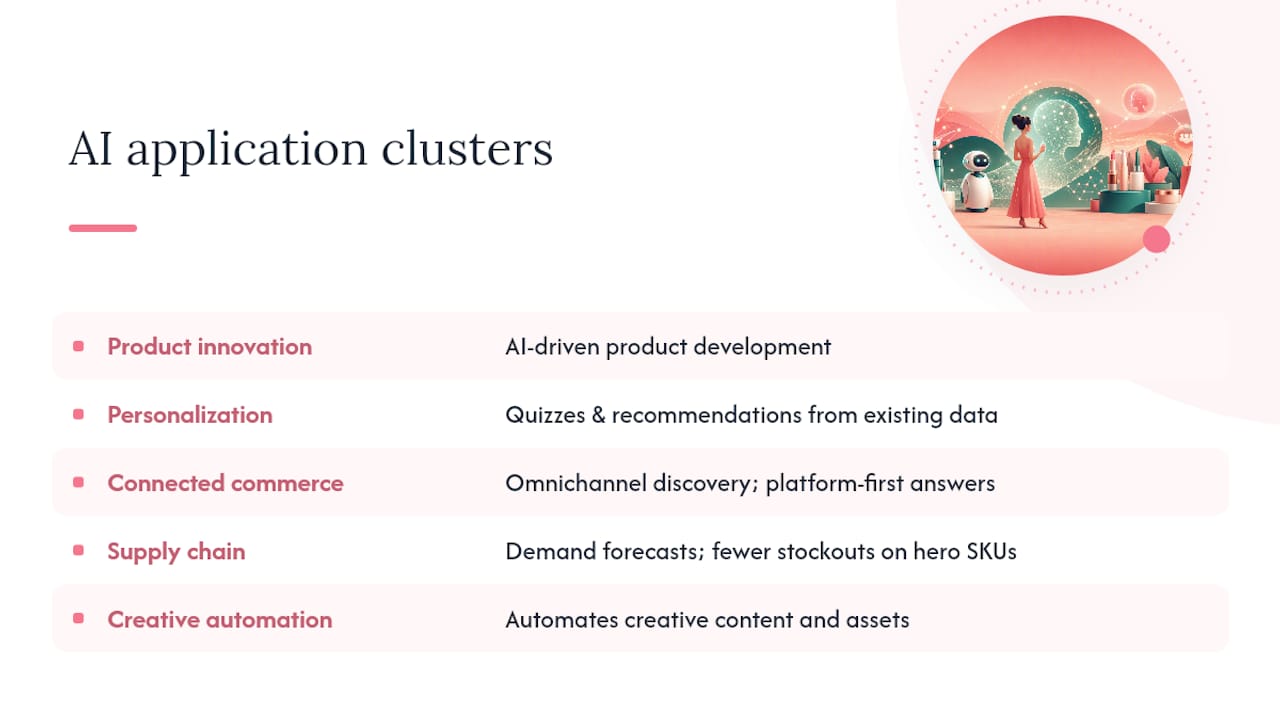
Demand forecasting models predict which SKUs will spike regionally, while dynamic inventory systems reduce stockouts on hero products. Industry analysis from Coresight identifies five major AI applications in beauty retailing, spanning product innovation, personalization, connected commerce, supply chain, and creative automation, and it’s a useful map for teams deciding where to start.
Pro Tip: Pick your first pilot based on data readiness, not ambition. A personalization quiz using data you already collect at checkout will ship faster and prove ROI sooner than a computer vision diagnostic tool that needs a fresh image dataset.
Consumer behavior backs the urgency here. NielsenIQ’s research on AI beauty advisors found that many shoppers have already received product recommendations from generative AI platforms, and more than half say they’re interested in using AI tools to guide future purchases. That interest doesn’t wait for brands to catch up. It just shifts discovery to whichever platform answers the question first.
How Is AI Changing Product Formulation and R&D?
AI’s biggest contribution to formulation isn’t inventing new ingredients out of thin air. It’s speeding up the screening process. Machine learning models can process ingredient interaction data and simulate likely outcomes far faster than a chemist working through combinations by hand, which shortens the early hypothesis-generation phase of R&D.
Where AI consistently falls short is sensory experience. Texture, scent, and skin feel are subjective, hard to quantify, and resistant to modeling. Chemical & Engineering News reports that AI struggles with these attributes, and over-relying on generative tools for formulation risks producing “algorithmic sameness,” products that test well on paper but feel indistinguishable from competitors on skin. Human sensory panels remain non-negotiable.
Short-term pilots that R&D teams can run without massive investment:
- Ingredient screening against safety and regulatory databases before formal testing begins
- Small-batch simulation of texture modifiers to narrow options before physical trials
- Prioritization scoring for which ingredient combinations get lab time first
Pro Tip: Run AI-suggested formulations through blind sensory panels before you run them through cost analysis. A formula that scores well computationally but fails on skin feel wastes far more money if it reaches consumer testing first.
How Do Virtual Try-On and AI Shopping Assistants Work?
Virtual try-on uses computer vision and color science to map a shopper’s face or skin in real time, then overlay a simulated product result, whether that’s a lipstick shade, a foundation match, or a projected skin outcome after weeks of consistent use. The underlying models combine facial landmark detection with color calibration to account for lighting and skin tone variation, which is where accuracy either builds trust or destroys it.
Beauty retail is now moving past try-on into something bigger: agentic commerce. Instead of a shopper landing on a product page, browsing reviews, and adding to cart, the entire journey (discovery, routine building, and checkout) can happen inside a conversational AI interface. Sephora’s expansion into Google’s AI ecosystem is the clearest example of this shift. The retailer is enabling conversational discovery and in-chat purchasing that draws on its first-party loyalty data, effectively turning its advisor relationship into something a chatbot can replicate at scale. Reported metrics from the rollout point to strong diagnostic completion and meaningful chat-to-purchase conversion, evidence that shoppers will finish a guided AI flow when it feels personal rather than generic.
This shift has a quiet but important implication: product data now has to be machine-readable, not just visually appealing. A gorgeous product page means nothing to an AI assistant scanning for structured attributes like skin type compatibility or ingredient concentration.
Retailers weighing similar moves should consider:
- Whether training data represents diverse skin tones and types accurately, not just a narrow demographic
- How facial image data is stored, consented to, and deleted after a diagnostic session
- Whether loyalty program data can feed personalization without violating platform privacy terms
- How virtual try-on accuracy is validated against real-world lighting conditions, not just studio photos
AI in Manufacturing, Supply Chain, and Personalized Fulfillment
Beyond the customer-facing layer, AI is quietly rewiring how beauty products get made and shipped. Demand forecasting models now predict regional spikes in specific shades or formulas before they happen, which means fewer emergency reorders and fewer markdowns on overstock. Dynamic pricing tools adjust promotions based on real-time inventory pressure instead of a fixed markdown calendar.
The more interesting shift is happening in manufacturing itself. Small-run, personalized production, custom foundation shades or made-to-order serums, used to be cost-prohibitive at scale. AI-assisted production planning is making low-waste, short-batch runs viable, because forecasting models can predict demand tightly enough that brands don’t need to overproduce a “safe” universal shade range.
Quick wins operations teams can pursue without a full platform overhaul:
- Layer demand forecasting onto your three or four highest-return SKUs first
- Test dynamic reorder points on regional bestsellers before rolling out chain-wide
- Pilot one small-batch personalized product line to validate the low-waste model
Market research on AI-enabled beauty devices and services shows expanding adoption of smart tools and AI-enabled software across the sector, a signal that operational AI investment is accelerating alongside the more visible personalization tools.
How Should Retailers Implement and Scale AI Beauty Tools?
Most beauty AI pilots die not because the technology fails, but because teams pick the wrong first project or lock themselves into a vendor they can’t later replace. A disciplined rollout avoids both traps.
- Choose your pilot by impact and data readiness, not novelty. Favor use cases where you already have clean first-party data (checkout history, quiz responses, loyalty purchases) over ones requiring new data collection.
- Decide what to buy, borrow, or build. McKinsey’s guidance on scaling gen AI in beauty recommends prioritizing a handful of high-impact use cases and adopting modular components rather than committing to one vendor’s full stack.
- Keep brand knowledge and product data proprietary. Outsource the underlying model infrastructure (vision APIs, LLM providers) but keep your ingredient database, formulation history, and customer data under your own control.
- Build for modularity from day one. Architect systems so you can swap an LLM or vision provider without rebuilding your personalization logic from scratch.
- Establish human-in-the-loop checkpoints. Every generative output, whether it’s a marketing headline or a formulation suggestion, needs a human sign-off step before it reaches a customer or a lab bench.
- Set privacy and brand-safety guardrails before launch, not after. Define what facial or biometric data gets collected, how long it’s retained, and who reviews AI-generated claims for regulatory accuracy.
Pro Tip: Treat every AI vendor contract as temporary. Build your data pipelines so that switching a diagnostics provider or an LLM partner is a configuration change, not a six-month migration project.
Warning: A rushed integration with messy product data (inconsistent ingredient naming, missing attributes, unstructured descriptions) will produce inaccurate recommendations no matter how good the underlying model is. Fix your data taxonomy before you scale anything.
What KPIs Prove AI Is Working in Beauty Retail?
Tracking the right numbers separates a pilot that gets funded again from one that quietly dies after six months. Primary KPIs worth tracking:
- Conversion lift on AI-guided sessions versus standard browsing
- Average order value (AOV) for routine-based purchases versus single-item purchases
- Return rate reduction tied to shade-matching or diagnostic accuracy
- Diagnostic completion rate (how many shoppers finish a scan versus abandon it)
- Chat-to-purchase conversion for conversational commerce flows
- Lifetime value (LTV) lift among customers who engage with personalization tools
- False positive and false negative rates for skin diagnostics, checked against dermatologist review
A basic testing checklist keeps model quality honest over time:
- Run A/B tests on generative content against human-written control versions
- Sample a percentage of AI outputs weekly for human review, not just at launch
- Monitor for data drift as seasonal trends shift what “normal” input looks like
- Combine hard metrics with qualitative brand-fit review, since a recommendation can convert well and still feel off-brand
What Are the Risks and Ethical Concerns With AI in Beauty?
The upside of AI personalization comes with real exposure if teams skip the guardrails. The major risks worth building policy around:
- Biased diagnostics that underperform on darker skin tones or textured hair when training data skews narrow
- Privacy concerns tied to storing and processing facial imagery for virtual try-on and skin scans
- Hallucinated product claims, where a generative model states an ingredient benefit that isn’t substantiated
- Ingredient or IP misrepresentation when AI-generated marketing copy overstates a formula’s origin or exclusivity
- Algorithmic sameness, where AI-assisted formulation or creative output converges toward generic, indistinguishable products
Warning: A skin diagnostic tool trained primarily on lighter skin tones will misread redness, hyperpigmentation, and texture on darker skin, leading to inaccurate product recommendations and, worse, eroded trust with the customers who needed the tool to work correctly most.
Pro Tip: Require a human sign-off step for every AI-generated marketing claim before it publishes, and run usability testing on diagnostic tools with a demographically diverse panel before launch, not after complaints arrive.
Real Examples: Sephora, L’Oréal, and Vendor Case Studies
The clearest agentic commerce example right now is Sephora’s move into Google’s AI ecosystem. Instead of shoppers navigating a traditional site, the retailer now supports conversational discovery, routine building, and checkout happening directly inside the AI interface. The initiative draws on Sephora’s first-party loyalty data to personalize recommendations, and reported engagement metrics point to strong diagnostic completion and chat-to-purchase conversion, evidence that shoppers will complete a purchase flow inside a chat interface when the personalization feels earned rather than generic.
L’Oréal has taken a different but complementary path, applying generative AI from partners including OpenAI to accelerate internal R&D processes and refine how it maps consumer beauty journeys. The company hasn’t positioned this as a customer-facing chatbot play so much as an internal acceleration tool, speeding up how formulation and marketing teams generate and test ideas before anything reaches a shelf or a screen.
On the vendor side, platforms like Haut.AI illustrate how smaller brands can access diagnostic capability without building computer vision teams internally. The company reports diagnostic models trained on millions of images, offering brands a plug-and-play route to skin scoring that would otherwise take years of proprietary data collection to build from scratch.
The pattern across all three examples: none of them replaced human expertise. Sephora’s rollout is explicitly framed as augmenting in-store advisors, not replacing them. L’Oréal’s R&D use accelerates chemist workflows rather than automating formulation outright. And broader consumer research confirms the demand is real: shoppers already trust AI recommendations, but they still want the option to talk to a real person when the stakes (skin reactions, allergies, big-ticket purchases) feel high enough.
Pro Tip: *When pitching AI investment to leadership, lead with completion and conversion metrics rather than technology capability.
What Product Curators Should Take Away From This Shift
Watching this space closely, the priority isn’t chasing every new AI capability that launches. It’s data hygiene. Every personalization engine, every diagnostic tool, every conversational shopping assistant is only as good as the product data feeding it, and most catalogs still have gaps: inconsistent ingredient naming, missing skin-type tags, thin concern-based categorization.
Fix that foundation before investing in flashier tools. Pilot selection matters more than most teams admit; pick the use case where your first-party data is already clean, not the one that looks most impressive in a demo. And never let AI-assisted efficiency replace sensory validation. A formula or routine that scores well computationally still has to feel right on real skin, which means cross-functional teams (data, R&D, merchandising) need to stay in the room together, measuring results continuously rather than shipping once and moving on.
Frequently Asked Questions
What is the main role of AI in beauty retail? AI’s main role is turning product discovery, personalization, diagnostics, and fulfillment into scalable systems, using recommendation engines, computer vision, and generative models to lift conversion, raise average order value, and cut returns.
How is AI changing beauty shopping for consumers? Shopping increasingly starts with a conversation or a scan rather than a search bar. Virtual try-on tools simulate shade matches, diagnostic tools score skin conditions, and conversational AI assistants build entire routines, sometimes completing checkout inside the chat itself.
Is AI replacing human beauty advisors? No. Every major rollout, including Sephora’s, is framed as augmenting human advisors, not replacing them. AI handles data-heavy screening and initial recommendations, while humans validate sensory experience and handle complex skin concerns.
What is agentic commerce in beauty retail? Agentic commerce describes shopping journeys where discovery, routine building, and checkout happen inside a conversational AI interface instead of a traditional product page, requiring brands to make product data machine-readable for AI systems to index and recommend accurately.
What are the biggest risks of AI in beauty retail? The biggest risks are biased diagnostics from unrepresentative training data, privacy exposure from facial imagery collection, hallucinated product claims, and algorithmic sameness when brands over-rely on AI for formulation and creative work.
Sources
For deeper research on how AI is reshaping beauty retail, these sources offer the data and case studies behind this guide:
- The AI beauty advisor era has arrived — is your product content ready?
- Sephora is bringing prestige beauty shopping into Google’s AI ecosystem
Ready to see personalization done well? Browse Spyraverified’s skincare collection to explore how curated, verified product discovery works when the data behind it is clean from the start.
