


Camellia Oil Hair Benefits: What to Expect and How to Use It
Camellia oil hydrates, smooths, and strengthens hair while calming the scalp, and concentrated seed extracts show early clinical promise for supporting hair growth. The oil’s high oleic acid content lets it bind to the hair cuticle, reduce protein loss, and leave strands noticeably softer and shinier without heavy residue.
Top practical effects:
- Hydrates dry ends and replenishes lipids stripped by heat or chemical processing
- Smooths the cuticle to reduce frizz and boost light reflection
- Protects color-treated or permed hair from further mechanical damage
Pro Tip: Before adding any new oil to your routine, apply a small amount to the inside of your wrist and wait 24 hours. Camellia oil is generally well-tolerated, but a patch test is the fastest way to rule out sensitivity.
Key Takeaways
Camellia oil’s most reliable hair benefits are hydration, cuticle smoothing, and damage protection, with growth support requiring concentrated seed extracts rather than plain cold-pressed oil.
| Point | Details |
|---|---|
| Core benefits are well-supported | Oleic acid in camellia oil replenishes cuticle lipids, reduces frizz, and protects against protein loss in chemically treated hair. |
| Growth claims need context | The +14.98 hairs/cm² clinical result came from a concentrated CJSE extract, not everyday cold-pressed oil. |
| Application method matters | Pre-shampoo masks protect before heat or chemical processing; leave-in on ends works best for daily hydration. |
| Choose cold-pressed for quality | Look for species-named, cold-pressed oil in dark glass packaging; position in the ingredient list signals concentration. |
| Spyraverified for curated options | The Spyraverified hair-care collection offers verified camellia and tsubaki oil treatments sourced directly from Japanese and Asian manufacturers. |
Table of Contents
- What is camellia oil and why does its composition matter for hair?
- What are the real camellia oil hair benefits?
- How does camellia oil actually work on hair follicles?
- How to use camellia oil on hair: methods and amounts
- How does camellia oil compare with argan, coconut, and jojoba?
- How to choose a quality camellia oil product and use it safely
- What do the studies actually show? A focused research review
- An editorial perspective on camellia oil and what it actually delivers
- Spyraverified carries authentic camellia oil hair treatments worth trying
- Sources
What is camellia oil and why does its composition matter for hair?
Camellia oil is pressed from the seeds of plants in the Camellia genus, most commonly Camellia japonica (the Japanese tsubaki) and Camellia oleifera, a species cultivated widely in China and parts of the American South. North Carolina State University’s plant profile notes that C. oleifera is grown commercially for its seed oil across multiple climates, which means the oil you find on shelves may come from either species depending on the brand’s sourcing.
The chemistry is what makes it genuinely useful for hair. Research on camellia oil’s composition confirms it is dominated by oleic acid, a monounsaturated fatty acid that makes up the majority of its lipid profile, alongside palmitic acid and squalene. Oleic acid is small enough to interact with the hair’s lipid layer, helping to fill gaps in a damaged or dry cuticle. Squalene adds a lightweight emollient quality. Some formulations also contain antioxidant polyphenols, though their concentration depends heavily on processing.
Key composition points:
- Oleic acid: the dominant fatty acid, responsible for cuticle binding and lipid replenishment
- Palmitic acid: a saturated fatty acid that contributes to surface smoothness
- Squalene: a natural emollient found in both the oil and in sebum
- Polyphenols and antioxidants: present in cold-pressed and extract forms, relevant to scalp benefits
Cold-pressed, unrefined oil retains the most polyphenols and minor lipids. Refined versions are more shelf-stable and lighter in color and scent, but some bioactive compounds are reduced in processing. Seed-cake extracts, which are concentrated from the pressed solids after oil extraction, contain higher levels of saponins (camelliasaponins) and are the form used in most clinical hair-growth research. That distinction matters: the benefits seen in cell studies and growth trials come from extracts, not always from the oil itself.
Pro Tip: When reading a product label, look for “Camellia japonica seed oil” or “Camellia oleifera seed oil” listed near the top of the ingredients. If it appears near the bottom, the concentration is likely too low to deliver meaningful hair benefits.
What are the real camellia oil hair benefits?
Hydration and lipid replenishment
Dry, brittle hair has often lost internal lipids through heat styling, chemical processing, or environmental exposure. Oleic acid, the primary fatty acid in camellia oil, can interact with the hair’s own lipid layer and help restore surface smoothness. The result is softer, more pliable strands, particularly at the ends where lipid loss tends to be most severe. This effect is most noticeable on medium-to-high-porosity hair, where the cuticle is already lifted and more receptive to oil absorption.
Cuticle smoothing and frizz control
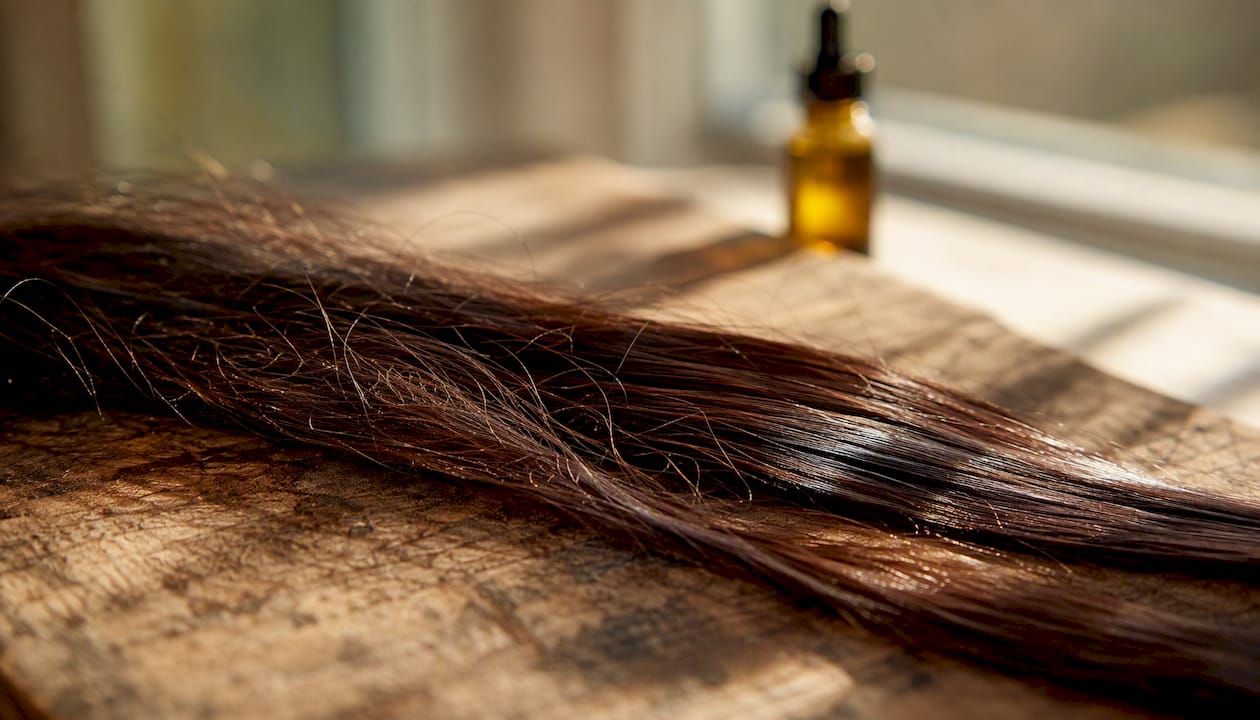
A roughened cuticle scatters light and catches on neighboring strands, which is what creates frizz. Camellia oil’s oleic acid content helps bind loose cuticle edges, reducing that surface roughness. The practical payoff is better light reflection (shine) and less tangling. Conditioner studies confirm that camellia oil treatments reduce cuticle damage and protein loss in bleached hair compared with no conditioner, which translates directly to smoother texture and less mechanical breakage during brushing.
Strength and damage protection
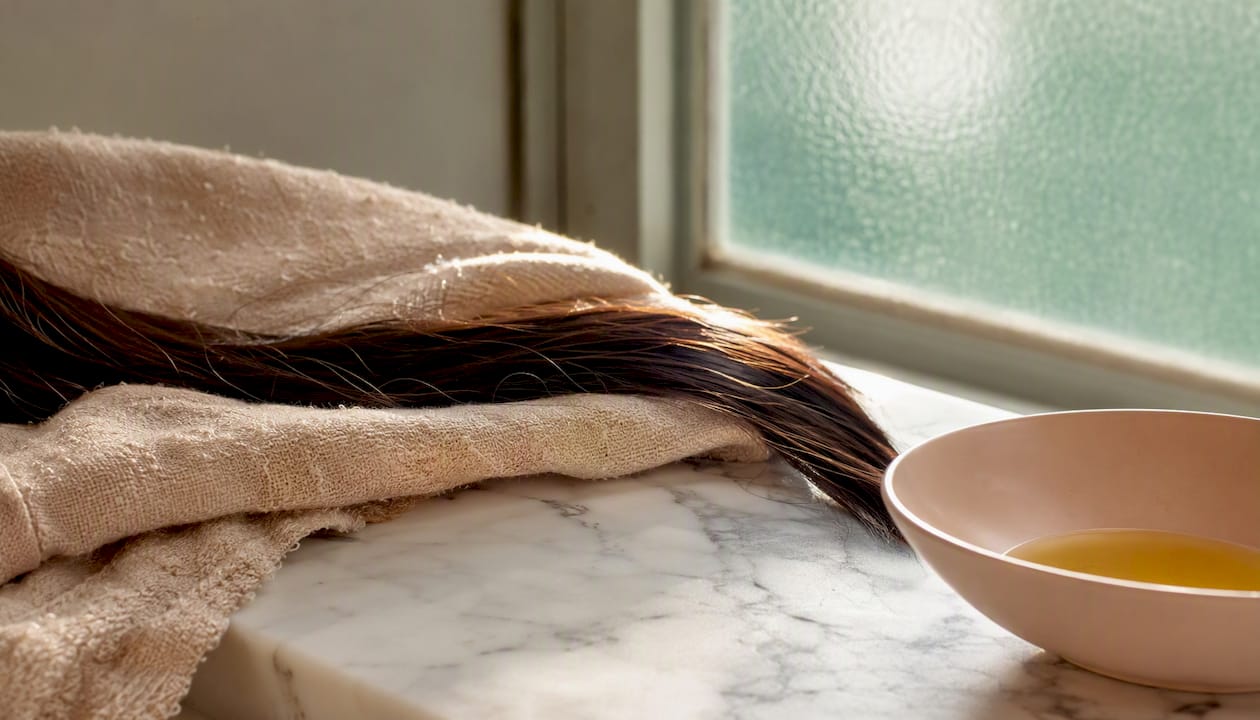
Chemically treated and heat-damaged hair loses protein through the cuticle over time. Camellia oil acts partly as a sealant, slowing that loss. For anyone who regularly bleaches, perms, or flat-irons, this is the benefit worth prioritizing.
Scalp soothing
Research on camellia’s antioxidant and anti-inflammatory properties shows that polyphenols in camellia extracts can reduce markers of oxidative stress and pro-inflammatory signaling in skin models. A calm, well-nourished scalp is the foundation for healthy hair growth, and a gentle camellia oil massage may help reduce irritation from dryness or mild sensitivity. This is not a treatment for clinical scalp conditions, but as a supportive measure it has a plausible mechanism.
Hair growth: what the evidence actually says
Growth claims deserve careful framing. The clinical evidence comes from Camellia japonica seed extract (CJSE), a concentrated saponin-rich fraction, not from everyday cold-pressed oil. A 24-week clinical trial showed a statistically significant increase in hair count in the CJSE-treated group compared with vehicle. That is a meaningful signal, but it comes from one trial with a specific extract concentration. Using cold-pressed camellia oil at home will not replicate those conditions. Expect hydration and cuticle benefits reliably; treat growth support as a possible bonus, not a guarantee.
Use-case callouts:
- Dry ends: Apply 2–3 drops as a leave-in after washing; focus on the last few inches
- Heat or permed hair: Use as a pre-shampoo mask to reduce protein loss before processing
- Frizz-prone hair: Smooth a small amount over dry hair before styling to flatten the cuticle
- Scalp massage: Warm a few drops and massage into the scalp weekly to support circulation and calm dryness
How does camellia oil actually work on hair follicles?
The cosmetic benefits (hydration, shine, frizz control) are driven primarily by oleic acid’s interaction with the hair’s lipid layer. The more interesting science involves what camellia seed extracts do at the cellular level.
Cell and organ-culture studies show that camellia seed extracts can influence dermal papilla cell behavior and hair follicle stem cell (HFSC) markers. Specifically, researchers observed that camelliasaponins appear to prevent DHT-induced senescence in dermal papilla cells by modulating the p16 INK4a–pRb pathway. In plain terms: DHT, the hormone linked to androgenetic hair loss, can push follicle cells into a dormant, aged state. Camelliasaponins appear to slow that process. Separately, the extracts showed evidence of activating hair follicle stem cells through p21 modulation, which is relevant to the follicle’s ability to cycle back into a growth phase.
The compound responsible for the lipid-replenishment and cuticle effects is oleic acid. The compounds responsible for the cellular effects are the saponins, which are concentrated in seed-cake extracts rather than in cold-pressed oil.
The antioxidant polyphenols in the oil add a third layer: by reducing oxidative stress at the scalp, they may help maintain a healthier follicle environment over time.
How to use camellia oil on hair: methods and amounts
Step-by-step application methods
- Pre-shampoo mask: Apply 4–6 drops (more for long or thick hair) to dry hair from mid-length to ends. Massage gently, cover with a shower cap, and leave for 20–30 minutes before shampooing. This is the best method for protecting hair before bleaching or heat styling.
- Leave-in on ends: After washing and towel-drying, smooth 1–3 drops between your palms and press onto the ends. Do not apply to roots if your hair is fine or prone to oiliness.
- Scalp massage: Warm 4–5 drops in your palms and massage into the scalp using circular motions for 3–5 minutes. Leave on for at least 30 minutes, then shampoo out. Pair this with a scalp-care routine for best results.
- Mixed into conditioner: Add 2–3 drops to your regular conditioner before applying. This boosts slip and cuticle coverage without requiring a separate step.
- Heat-assisted oiling: Apply as a pre-shampoo treatment, then wrap hair in a warm towel for 10–15 minutes. Gentle heat opens the cuticle slightly and may improve absorption.
Dos and don’ts
- Do start with less than you think you need; a little goes a long way
- Do focus application on mid-lengths and ends for leave-in use
- Don’t apply mid-shampoo on very fine hair; it can leave residue that weighs strands down
- Don’t skip shampooing after a scalp treatment if you are prone to buildup
- Do use a clarifying or acid-repair shampoo once a week if you oil regularly
Cosmetic formulation research notes that camellia oil stays liquid at room temperature and absorbs readily, which is why it works well in leave-in applications without the solidification issues you get with some saturated oils.
Troubleshooting:
- Greasiness: Use less oil or apply only to ends; avoid roots entirely
- Limpness: Switch to a pre-shampoo application instead of leave-in
- Scalp irritation: Discontinue use and check for fragrance additives in the formulation
Pro Tip: Camellia oil pairs well with heat-repair conditioners — apply the oil as a pre-treatment, then follow with a conditioner after washing to lock in moisture and smooth the cuticle in two steps.
How does camellia oil compare with argan, coconut, and jojoba?
Each oil has a different fatty-acid profile, which determines how it behaves on hair and who benefits most.
Camellia oil is high in oleic acid, which makes it effective at binding to the cuticle and replenishing surface lipids. It absorbs quickly, leaves minimal residue, and works across most hair types. Bleaching studies show it reduces cuticle damage and protein loss, though argan oil performed slightly better in color retention and tensile strength under the same bleaching conditions. Both oils outperformed the no-conditioner control.
Argan oil is also oleic-acid-dominant but contains a higher proportion of linoleic acid and tocopherols. The comparative research suggests it may be the better choice specifically for bleached or color-treated hair where color retention matters.
Coconut oil is unique because its medium-chain lauric acid can penetrate the hair shaft more deeply than most oils. That deep penetration reduces protein loss effectively, but it can also cause stiffness or brittleness in low-porosity hair that is already protein-sensitive.
Jojoba oil is technically a liquid wax, not an oil, and its molecular structure closely resembles sebum. It is lighter than camellia oil and particularly good for scalp balancing and fine hair that cannot tolerate heavier oils.
Quick comparison:
- Choose camellia for shine, softness, and cuticle protection without heaviness; works well as a daily leave-in
- Choose argan when color retention after bleaching is the priority
- Choose coconut for deep protein-loss prevention on thick, high-porosity hair (avoid on protein-sensitive strands)
- Choose jojoba for fine hair, oily scalps, or as a lightweight daily scalp treatment
- Cost: Camellia oil tends to be slightly pricier than coconut but comparable to argan; jojoba is widely available at similar price points
- Scent: Cold-pressed camellia has a light, neutral scent; coconut is distinctly fragrant; argan has a faint nutty note
- Styling compatibility: Camellia and jojoba layer well under styling products; coconut can interfere with hold
How to choose a quality camellia oil product and use it safely
Product label checklist
- Species named: “Camellia japonica seed oil” or “Camellia oleifera seed oil” (not just “camellia oil”)
- Processing method: “cold-pressed” or “expeller-pressed” for maximum bioactive retention
- Position in the ingredient list: near the top for meaningful concentration
- Additives and fragrance: check for added fragrances or mineral oil if you have a sensitive scalp
- Packaging: dark glass or opaque bottles protect oleic-acid-rich oils from light degradation
Patch test protocol
- Apply a small amount (pea-sized) to the inside of your elbow or wrist
- Leave uncovered for 24 hours
- Check for redness, itching, or swelling
- If no reaction appears, proceed with normal use
Watch for: persistent itching, redness, or small bumps at the application site. These may indicate sensitivity to the oil itself or to an additive in the formulation. If you have a known tree-nut or seed allergy, consult a dermatologist before using any new plant oil.
Storage and shelf life
Camellia oil is relatively stable compared with polyunsaturated oils, but oleic acid does oxidize over time. Store in a cool, dark location away from direct sunlight. Once opened, most cold-pressed camellia oils remain stable for 12–18 months. A rancid smell (sharp, crayon-like) means the oil has oxidized and should be discarded.
Pro Tip: Adulteration is a real concern with premium plant oils. If a “pure camellia oil” is priced significantly below comparable products, it may be diluted with cheaper oils like sunflower or soybean. Buying from brands that source directly from verified manufacturers reduces that risk considerably.
What do the studies actually show? A focused research review
The strongest clinical evidence
The most direct clinical evidence for camellia’s hair-growth effects comes from a study on Camellia japonica seed extract (CJSE). The Springer Nature trial reported that the CJSE-treated group showed an average hair-count increase of approximately +14.98 hairs/cm² at 24 weeks, while the vehicle group showed a decrease. That is a statistically significant difference, and the mechanistic work accompanying the trial identified camelliasaponins as the active fraction.
Cell and organ-culture findings
PMC9171030 provides the mechanistic backbone: camellia seed extracts reduced markers of DHT-induced senescence in dermal papilla cells and showed evidence of HFSC activation. These are the two cellular processes most directly linked to androgenetic hair thinning, which gives the extract a plausible biological rationale beyond the clinical trial alone.
Limitations and practical interpretation
What the evidence does and does not support:
- The clinical trial used a concentrated CJSE formulation, not cold-pressed oil applied at home
- Sample sizes in available trials are small; independent replication has not yet been published
- In vitro results do not automatically translate to scalp application outcomes
- PubMed-indexed reviews confirm the evidence base is growing but remains limited in high-powered clinical trials
For someone using cold-pressed camellia oil at home, the reliable benefits are hydration, cuticle smoothing, and damage protection. Growth support is a plausible but unconfirmed bonus at typical consumer-use concentrations. If hair growth is the primary goal, look for products that specify CJSE or camelliasaponin content rather than plain seed oil.
An editorial perspective on camellia oil and what it actually delivers
Camellia oil is a good example of where that gap matters.
The cosmetic benefits are real and well-supported: oleic acid is one of the most effective fatty acids for cuticle binding, and camellia oil delivers it in a lightweight, non-greasy form that works across hair types. For hydration, frizz control, and damage protection, it genuinely earns its place in a routine. The scalp-soothing angle is also credible, given the antioxidant and anti-inflammatory activity documented in the research.
The growth claims are where you need to read carefully. The clinical trial showing increased hair count used a seed extract with concentrated saponins, not the oil you drizzle on your ends. That does not make the finding irrelevant. It means the product form matters. A well-formulated CJSE serum is a different product from a cold-pressed oil, and conflating them does readers a disservice.
What I find most compelling about camellia oil is how it fits into a broader routine. It is not a single-ingredient fix. Paired with a keratin repair mask or used consistently before heat styling, it compounds over time. The strands you protect today are the ones that reach length tomorrow. That cumulative effect is where the real value sits, and it is something no single clinical trial will ever fully capture.
Spyraverified carries authentic camellia oil hair treatments worth trying
If you want to skip the sourcing guesswork, Spyraverified’s hair-care collection brings together authentic Japanese and Asian hair treatments, including camellia and tsubaki oil formulations, sourced directly from verified manufacturers. Every product in the range is curated against the same checklist this article describes: species transparency, processing method, and formulation integrity.
The collection covers the full routine, from pre-wash treatments and repair oils to leave-ins and scalp-focused products. If you are exploring how plant oils fit into a broader skin and hair regimen, the skincare collection includes complementary options that use similar bioactive botanicals. Browse the hair-care range and find the camellia oil treatment that matches your hair type and goals.
Sources
- NCBI PMC article (PMC9368027) — composition and cosmetic uses
- NCBI PMC article (PMC9171030) — camellia seed extract cell studies
- NCBI PMC article (PMC5759849) — antioxidant and anti‑inflammatory properties
- Effect of rinse-off hair conditioner containing argan oil or camellia oil on the recovery of hair damaged by bleaching | Fashion and Textiles | Springer Nature Link
- NCBI PMC article (PMC3288507) — cosmetic formulation notes
