

The Role of Water in Skincare: Your 2026 Guide
Water is the most important ingredient in skincare, functioning as both a hydrating agent and the solvent that makes active ingredients work. Most moisturizers, serums, and toners list “aqua” as their first ingredient because water makes up the largest portion of the formula. Without it, active compounds like niacinamide or vitamin C could not dissolve, spread, or absorb into skin. Understanding the role of water in skincare means understanding why your entire routine either works or falls short.
How water works in skincare products
Water acts as a solvent in cosmetic formulations, dissolving active ingredients so they can reach skin cells. That single function explains why water appears first on nearly every ingredient label. When an ingredient cannot dissolve, it cannot penetrate. Water makes penetration possible.
Beyond dissolving actives, water improves how a product feels and spreads. It gives lotions their light texture, helps serums glide without dragging, and allows thin layers to absorb quickly. A formula without water tends to feel heavy, greasy, or difficult to spread evenly.

Water-based formulas do come with one real challenge: contamination. Water creates an environment where bacteria and mold can grow. That is why any water-containing product requires preservatives such as phenoxyethanol, sodium benzoate, or parabens. The preservative system is not optional. It is what keeps a water-based product safe from the moment it is manufactured to the last day you use it.
Water-free formulas, like facial oils and anhydrous balms, skip preservatives entirely because there is no water to support microbial growth. They work well for occlusive protection but cannot deliver the same lightweight hydration that water-based products provide.
- Dissolves actives so ingredients like vitamin C and hyaluronic acid can function
- Improves texture by giving products a spreadable, lightweight feel
- Requires preservatives to prevent bacterial growth in the formula
- Enables layering because water-based products absorb before heavier formulas are applied
Pro Tip: Check the ingredient list on your serum or moisturizer. If “aqua” or “water” is not in the first three ingredients, the product is likely water-free and works best layered under a water-based hydrator.
Does drinking water actually improve your skin?
The short answer is yes, but with important limits. Drinking 500 ml of water causes a measurable short-term increase in skin blood flow within minutes. That increased circulation delivers more oxygen and nutrients to skin cells, which supports their repair and renewal functions.
The longer-term picture is equally clear. Increasing daily water intake by 2 liters over four weeks improves skin density and thickness, particularly in people who started with low baseline intake. That result matters because it tells you who benefits most from drinking more water.
Drinking more water benefits skin appearance significantly mainly in those who are initially underhydrated. Once you reach adequate hydration, the visible gains plateau. Water is a foundation, not a treatment.
Drinking water also supports lymphatic drainage, toxin removal, and collagen production. These are indirect benefits, but they are real. Skin that cannot clear waste efficiently tends to look dull and puffy. Adequate hydration keeps those systems running.
The nuance most people miss is this: water alone cannot replace topical skincare. Your skin loses moisture through evaporation constantly, a process called transepidermal water loss (TEWL). No amount of drinking water stops that process. You need topical products to seal moisture in.
What is the difference between hydration and moisturization?
Hydration and moisturization are distinct processes that work together. Hydration increases the water content inside skin cells. Moisturization seals the skin surface to prevent that water from escaping. You need both, and confusing them leads to routines that only do half the job.
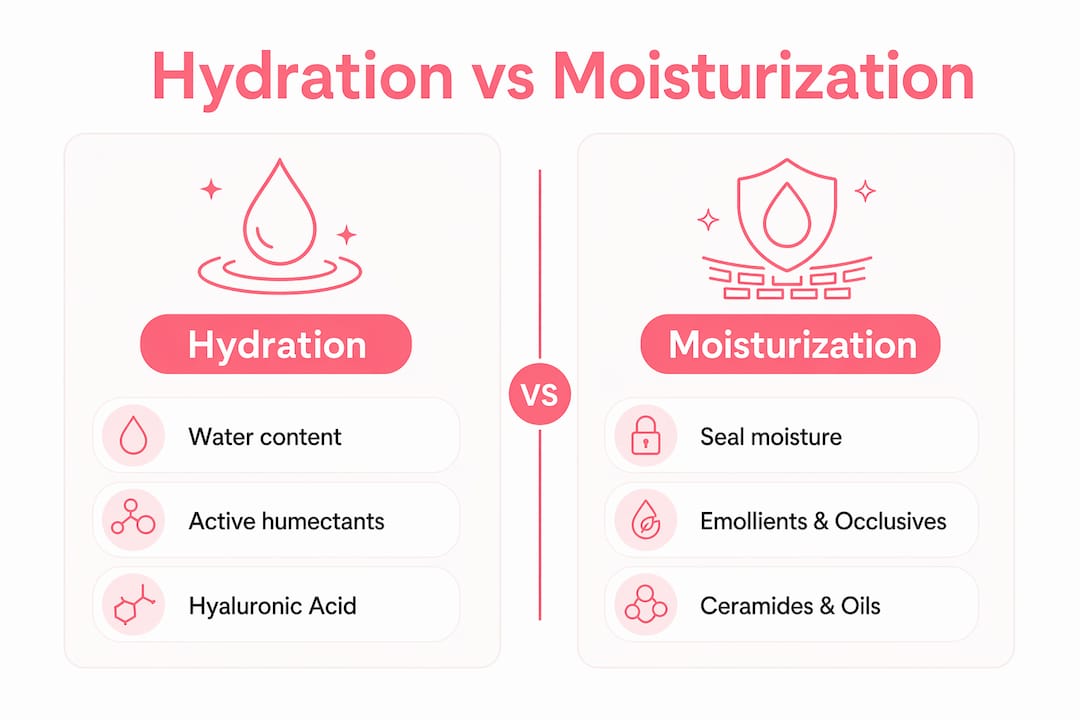
Understanding the ingredients behind each process makes product selection much easier. The three main categories are humectants, emollients, and occlusives.
| Ingredient type | Function | Common examples |
|---|---|---|
| Humectant | Draws water into skin cells | Hyaluronic acid, glycerin, aloe vera |
| Emollient | Smooths and softens skin surface | Squalane, shea butter, jojoba oil |
| Occlusive | Forms a seal to prevent water loss | Petrolatum, beeswax, dimethicone |
Hyaluronic acid, ceramides, and glycerin are the most studied ingredients for locking in moisture and strengthening the skin barrier. Hyaluronic acid pulls water toward skin cells. Ceramides repair the barrier so water cannot escape. Glycerin keeps the surface layer soft and pliable.
The practical takeaway is that a serum with hyaluronic acid hydrates, but it needs a moisturizer on top to seal that hydration in. Applying a humectant without an occlusive or emollient on top is like filling a bucket with a hole in it. You also want to understand amino acids and their role in supporting the skin barrier alongside these hydration-focused ingredients.
Pro Tip: Layer your products from thinnest to thickest. Apply a water-based serum with hyaluronic acid first, then follow with a moisturizer containing ceramides or squalane to lock everything in.
How to build a skincare routine around hydration
Getting the most from water’s benefits requires both internal habits and smart product choices. These two areas work together, and neglecting one limits the other.
Internal hydration habits
- Drink consistently throughout the day rather than in large amounts at once. Skin hydration responds to sustained intake, not single large doses.
- Prioritize water intake if you are currently underhydrated. The visible skin improvements from increased intake are most pronounced in people who start from a low baseline.
- Account for environment. Dry climates, air conditioning, and heated indoor spaces all increase water loss from skin and body. Adjust intake accordingly.
- Support hydration through diet. Foods with high water content, such as cucumber, watermelon, and leafy greens, contribute to total fluid intake.
Topical application best practices
- Apply moisturizer within three minutes of showering. The 3-minute rule reduces transepidermal water loss by sealing in the moisture your skin absorbed during the shower.
- Use products with aloe vera, glycerin, and ceramides for water retention throughout the day.
- Avoid over-cleansing. Barrier damage from harsh cleansing causes moisture to escape faster than internal hydration can replenish it. A gentle cleanser preserves the barrier while still removing impurities. The double cleansing method done correctly removes makeup and sunscreen without stripping the skin.
- Fix your layering order. Common skincare layering mistakes like applying oil before serum block water-based actives from absorbing properly.
- Choose water-based products for your first layers and finish with an emollient or occlusive to seal everything in.
Key Takeaways
Skin hydration requires both adequate internal water intake and topical products that attract, retain, and seal moisture into the skin barrier.
| Point | Details |
|---|---|
| Water is the base ingredient | Most skincare products list aqua first because water dissolves actives and improves absorption. |
| Drinking water has real limits | Benefits are strongest for underhydrated people; drinking more water cannot stop transepidermal water loss. |
| Hydration and moisturization differ | Humectants draw water in; occlusives and emollients seal it there. Both steps are required. |
| Timing matters topically | Applying moisturizer within three minutes of showering maximizes moisture retention. |
| Barrier protection is non-negotiable | Over-cleansing and harsh products damage the barrier and accelerate water loss faster than drinking water can fix. |
Water in skincare is more nuanced than most people realize
I have spent years watching people chase glowing skin by drinking more water, only to feel frustrated when their skin stays dry or dull. The frustration is understandable. The advice to “drink more water” is everywhere, and it is not wrong. It is just incomplete.
What I have seen work consistently is treating internal hydration and topical care as two separate but equally necessary systems. Drinking water feeds your skin from the inside. But your skin barrier is what decides how much of that water actually stays. A compromised barrier, from over-cleansing, harsh actives, or cold dry air, will drain moisture faster than any amount of drinking water can restore it.
The other thing I push back on is the idea that expensive water-based serums alone are enough. A hyaluronic acid serum applied to dry skin in a dry room can actually pull moisture out of your skin cells if there is nothing to seal it in. That is a real phenomenon, and it catches a lot of people off guard.
My honest advice: fix your barrier first. Use a gentle cleanser, apply your hydrating serum to damp skin, and always follow with a moisturizer that contains ceramides or squalane. Drink your water, yes. But build a routine that keeps that water where it belongs.
— Anni
Spyraverified’s skincare collection for hydrated, healthy skin
Hydration works best when your products are formulated to both attract water and protect the barrier that holds it in.
Spyraverified curates high-quality skincare products from Japanese and Asian beauty brands that specialize in exactly this combination. These formulas are built around ingredients like ceramides, hyaluronic acid, and plant-based humectants that work together to support the skin barrier and maintain moisture levels throughout the day. Many of these brands are difficult to find outside their home markets, and Spyraverified brings them directly to you with verified authenticity. If you are building a routine around water-based skincare, this is a strong place to start.
FAQ
What does water do in skincare products?
Water acts as a solvent that dissolves active ingredients and improves product texture and absorption. It is typically the first ingredient listed in moisturizers, serums, and toners.
Does drinking more water clear your skin?
Drinking more water improves skin density and blood flow, especially if you are currently underhydrated. Once you reach adequate hydration, the visible skin benefits plateau and topical care becomes the primary driver of improvement.
What is the difference between hydrated and moisturized skin?
Hydrated skin has sufficient water content inside its cells, while moisturized skin has a sealed surface that prevents water from escaping. Both conditions are needed for healthy, resilient skin.
How soon after showering should I apply moisturizer?
Apply moisturizer within three minutes of showering. This timing, known as the 3-minute rule, seals in moisture before transepidermal water loss begins.
Can water-based skincare products cause breakouts?
Water-based products are generally lighter and less likely to clog pores than oil-heavy formulas. However, products with certain preservatives or fragrances can irritate sensitive or acne-prone skin, so checking the full ingredient list matters.
